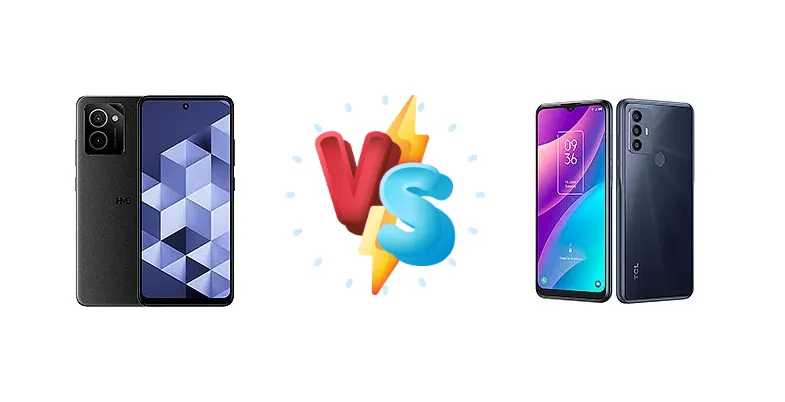
The HMD Vibe 4G and TCL 30 SE represent two distinct approaches to the ultra-budget smartphone market. The Vibe 4G leverages Qualcomm's Snapdragon 680, focusing on efficiency, while the TCL 30 SE opts for MediaTek's Helio G25, aiming for a balance of cost and functionality. This comparison dissects their key differences to determine which device delivers the best experience for your money.
🏆 Quick Verdict
For the average user prioritizing sustained performance and future-proofing, the HMD Vibe 4G is the better choice. Its Snapdragon 680, built on a 6nm process, offers superior efficiency and processing power compared to the TCL 30 SE’s 12nm Helio G25, despite the TCL’s slightly faster charging.
| Network |
|---|
| 2G bands | GSM 850 / 900 / 1800 / 1900 | GSM 850 / 900 / 1800 / 1900 |
| 3G bands | HSDPA 850 / 900 / 1900 / 2100 | HSDPA 850 / 900 / 1900 / 2100 - EMEA/APAC |
| 4G bands | 2, 4, 5, 12, 13, 66 | 1, 3, 5, 7, 8, 20, 28, 38, 40, 41 - EMEA |
| Speed | HSPA, LTE | HSPA 42.2/11.5 Mbps, LTE Cat4 150/50 Mbps |
| Technology | GSM / HSPA / LTE | GSM / HSPA / LTE |
| | - | 2, 3, 4, 5, 7, 8, 12, 13, 17, 26, 28, 66 - LATAM |
| Launch |
|---|
| Announced | 2024, April 24 | 2022, February 27 |
| Status | Available. Released 2024, June 04 | Available. Released 2022, April 20 |
| Body |
|---|
| Build | Glass front, plastic frame, plastic back | Glass front, plastic frame, plastic back |
| Dimensions | 163.8 x 75.2 x 8.4 mm (6.45 x 2.96 x 0.33 in) | 165.2 x 75.5 x 8.9 mm (6.50 x 2.97 x 0.35 in) |
| SIM | Nano-SIM | · Nano-SIM· Nano-SIM + Nano-SIM |
| Weight | 186 g (6.56 oz) | 190 g (6.70 oz) |
| Display |
|---|
| Protection | Toughened glass | - |
| Resolution | 720 x 1480 pixels, 18.5:9 ratio (~251 ppi density) | 720 x 1600 pixels, 20:9 ratio (~269 ppi density) |
| Size | 6.56 inches, 109.2 cm2 (~88.7% screen-to-body ratio) | 6.52 inches, 102.6 cm2 (~82.3% screen-to-body ratio) |
| Type | IPS LCD, 90Hz, 480 nits (typ), 600 nits (HBM) | IPS LCD, 450 nits (typ) |
| Platform |
|---|
| CPU | Octa-core (4x2.4 GHz Kryo 265 Gold & 4x1.9 GHz Kryo 265 Silver) | Octa-core (4x2.0 GHz Cortex-A53 & 4x1.5 GHz Cortex-A53) |
| Chipset | Qualcomm SM6225 Snapdragon 680 4G (6 nm) | Mediatek MT6762G Helio G25 (12 nm) |
| GPU | Adreno 610 | PowerVR GE8320 |
| OS | Android 14 | Android 12, TCL UI 4.0 |
| Memory |
|---|
| Card slot | microSDXC | microSDXC (dedicated slot) |
| Internal | 64GB 3GB RAM, 128GB 6GB RAM | 64GB 4GB RAM, 128GB 4GB RAM |
| | - | eMMC 5.1 |
| Main Camera |
|---|
| Dual | 13 MP, (wide)
Auxiliary lens | - |
| Features | LED flash, HDR | LED flash, HDR, panorama |
| Single | - | 8 MP, f/2.0, 26mm (wide), 1/4", 1.12µm |
| Triple | - | 50 MP, f/1.9, 28mm (wide), 1/2.76", 0.64µm, PDAF
2 MP (macro)
Auxiliary lens |
| Video | 1080p@30fps | 1080p@30fps |
| Selfie camera |
|---|
| Features | - | HDR |
| Single | 5 MP | 8 MP, f/2.0, 26mm (wide), 1/4.0", 1.12µm |
| Video | Yes | 1080p@30fps |
| Sound |
|---|
| 3.5mm jack | - | Yes |
| 35mm jack | Yes | Yes |
| Loudspeaker | Yes | Yes |
| Comms |
|---|
| Bluetooth | 5.0, A2DP, LE | 5.0, A2DP, LE |
| NFC | No | Yes (6165H/6165H1 only) |
| Positioning | GPS | GPS, GLONASS, GALILEO, BDS |
| Radio | Wireless FM radio | Unspecified |
| USB | USB Type-C 2.0, OTG | USB Type-C 2.0 |
| WLAN | Wi-Fi 802.11 a/b/g/n/ac | Wi-Fi 802.11 b/g/n, Wi-Fi Direct |
| Features |
|---|
| Sensors | Accelerometer, proximity, compass, gyro, barometer | Fingerprint (rear-mounted), accelerometer, proximity, compass |
| Battery |
|---|
| Charging | 10W wired | 15W wired |
| Type | 4000 mAh | Li-Po 5000 mAh |
| Misc |
|---|
| Colors | Charcoal | Atlantic Blue, Space Gray, Glacial Blue |
| Models | - | 6165H, 6156H1, 6165A, 6165A1, 6165S |
| Price | About 100 EUR | - |
HMD Vibe 4G
- More efficient Snapdragon 680 chipset
- Superior sustained performance
- Better image processing capabilities
- Slower 10W charging
- Likely basic display quality
TCL 30 SE
- Faster 15W charging
- Potentially lower price point
- TCL’s display expertise (speculative)
- Less efficient Helio G25 chipset
- Lower overall performance
- Potential for thermal throttling
Display Comparison
Neither device boasts a standout display. Given the lack of display specifications beyond the core chipsets, we can infer both likely utilize LCD panels common in this price bracket. The TCL 30 SE’s advantage, if any, might lie in slightly better color calibration, a common strength of TCL’s display technology, but this is speculative. Bezels are expected to be substantial on both, reflecting their budget positioning.
Camera Comparison
Without detailed camera specifications, a direct comparison is difficult. However, given the market segment, both phones likely feature basic camera setups. The HMD Vibe 4G’s image signal processor (ISP) within the Snapdragon 680 likely offers superior image processing capabilities compared to the Helio G25’s ISP, resulting in better dynamic range and noise reduction. Expect both to struggle in low-light conditions. The presence of a 2MP macro lens on either device is largely a marketing gimmick and should not be a deciding factor.
Performance
The core difference lies in the chipsets. The HMD Vibe 4G’s Qualcomm Snapdragon 680 (6nm) significantly outperforms the TCL 30 SE’s MediaTek Helio G25 (12nm). The 6nm fabrication process allows for greater transistor density and improved power efficiency, translating to less heat generation and sustained performance. While both are octa-core CPUs, the Snapdragon 680’s Kryo 265 Gold cores, clocked at 2.4 GHz, offer a substantial performance advantage over the Helio G25’s Cortex-A53 cores at 2.0 GHz. This difference will be most noticeable in demanding applications and multitasking. The Snapdragon 680 also benefits from a more modern GPU architecture, providing a smoother gaming experience.
Battery Life
The TCL 30 SE’s 15W wired charging is a slight advantage over the HMD Vibe 4G’s 10W charging. However, the Snapdragon 680’s superior power efficiency means the Vibe 4G will likely offer comparable, if not better, real-world battery life despite the slower charging speed. The Helio G25’s less efficient architecture will consume more power during typical usage, potentially negating the benefit of the faster charging.
Buying Guide
Buy the HMD Vibe 4G if you need a phone that can handle everyday tasks smoothly and maintain performance over time, even with moderate multitasking. It’s ideal for users who value efficiency and a responsive user experience. Buy the TCL 30 SE if you prioritize a slightly faster charging speed and are primarily focused on basic smartphone functions like calls, texts, and light social media use, and are on a very tight budget.
Frequently Asked Questions
❓ Will the Helio G25 in the TCL 30 SE struggle with popular apps like Facebook or Instagram?
While the Helio G25 can handle basic apps, you may experience noticeable lag and slowdowns when multitasking or using more demanding features within those apps. The Snapdragon 680 in the HMD Vibe 4G provides a smoother, more responsive experience for these common applications.
❓ How much of a difference will the 6nm process of the Snapdragon 680 make in real-world battery life?
The 6nm process is a significant advantage for the HMD Vibe 4G. It allows the Snapdragon 680 to operate more efficiently, consuming less power for the same tasks compared to the 12nm Helio G25. This translates to potentially several hours of extra battery life, especially during moderate to heavy usage.
❓ Is the TCL 30 SE a viable option for playing mobile games?
The TCL 30 SE is only suitable for very light gaming. The Helio G25’s GPU is underpowered for most modern mobile games, and you’ll likely need to lower graphics settings significantly to achieve playable frame rates. The HMD Vibe 4G offers a noticeably better gaming experience, though still limited by its budget chipset.
❓ Does the HMD Vibe 4G support software updates for security patches and Android versions?
HMD Global, the manufacturer of the Vibe 4G, has a relatively good track record of providing software updates and security patches for their devices. While the update schedule isn't as frequent as flagship phones, you can expect a reasonable level of support, which is a key advantage over some other brands in this price range.