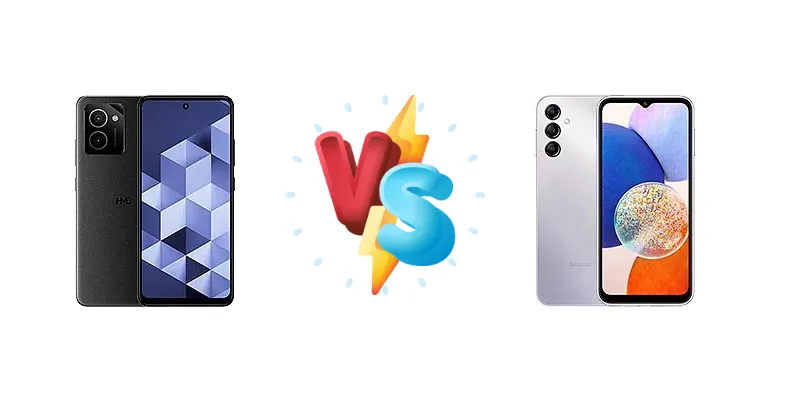
The HMD Vibe 4G and Samsung Galaxy A14 5G represent compelling options in the sub-$200 smartphone market. While both aim to deliver essential smartphone functionality, they diverge significantly in their core hardware. The Vibe 4G prioritizes efficiency with a Snapdragon 680, while the A14 5G offers the allure of 5G connectivity powered by either an Exynos 1330 or Dimensity 700, depending on the region.
🏆 Quick Verdict
For the average user prioritizing efficiency and a smooth, consistent experience, the HMD Vibe 4G emerges as the better choice. Its Snapdragon 680, built on a 6nm process, offers a more refined balance of performance and power consumption than the A14 5G’s Exynos 1330 or Dimensity 700. However, if 5G connectivity is a non-negotiable requirement, the Galaxy A14 5G is the only option.
| Network |
|---|
| 2G bands | GSM 850 / 900 / 1800 / 1900 | GSM 850 / 900 / 1800 / 1900 |
| 3G bands | HSDPA 850 / 900 / 1900 / 2100 | HSDPA 850 / 900 / 1700(AWS) / 1900 / 2100 |
| 4G bands | 2, 4, 5, 12, 13, 66 | 1, 2, 3, 4, 5, 7, 8, 12, 17, 20, 26, 28, 38, 40, 41, 66 - International |
| 5G bands | - | 2, 5, 66, 77 Sub6/mmWave - USA |
| Speed | HSPA, LTE | HSPA, LTE, 5G |
| Technology | GSM / HSPA / LTE | GSM / HSPA / LTE / 5G |
| | - | 1, 3, 5, 7, 8, 20, 28, 40, 41, 78 SA/NSA/Sub6 - India |
| Launch |
|---|
| Announced | 2024, April 24 | 2023, January 04 |
| Status | Available. Released 2024, June 04 | Available. Released 2023, January 12 |
| Body |
|---|
| Build | Glass front, plastic frame, plastic back | Glass front, plastic back, plastic frame |
| Dimensions | 163.8 x 75.2 x 8.4 mm (6.45 x 2.96 x 0.33 in) | 167.7 x 78 x 9.1 mm (6.60 x 3.07 x 0.36 in) |
| SIM | Nano-SIM | · Nano-SIM· Nano-SIM + Nano-SIM |
| Weight | 186 g (6.56 oz) | 202 g (7.13 oz) |
| Display |
|---|
| Protection | Toughened glass | - |
| Resolution | 720 x 1480 pixels, 18.5:9 ratio (~251 ppi density) | 1080 x 2408 pixels, 20:9 ratio (~400 ppi density) |
| Size | 6.56 inches, 109.2 cm2 (~88.7% screen-to-body ratio) | 6.6 inches, 104.9 cm2 (~80.2% screen-to-body ratio) |
| Type | IPS LCD, 90Hz, 480 nits (typ), 600 nits (HBM) | PLS LCD, 90Hz |
| Platform |
|---|
| CPU | Octa-core (4x2.4 GHz Kryo 265 Gold & 4x1.9 GHz Kryo 265 Silver) | Octa-core (2x2.4 GHz Cortex-A78 & 6x2.0 GHz Cortex-A55) - SM-A146BOcta-core (2x2.2 GHz Cortex-A76 & 6x2.0 GHz Cortex-A55) - SM-A146P |
| Chipset | Qualcomm SM6225 Snapdragon 680 4G (6 nm) | Exynos 1330 (5 nm) - SM-A146BMediatek Dimensity 700 (7 nm) - SM-A146P |
| GPU | Adreno 610 | Mali-G68 MP2 - SM-A146BMali-G57 MC2 - SM-A146P |
| OS | Android 14 | Android 13, upgradable to Android 15, One UI Core 7 |
| Memory |
|---|
| Card slot | microSDXC | microSDXC (uses shared SIM slot) - USA onlymicroSDXC (dedicated slot) - International |
| Internal | 64GB 3GB RAM, 128GB 6GB RAM | 64GB 4GB RAM, 128GB 4GB RAM, 128GB 6GB RAM, 128GB 8GB RAM |
| Main Camera |
|---|
| Dual | 13 MP, (wide)
Auxiliary lens | - |
| Features | LED flash, HDR | LED flash, panorama, HDR |
| Single | - | 13 MP, f/2.0, (wide) |
| Triple | - | 50 MP, f/1.8, 26mm (wide), 1/2.76", 0.64µm, PDAF
2 MP (macro)
Auxiliary lens |
| Video | 1080p@30fps | 1080p@30fps |
| Selfie camera |
|---|
| Single | 5 MP | 13 MP, f/2.0, 26mm (wide), 1.12µm |
| Video | Yes | 1080p@30fps |
| Sound |
|---|
| 3.5mm jack | - | Yes |
| 35mm jack | Yes | Yes |
| Loudspeaker | Yes | Yes |
| Comms |
|---|
| Bluetooth | 5.0, A2DP, LE | 5.2, A2DP, LE |
| NFC | No | Yes |
| Positioning | GPS | GPS, GLONASS, GALILEO |
| Radio | Wireless FM radio | FM radio (Exynos 1330 chipset only), recording |
| USB | USB Type-C 2.0, OTG | USB Type-C 2.0 |
| WLAN | Wi-Fi 802.11 a/b/g/n/ac | Wi-Fi 802.11 a/b/g/n/ac, dual-band, Wi-Fi Direct |
| Features |
|---|
| Sensors | Accelerometer, proximity, compass, gyro, barometer | Fingerprint (side-mounted), accelerometer, gyro, proximity, compass, barometer (USA only) |
| Battery |
|---|
| Charging | 10W wired | 15W wired |
| Type | 4000 mAh | Li-Po 5000 mAh |
| Misc |
|---|
| Colors | Charcoal | Black, Light Green, Dark Red, Silver |
| Models | - | SM-A146B, SM-A146B/DS, SM-A146P, SM-A146P/DS, SM-A146U, SM-A146U1, SM-A146U1/DS, SM-A146W, SM-A146P/N, SM-A146P/DSN, SM-S146VL, SM-A146M |
| Price | About 100 EUR | $ 77.63 / C$ 151.00 / £ 97.00 / € 159.79 / ₹ 14,990 |
| SAR | - | 1.00 W/kg (head) 1.00 W/kg (body) |
| SAR EU | - | 0.56 W/kg (head) 1.28 W/kg (body) |
| Tests |
|---|
| Battery life | - |
Endurance rating 130h
|
| Camera | - |
Photo / Video |
| Display | - |
Contrast ratio: 1334:1 (nominal) |
| Loudspeaker | - |
-26.8 LUFS (Good)
|
| Performance | - |
AnTuTu: 307886 (v9)
GeekBench: 1727 (v5.1)
GFXBench: 12fps (ES 3.1 onscreen) |
HMD Vibe 4G
- More efficient Snapdragon 680 chipset
- Potentially longer battery life
- Smoother, more consistent performance
- Lacks 5G connectivity
- Slower charging speed (10W)
Samsung Galaxy A14 5G
- 5G connectivity
- Higher peak display brightness
- Faster charging speed (15W)
- Chipset performance varies (Exynos vs. Dimensity)
- Potential for thermal throttling
- Less efficient chipset
Display Comparison
Both devices feature a similar contrast ratio of 1334:1, suggesting comparable image quality in terms of black levels. However, the Samsung Galaxy A14 5G boasts a measured peak brightness of 519 nits, which is a significant advantage in outdoor visibility compared to the HMD Vibe 4G (brightness data unavailable). While neither display is expected to be exceptional, the A14 5G’s higher brightness provides a more usable experience in bright sunlight. The lack of high refresh rate panels on both devices is typical for this price segment.
Camera Comparison
Both phones offer a 'Photo / Video' camera experience, but details are sparse. Without specific sensor size or aperture information, it’s difficult to make a definitive judgment. The presence of a 2MP macro camera on the A14 5G is unlikely to provide significant photographic value. The image processing style will likely differ between the two devices, with Samsung typically favoring more saturated colors. The A14 5G’s potential for better dynamic range, if the Exynos variant is equipped with a larger sensor, could be a differentiating factor.
Performance
The chipset is where the most significant difference lies. The HMD Vibe 4G utilizes the Qualcomm Snapdragon 680, fabricated on a 6nm process. This translates to improved power efficiency and thermal management compared to the Samsung Galaxy A14 5G’s Exynos 1330 (5nm) or Dimensity 700 (7nm). The Snapdragon 680’s octa-core CPU (4x2.4 GHz Kryo 265 Gold & 4x1.9 GHz Kryo 265 Silver) is well-suited for everyday tasks and light multitasking. The A14 5G’s Exynos 1330 (2x2.4 GHz Cortex-A78 & 6x2.0 GHz Cortex-A55) offers a theoretical performance edge, but the 5nm process doesn't guarantee sustained performance due to potential thermal throttling. The Dimensity 700 variant (2x2.2 GHz Cortex-A76 & 6x2.0 GHz Cortex-A55) is less powerful than the Exynos 1330. The Vibe 4G’s efficiency will likely result in smoother, more consistent performance over extended use.
Battery Life
Both devices achieve an endurance rating of 130 hours, suggesting similar overall battery life. However, the HMD Vibe 4G’s more efficient Snapdragon 680 chipset will likely translate to longer screen-on time for comparable usage. The A14 5G supports 15W wired charging, slightly faster than the Vibe 4G’s 10W charging, but the difference in charging speed is unlikely to be substantial. The efficiency of the Snapdragon 680 will minimize the need for frequent charging.
Buying Guide
Buy the HMD Vibe 4G if you need a reliable, efficient smartphone for everyday tasks, prioritizing battery life and consistent performance over cutting-edge features. Buy the Samsung Galaxy A14 5G if you absolutely require 5G connectivity and are willing to accept potentially lower battery life and variable performance depending on the chipset variant (Exynos or Dimensity).
Frequently Asked Questions
❓ Does the Exynos 1330 in the Galaxy A14 5G overheat during prolonged gaming sessions?
The Exynos 1330 is known to exhibit some thermal throttling under sustained load. While it can handle casual gaming, demanding titles may experience frame drops or reduced performance after extended play. The HMD Vibe 4G’s Snapdragon 680, with its more efficient 6nm process, is less prone to overheating and will likely provide a more consistent gaming experience, albeit at lower graphical settings.
❓ Is the 2MP macro camera on the Samsung Galaxy A14 5G actually useful for taking detailed close-up photos?
Generally, 2MP macro cameras on budget smartphones offer limited utility. The low resolution results in images lacking detail and sharpness. While it can capture close-up shots, the quality is unlikely to be significantly better than using the main camera in standard mode with digital zoom. Don't expect professional-level macro photography from this sensor.
❓ Which phone is better for streaming videos and browsing the web?
Both phones are capable of handling video streaming and web browsing. However, the HMD Vibe 4G’s more efficient processor will likely result in smoother scrolling and less lag during these tasks. The A14 5G’s higher screen brightness is beneficial for viewing content outdoors.
❓ What chipset does the Samsung Galaxy A14 5G have, and how does it affect performance?
The Samsung Galaxy A14 5G comes in two main variants: one with the Exynos 1330 (SM-A146B) and another with the MediaTek Dimensity 700 (SM-A146P). The Exynos 1330 is generally more powerful, offering better CPU and GPU performance. The Dimensity 700 is a capable chip, but it's less powerful than the Exynos variant. Performance will vary depending on which version you purchase.