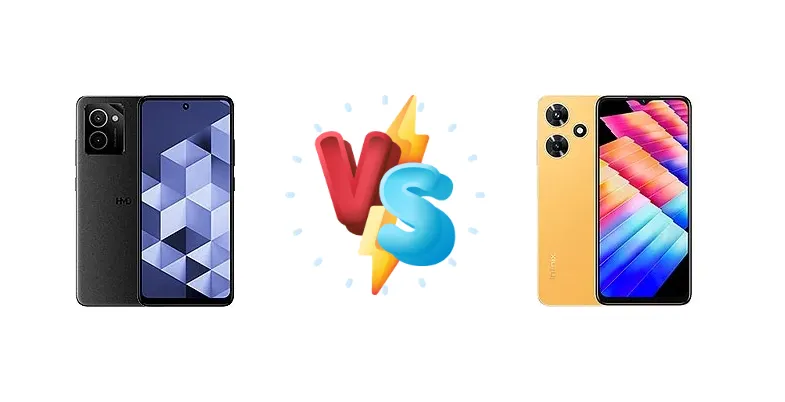
The HMD Vibe 4G and Infinix Hot 30i represent two compelling options in the crowded sub-$150 smartphone market. The Vibe 4G leverages Qualcomm’s established Snapdragon platform, while the Hot 30i opts for a Unisoc chipset. This comparison dissects their core components to determine which device offers the best balance of performance, battery life, and overall value.
🏆 Quick Verdict
For the average user prioritizing sustained performance and efficiency, the HMD Vibe 4G emerges as the stronger choice. Its Snapdragon 680, built on a 6nm process, provides a noticeable advantage in multitasking and app responsiveness compared to the Infinix Hot 30i’s 12nm Unisoc T606, despite the latter’s faster charging.
| Network |
|---|
| 2G bands | GSM 850 / 900 / 1800 / 1900 | GSM 850 / 900 / 1800 / 1900 |
| 3G bands | HSDPA 850 / 900 / 1900 / 2100 | HSDPA 850 / 900 / 1700(AWS) / 1900 / 2100 |
| 4G bands | 2, 4, 5, 12, 13, 66 | 1, 2, 3, 4, 5, 7, 8, 20, 28, 38, 40, 41 |
| Speed | HSPA, LTE | HSPA, LTE |
| Technology | GSM / HSPA / LTE | GSM / HSPA / LTE |
| Launch |
|---|
| Announced | 2024, April 24 | 2023, March 31 |
| Status | Available. Released 2024, June 04 | Available. Released 2023, March 31 |
| Body |
|---|
| Build | Glass front, plastic frame, plastic back | Glass front, plastic frame, plastic back |
| Dimensions | 163.8 x 75.2 x 8.4 mm (6.45 x 2.96 x 0.33 in) | 164 x 75.8 x 8.4 mm (6.46 x 2.98 x 0.33 in) |
| SIM | Nano-SIM | Nano-SIM + Nano-SIM |
| Weight | 186 g (6.56 oz) | 191 g (6.74 oz) |
| Display |
|---|
| Protection | Toughened glass | - |
| Resolution | 720 x 1480 pixels, 18.5:9 ratio (~251 ppi density) | 720 x 1612 pixels, 20:9 ratio (~269 ppi density) |
| Size | 6.56 inches, 109.2 cm2 (~88.7% screen-to-body ratio) | 6.56 inches, 103.4 cm2 (~83.2% screen-to-body ratio) |
| Type | IPS LCD, 90Hz, 480 nits (typ), 600 nits (HBM) | IPS LCD, 90Hz, 500 nits (peak) |
| Platform |
|---|
| CPU | Octa-core (4x2.4 GHz Kryo 265 Gold & 4x1.9 GHz Kryo 265 Silver) | Octa-core (2x1.6 GHz Cortex-A75 & 6x1.6 GHz Cortex-A55) |
| Chipset | Qualcomm SM6225 Snapdragon 680 4G (6 nm) | Unisoc T606 (12 nm) |
| GPU | Adreno 610 | Mali-G57 MP1 |
| OS | Android 14 | Android 12, XOS 10.6 |
| Memory |
|---|
| Card slot | microSDXC | microSDXC (dedicated slot) |
| Internal | 64GB 3GB RAM, 128GB 6GB RAM | 64GB 4GB RAM, 128GB 4GB RAM, 128GB 8GB RAM |
| | - | UFS 2.2 |
| Main Camera |
|---|
| Dual | 13 MP, (wide)
Auxiliary lens | 13 MP, f/1.9, (wide), AF
0.08 MP, (depth) |
| Features | LED flash, HDR | Dual-LED flash, HDR, panorama |
| Single | - | 13 MP, f/1.9, (wide), 1/3.07", AF
Auxiliary lens |
| Video | 1080p@30fps | 1080p@30fps |
| Selfie camera |
|---|
| Features | - | Dual-LED flash |
| Single | 5 MP | 8 MP, f/2.0, (wide), 1/3.94" |
| Video | Yes | 1080p@30fps |
| Sound |
|---|
| 3.5mm jack | - | Yes |
| 35mm jack | Yes | Yes |
| Loudspeaker | Yes | Yes |
| Comms |
|---|
| Bluetooth | 5.0, A2DP, LE | Yes |
| NFC | No | Yes (Hot 30i NFC only) |
| Positioning | GPS | GPS |
| Radio | Wireless FM radio | FM radio |
| USB | USB Type-C 2.0, OTG | USB Type-C 2.0, OTG |
| WLAN | Wi-Fi 802.11 a/b/g/n/ac | Wi-Fi 802.11 a/b/g/n/ac, dual-band |
| Features |
|---|
| Sensors | Accelerometer, proximity, compass, gyro, barometer | Fingerprint (side-mounted), accelerometer, proximity, compass |
| Battery |
|---|
| Charging | 10W wired | 18W wired |
| Type | 4000 mAh | 5000 mAh |
| Misc |
|---|
| Colors | Charcoal | Mirror Black, Glacier Blue, Diamond White, Marigold |
| Models | - | X669, X669D |
| Price | About 100 EUR | - |
HMD Vibe 4G
- More efficient Snapdragon 680 chipset
- Better sustained performance
- Potentially smoother multitasking
- Slower 10W charging
- Likely less vibrant display
Infinix Hot 30i
- Faster 18W wired charging
- Potentially lower price point
- Cortex-A75 cores offer burst performance
- Less efficient Unisoc T606 chipset
- Potential for thermal throttling
- Likely less refined software experience
Display Comparison
Neither device boasts a standout display. Given the lack of display specifications in the provided data, we can infer both likely utilize LCD panels common in this price bracket. The key difference will likely be color calibration and peak brightness, areas where HMD often demonstrates a slight edge. Bezels are expected to be substantial on both, prioritizing affordability over an immersive viewing experience.
Camera Comparison
Without detailed camera specs, a direct comparison is limited. However, it’s safe to assume both phones feature basic camera setups geared towards social media sharing. The absence of information regarding sensor size or optical image stabilization suggests neither device will excel in low-light photography. Image processing will likely be the differentiating factor, with HMD’s software potentially offering more natural-looking results. The inclusion of a 2MP macro lens on either device is largely a marketing gimmick and shouldn’t heavily influence purchasing decisions.
Performance
The core battleground is the chipset. The HMD Vibe 4G’s Qualcomm Snapdragon 680 (6nm) is architecturally superior to the Infinix Hot 30i’s Unisoc T606 (12nm). The 6nm node allows for greater transistor density and improved power efficiency, translating to less heat generation and sustained performance. While the Hot 30i’s Cortex-A75 cores offer a higher peak clock speed (1.6 GHz vs 2.4 GHz on the Vibe 4G’s Kryo 265 Gold), the Snapdragon’s more modern architecture and efficient process node will likely deliver a smoother experience in demanding applications. The Vibe 4G’s octa-core configuration, with a mix of performance and efficiency cores, is better suited for multitasking.
Battery Life
The Infinix Hot 30i’s 18W wired charging is a clear advantage over the HMD Vibe 4G’s 10W charging. This translates to significantly faster top-up times, a boon for users who frequently need to recharge. However, battery life isn’t solely determined by charging speed. The Snapdragon 680’s superior power efficiency in the Vibe 4G could offset the Hot 30i’s faster charging, resulting in comparable or even longer real-world usage, depending on usage patterns.
Buying Guide
Buy the HMD Vibe 4G if you need a phone that handles daily tasks smoothly and offers better long-term performance thanks to its more efficient chipset. It’s ideal for users who value responsiveness and don’t want to compromise on core functionality. Buy the Infinix Hot 30i if you prioritize quick charging and are willing to trade some processing power for faster top-ups, making it suitable for users who frequently find themselves needing a rapid battery boost.
Frequently Asked Questions
❓ Will the Unisoc T606 in the Infinix Hot 30i overheat during prolonged gaming sessions?
The Unisoc T606, being built on a 12nm process, is more prone to thermal throttling than the Snapdragon 680 (6nm). While it can handle casual gaming, extended sessions with graphically demanding titles may lead to noticeable performance drops as the chip attempts to manage heat.
❓ How much faster is the 18W charging on the Infinix Hot 30i compared to the 10W charging on the HMD Vibe 4G?
The 18W charging on the Infinix Hot 30i will significantly reduce charging times. While exact figures depend on battery capacity and usage, expect a 0-100% charge to be roughly 30-50% faster on the Hot 30i compared to the Vibe 4G.
❓ Is the Snapdragon 680 in the HMD Vibe 4G powerful enough for modern social media apps and light multitasking?
Yes, the Snapdragon 680 is more than capable of handling everyday tasks like browsing social media, streaming videos, and light multitasking. Its efficient architecture ensures a smooth and responsive experience for these common use cases.
❓ Does either phone support VoLTE or VoWiFi for improved call quality?
This information isn't provided in the specifications. However, given both phones target budget markets, VoLTE/VoWiFi support is not guaranteed and will vary by region and carrier. Checking carrier compatibility is crucial before purchase.