
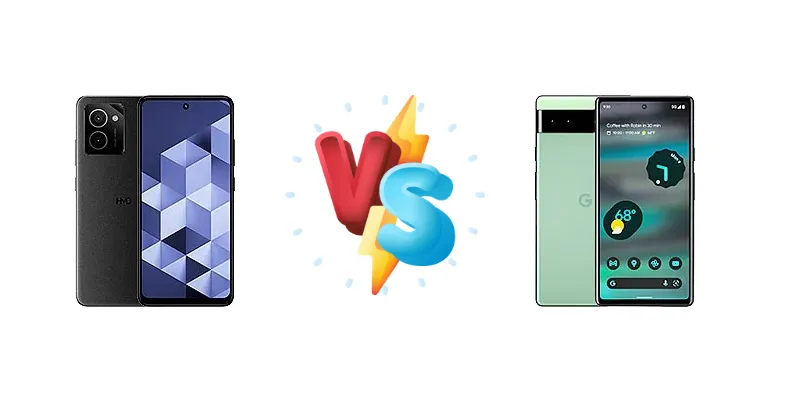
HMD Vibe 4G vs. Google Pixel 6a: A Detailed Comparison of Budget & Mid-Range Androids
| Phones Images | |||||
|---|---|---|---|---|---|
|
🏆 Quick Verdict
For most users, the Google Pixel 6a is the superior choice. Its Google Tensor chipset delivers significantly faster performance and a smoother user experience, despite sharing the same 94-hour endurance rating as the Vibe 4G. While the Vibe 4G offers a lower entry price, the Pixel 6a’s enhanced capabilities justify the cost difference.
| PHONES | ||
|---|---|---|
| Phone Names | HMD Vibe 4G | Google Pixel 6a |
| Network | ||
|---|---|---|
| 2G bands | GSM 850 / 900 / 1800 / 1900 | GSM 850 / 900 / 1800 / 1900 |
| 3G bands | HSDPA 850 / 900 / 1900 / 2100 | HSDPA 800 / 850 / 900 / 1700(AWS) / 1900 / 2100 |
| 4G bands | 2, 4, 5, 12, 13, 66 | 1, 2, 3, 4, 5, 7, 8, 12, 13, 14, 17, 18, 19, 20, 25, 26, 28, 29, 30, 38, 39, 40, 41, 42, 48, 66, 71 - GX7AS, GB62Z (USA/Canada) |
| 5G bands | - | 1, 2, 3, 5, 7, 8, 12, 20, 25, 28, 30, 38, 40, 41, 48, 66, 71, 77, 78 SA/NSA/Sub6 - GX7AS (USA/Canada) |
| Speed | HSPA, LTE | HSPA, LTE, 5G |
| Technology | GSM / HSPA / LTE | GSM / HSPA / LTE / 5G |
| - | 1, 2, 3, 5, 7, 8, 12, 20, 25, 28, 30, 40, 48, 66, 71, 77, 78 SA/NSA/Sub6 - G1AZG (International) | |
| Launch | ||
|---|---|---|
| Announced | 2024, April 24 | 2022, May 11 |
| Status | Available. Released 2024, June 04 | Available. Released 2022, July 21 |
| Body | ||
|---|---|---|
| Build | Glass front, plastic frame, plastic back | Glass front (Gorilla Glass 3), aluminum frame, plastic back |
| Dimensions | 163.8 x 75.2 x 8.4 mm (6.45 x 2.96 x 0.33 in) | 152.2 x 71.8 x 8.9 mm (5.99 x 2.83 x 0.35 in) |
| SIM | Nano-SIM | Nano-SIM + eSIM |
| Weight | 186 g (6.56 oz) | 178 g (6.28 oz) |
| - | IP67 dust/water resistant (up to 1m for 30 min) | |
| Display | ||
|---|---|---|
| Protection | Toughened glass | Corning Gorilla Glass 3 |
| Resolution | 720 x 1480 pixels, 18.5:9 ratio (~251 ppi density) | 1080 x 2400 pixels, 20:9 ratio (~429 ppi density) |
| Size | 6.56 inches, 109.2 cm2 (~88.7% screen-to-body ratio) | 6.1 inches, 90.7 cm2 (~83.0% screen-to-body ratio) |
| Type | IPS LCD, 90Hz, 480 nits (typ), 600 nits (HBM) | OLED, HDR |
| - | Always-on display | |
| Platform | ||
|---|---|---|
| CPU | Octa-core (4x2.4 GHz Kryo 265 Gold & 4x1.9 GHz Kryo 265 Silver) | Octa-core (2x2.80 GHz Cortex-X1 & 2x2.25 GHz Cortex-A76 & 4x1.80 GHz Cortex-A55) |
| Chipset | Qualcomm SM6225 Snapdragon 680 4G (6 nm) | Google Tensor (5 nm) |
| GPU | Adreno 610 | Mali-G78 MP20 |
| OS | Android 14 | Android 12, upgradable to Android 15, up to 5 major Android upgrades |
| Memory | ||
|---|---|---|
| Card slot | microSDXC | No |
| Internal | 64GB 3GB RAM, 128GB 6GB RAM | 128GB 6GB RAM |
| - | UFS 3.1 | |
| Main Camera | ||
|---|---|---|
| Dual | 13 MP, (wide) Auxiliary lens | 12.2 MP, f/1.7, 27mm, (wide), 1/2.55", 1.4µm, dual pixel PDAF, OIS 12 MP, f/2.2, 17mm, 114˚ (ultrawide), 1.25µm |
| Features | LED flash, HDR | Dual-LED flash, Pixel Shift, Auto-HDR, panorama |
| Single | - | 8 MP, f/2.0, 24mm (wide), 1.12µm |
| Video | 1080p@30fps | 4K@30/60fps, 1080p@30/60/120/240fps; gyro-EIS, OIS |
| Selfie camera | ||
|---|---|---|
| Features | - | HDR, panorama |
| Single | 5 MP | 8 MP, f/2.0, 24mm (wide), 1.12µm |
| Video | Yes | 1080p@30fps |
| Sound | ||
|---|---|---|
| 3.5mm jack | - | No |
| 35mm jack | Yes | No |
| Loudspeaker | Yes | Yes, with stereo speakers |
| Comms | ||
|---|---|---|
| Bluetooth | 5.0, A2DP, LE | 5.2, A2DP, LE |
| NFC | No | Yes |
| Positioning | GPS | GPS, GLONASS, GALILEO, QZSS |
| Radio | Wireless FM radio | No |
| USB | USB Type-C 2.0, OTG | USB Type-C 3.1 |
| WLAN | Wi-Fi 802.11 a/b/g/n/ac | Wi-Fi 802.11 a/b/g/n/ac/6e, dual-band, Wi-Fi Direct |
| Features | ||
|---|---|---|
| Sensors | Accelerometer, proximity, compass, gyro, barometer | Fingerprint (under display, optical), accelerometer, gyro, proximity, compass, barometer |
| Battery | ||
|---|---|---|
| Charging | 10W wired | 18W wired, PD3.0 |
| Type | 4000 mAh | Li-Po 4410 mAh |
| Misc | ||
|---|---|---|
| Colors | Charcoal | Chalk, Charcoal, Sage |
| Models | - | GX7AS, GB62Z, G1AZG, GB17L |
| Price | About 100 EUR | $ 138.99 / C$ 228.74 / ₹ 23,999 |
| Tests | ||
|---|---|---|
| Battery life | - | Endurance rating 94h |
| Display | - | Contrast ratio: Infinite (nominal) |
HMD Vibe 4G
- Significantly lower price point
- Simple and straightforward user experience
- Decent battery endurance
- Underpowered Snapdragon 680 chipset
- Likely inferior display quality
- Limited camera capabilities
Google Pixel 6a
- Powerful Google Tensor chipset
- Bright and vibrant OLED display
- Excellent camera with Google’s image processing
- Higher price compared to the HMD Vibe 4G
- Charging speed, while faster, isn't class-leading
- May be overkill for basic users
Display Comparison
The Pixel 6a boasts a significantly brighter display, reaching a measured peak of 876 nits, compared to an unspecified brightness for the Vibe 4G. This higher brightness translates to better visibility outdoors. While both phones share an 'infinite' (nominal) contrast ratio, the Pixel 6a’s OLED panel likely provides deeper blacks and more vibrant colors. The Vibe 4G’s display technology is not specified, suggesting a potentially lower-quality LCD panel. Bezels are also likely slimmer on the Pixel 6a, contributing to a more modern aesthetic.
Camera Comparison
While both phones likely feature multi-camera systems, the Pixel 6a benefits from Google’s renowned computational photography. Details on the Vibe 4G’s camera sensors are unavailable, but its market positioning suggests a less sophisticated setup. The Pixel 6a’s image processing algorithms excel in dynamic range, low-light performance, and overall image quality. The absence of details regarding OIS (Optical Image Stabilization) on the Vibe 4G suggests it may lack this feature, impacting low-light video and still photography. The Pixel 6a’s camera is a clear advantage for photography enthusiasts.
Performance
The core difference lies in the chipsets. The Google Pixel 6a’s Google Tensor (5nm) is a flagship-class processor featuring a tri-cluster configuration with 2x2.80 GHz Cortex-X1 cores, 2x2.25 GHz Cortex-A76 cores, and 4x1.80 GHz Cortex-A55 cores. This contrasts sharply with the HMD Vibe 4G’s Qualcomm Snapdragon 680 (6nm) which utilizes a more modest octa-core setup with 4x2.4 GHz Kryo 265 Gold and 4x1.9 GHz Kryo 265 Silver cores. The 5nm fabrication process of the Tensor chip provides superior power efficiency and thermal performance compared to the 6nm Snapdragon 680. This means the Pixel 6a will handle demanding tasks and sustained workloads with less throttling. The Pixel 6a will offer a much smoother experience for gaming and app usage.
Battery Life
Both devices achieve an endurance rating of 94 hours, indicating similar real-world battery life despite potential differences in battery capacity. However, the Pixel 6a’s 18W wired charging with PD3.0 support is significantly faster than the Vibe 4G’s 10W charging. This means the Pixel 6a can be topped up much more quickly, minimizing downtime. While the Vibe 4G may offer comparable longevity, the convenience of faster charging on the Pixel 6a is a notable benefit.
Buying Guide
Buy the HMD Vibe 4G if you prioritize extreme affordability and need a reliable phone for basic tasks like calls, texts, and light social media use. You’ll appreciate its simplicity and lower price tag. Buy the Google Pixel 6a if you value performance, a superior camera experience, and Google’s software features, including guaranteed updates and a clean Android interface. It’s ideal for users who multitask, game, or rely heavily on their smartphone’s camera.