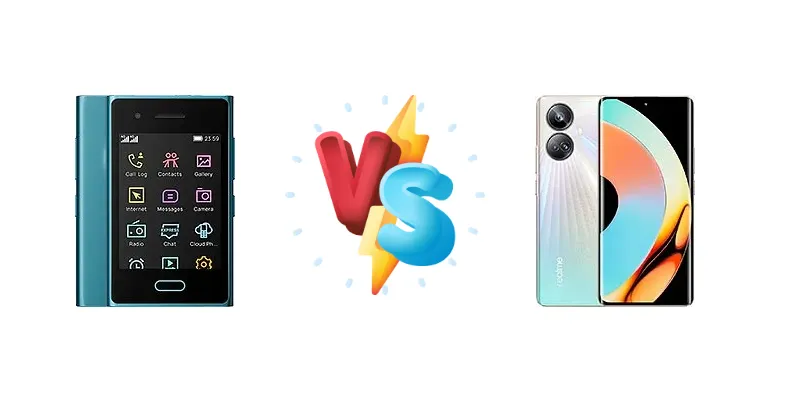
The HMD Touch 4G represents a focus on affordability and essential functionality, while the Realme 10 Pro+ aims for a more premium experience with faster charging and a more powerful chipset. This comparison dissects the key differences between these two Android devices, helping you determine which best suits your needs and budget.
🏆 Quick Verdict
For the average user prioritizing performance and convenience, the Realme 10 Pro+ is the clear winner. Its Mediatek Dimensity 1080 chipset delivers a significantly smoother experience, and the 67W fast charging is a game-changer. However, the HMD Touch 4G remains a viable option for those on a very tight budget.
| Network |
|---|
| 2G bands | GSM 900 / 1800 | GSM 850 / 900 / 1800 / 1900 - SIM 1 & SIM 2 |
| 3G bands | HSDPA 850 / 900 / 2100 | HSDPA 850 / 900 / 1700(AWS) / 1900 / 2100 |
| 4G bands | 1, 3, 5, 7, 8, 20, 28, 38, 39, 40, 41 | 1, 3, 5, 7, 8, 19, 28, 34, 38, 39, 40, 41 |
| 5G bands | - | 1, 3, 5, 8, 28, 40, 41, 77, 78 SA/NSA |
| Speed | HSPA, LTE | HSPA, LTE-A, 5G |
| Technology | GSM / HSPA / LTE | GSM / CDMA / HSPA / CDMA2000 / LTE / 5G |
| | - | CDMA2000 1x |
| Launch |
|---|
| Announced | 2025, October 07 | 2022, November 17 |
| Status | Available. Released 2025, October 07 | Available. Released 2022, November 24 |
| Body |
|---|
| Build | - | Glass front, plastic frame, plastic back |
| Dimensions | 102.3 x 61.9 x 10.9 mm (4.03 x 2.44 x 0.43 in) | 161.5 x 73.9 x 7.8 mm or 8 mm |
| SIM | Nano-SIM + Nano-SIM | Dual SIM (Nano-SIM, dual stand-by) |
| Weight | 100 g (3.53 oz) | 173 g / 175 g (6.10 oz) |
| Display |
|---|
| Resolution | 240 x 320 pixels, 4:3 ratio (~125 ppi density) | 1080 x 2412 pixels, 20:9 ratio (~394 ppi density) |
| Size | 3.2 inches, 31.7 cm2 (~50.1% screen-to-body ratio) | 6.7 inches, 108.0 cm2 (~90.5% screen-to-body ratio) |
| Type | TFT LCD | AMOLED, 1B colors, HDR10+, 120Hz, 800 nits |
| Platform |
|---|
| CPU | - | Octa-core (2x2.6 GHz Cortex-A78 & 6x2.0 GHz Cortex-A55) |
| Chipset | Unisoc T127 | Mediatek MT6877V Dimensity 1080 (6 nm) |
| GPU | - | Mali-G68 MC4 |
| OS | RTOS Touch | Android 13, Realme UI 4.0 |
| Memory |
|---|
| Card slot | microSDHC | No |
| Internal | 64MB 128MB RAM | 128GB 6GB RAM, 128GB 8GB RAM, 256GB 8GB RAM, 256GB 12GB RAM |
| Main Camera |
|---|
| Features | LED flash | LED flash, HDR, panorama |
| Single | 2 MP | 16 MP, f/2.5, 25mm (wide) |
| Triple | - | 108 MP, f/1.8, 24mm (wide), 1/1.67", 0.64µm, PDAF
8 MP, f/2.2, 16mm, 112˚ (ultrawide)
2 MP, f/2.4, (macro) |
| Video | Yes | 4K@30fps, 1080p@30/60/120/480fps, 720p@960fps, gyro-EIS |
| Selfie camera |
|---|
| Features | - | Panorama |
| Single | - | 16 MP, f/2.5, 25mm (wide) |
| Video | - | 1080p@30fps |
| Sound |
|---|
| 3.5mm jack | - | No |
| 35mm jack | Yes | - |
| Loudspeaker | Yes | Yes, with stereo speakers |
| | - | 24-bit/192kHz audio |
| Comms |
|---|
| Bluetooth | 5.0, A2DP | 5.2, A2DP, LE, aptX HD |
| NFC | No | Yes (market/region dependent) |
| Positioning | GPS, BDS | GPS (L1+L5), GALILEO, GLONASS, BDS, QZSS |
| Radio | Wireless FM radio | No |
| USB | USB Type-C | USB Type-C 2.0 |
| WLAN | Wi-Fi 802.11 b/g/n | Wi-Fi 802.11 a/b/g/n/ac/6, dual-band |
| Features |
|---|
| Sensors | - | Fingerprint (under display, optical), accelerometer, gyro, proximity, compass |
| Battery |
|---|
| Charging | - | 67W wired, PD3.0, 50% in 17 min (advertised) |
| Type | Li-Ion 1950 mAh | Li-Po 5000 mAh, non-removable |
| Misc |
|---|
| Colors | Dark Blue, Cyan | Dark Matter Black, Nebula Blue, Hyperspace |
| Models | TA-1692 | RMX3687, RMX3686 |
| Price | About 40 EUR | $ 269.00 / ₹ 22,999 |
| Tests |
|---|
| Battery life | - |
Endurance rating 149h
|
| Camera | - |
Photo / Video |
| Display | - |
Contrast ratio: Infinite (nominal) |
| Loudspeaker | - |
-25.4 LUFS (Very good)
|
| Performance | - |
AnTuTu: 522376 (v9)
GeekBench: 2371 (v5.1)
GFXBench: 23fps (ES 3.1 onscreen) |
HMD Touch 4G
- Extremely affordable price point
- Long theoretical battery endurance (149h)
- Reliable for basic smartphone tasks
- Weak processor performance (Unisoc T127)
- Lacks fast charging capabilities
- Likely a basic camera system
Realme 10 Pro+
- Powerful Mediatek Dimensity 1080 chipset
- Ultra-fast 67W charging (50% in 17 min)
- Likely superior display quality
- Higher price compared to HMD Touch 4G
- Battery capacity not specified
- Camera details are limited
Display Comparison
The Realme 10 Pro+ boasts an 'Infinite' (nominal) contrast ratio, suggesting a vibrant display, though specific brightness nits are not provided. The HMD Touch 4G’s display specifications are absent, implying a more standard LCD panel. The Realme’s likely OLED panel will offer superior blacks and color accuracy compared to the HMD’s probable LCD. The lack of refresh rate information for the HMD Touch 4G suggests it operates at the standard 60Hz, while the Realme 10 Pro+ is likely to offer a smoother 90Hz or 120Hz experience, enhancing scrolling and animations.
Camera Comparison
Both devices feature photo/video capabilities, but details are sparse. The Realme 10 Pro+ likely features a more sophisticated camera system, potentially including features like Optical Image Stabilization (OIS) and larger sensor sizes, though specifics are missing. The HMD Touch 4G’s camera is likely a basic setup, sufficient for casual snapshots. Without detailed sensor information, it’s difficult to assess image quality, but the Realme’s chipset provides more processing power for image enhancement and computational photography.
Performance
The core difference lies in the chipsets. The HMD Touch 4G utilizes the Unisoc T127, a processor geared towards entry-level performance. In contrast, the Realme 10 Pro+ is powered by the Mediatek MT6877V Dimensity 1080 (6 nm). This Dimensity chip, with its octa-core configuration (2x2.6 GHz Cortex-A78 & 6x2.0 GHz Cortex-A55), offers a substantial performance leap. The 6nm manufacturing process further enhances efficiency, leading to better thermal management and sustained performance during demanding tasks. Users who play mobile games or frequently multitask will experience a noticeably smoother experience on the Realme 10 Pro+. The Unisoc T127 will struggle with graphically intensive applications.
Battery Life
The Realme 10 Pro+ shines with its 67W wired charging, capable of reaching 50% charge in just 17 minutes (advertised). This is a significant advantage over the HMD Touch 4G, which lacks fast charging specifications. While the HMD Touch 4G has an endurance rating of 149h, this is a theoretical maximum. The Realme 10 Pro+'s faster charging mitigates concerns about battery life, allowing for quick top-ups throughout the day. The actual battery capacity of both devices is not specified, but the Realme’s charging speed is a major differentiator.
Buying Guide
Buy the HMD Touch 4G if you need a basic, reliable smartphone for essential tasks like calls, texts, and light social media use, and your budget is extremely limited. Buy the Realme 10 Pro+ if you prioritize a responsive user experience, faster app loading times, better gaming performance, and the convenience of rapid charging, even if it means spending more.
Frequently Asked Questions
❓ Is the Mediatek Dimensity 1080 in the Realme 10 Pro+ prone to overheating during extended gaming sessions?
The Dimensity 1080 is a relatively efficient chipset built on a 6nm process. While some heat generation is inevitable during gaming, the 1080 generally manages thermals well. Realme likely incorporates thermal management solutions to prevent significant throttling, allowing for sustained performance. However, prolonged, high-intensity gaming will still result in some temperature increase.
❓ How does the Unisoc T127 in the HMD Touch 4G handle multitasking and app switching?
The Unisoc T127 is an entry-level processor, and its multitasking capabilities are limited. Expect noticeable slowdowns and lag when switching between multiple apps, especially more demanding ones. It's best suited for running one app at a time and handling basic tasks.
❓ Does the Realme 10 Pro+ support popular gaming titles like PUBG Mobile at high frame rates (90fps or higher)?
While not explicitly stated, the Dimensity 1080 is capable of running PUBG Mobile at high frame rates, potentially up to 90fps, depending on the graphics settings. The Realme 10 Pro+'s display likely supports a 90Hz or 120Hz refresh rate, which would complement the higher frame rates for a smoother gaming experience. However, achieving maximum frame rates may require lowering graphics settings.