
Google Pixel 7a vs. HMD Touch 4G: A Deep Dive into Performance and Value
| Phones Images | |||||
|---|---|---|---|---|---|
|
🏆 Quick Verdict
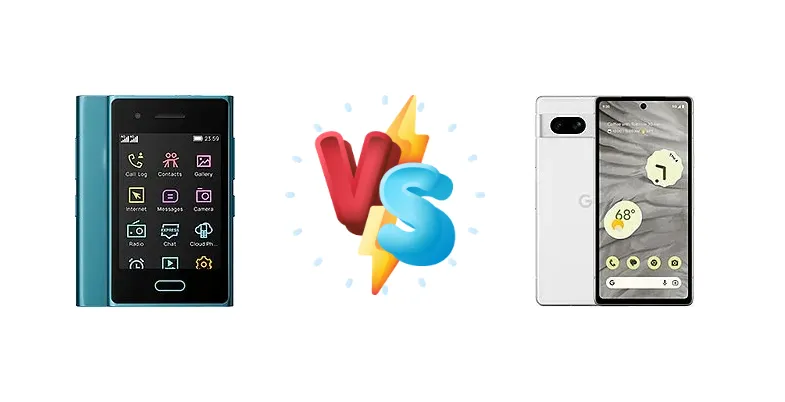
For most users, the Google Pixel 7a is the superior choice. Its Tensor G2 chipset provides significantly faster performance and unlocks advanced features like Google's AI-powered camera capabilities. While the HMD Touch 4G offers a lower price point, the performance gap is substantial, making the Pixel 7a a worthwhile investment for those prioritizing speed and features.
| PHONES | ||
|---|---|---|
| Phone Names | HMD Touch 4G | Google Pixel 7a |
| Network | ||
|---|---|---|
| 2G bands | GSM 900 / 1800 | GSM 850 / 900 / 1800 / 1900 |
| 3G bands | HSDPA 850 / 900 / 2100 | HSDPA 800 / 850 / 900 / 1700(AWS) / 1900 / 2100 |
| 4G bands | 1, 3, 5, 7, 8, 20, 28, 38, 39, 40, 41 | 1, 2, 3, 4, 5, 7, 8, 12, 13, 14, 17, 20, 25, 26, 28, 29, 30, 38, 40, 41, 48, 66, 71 - GWKK3, G0DZQ |
| 5G bands | - | 1, 2, 3, 5, 7, 8, 12, 14, 20, 25, 28, 30, 38, 41, 48, 66, 71, 77, 78 SA/NSA/Sub6 - GWKK3 |
| Speed | HSPA, LTE | HSPA, LTE, 5G |
| Technology | GSM / HSPA / LTE | GSM / HSPA / LTE / 5G |
| - | 1, 2, 3, 5, 7, 8, 12, 20, 25, 28, 38, 40, 41, 66, 75, 76, 77, 78, 79 SA/NSA/Sub6 - GHL1X, G82U8 | |
| Launch | ||
|---|---|---|
| Announced | 2025, October 07 | 2023, May 10 |
| Status | Available. Released 2025, October 07 | Available. Released 2023, May 10 |
| Body | ||
|---|---|---|
| Build | - | Glass front (Gorilla Glass 3), aluminum frame, plastic back |
| Dimensions | 102.3 x 61.9 x 10.9 mm (4.03 x 2.44 x 0.43 in) | 152 x 72.9 x 9 mm (5.98 x 2.87 x 0.35 in) |
| SIM | Nano-SIM + Nano-SIM | Nano-SIM + eSIM |
| Weight | 100 g (3.53 oz) | 193.5 g (6.84 oz) |
| - | IP67 dust/water resistant (up to 1m for 30 min) | |
| Display | ||
|---|---|---|
| Protection | - | Corning Gorilla Glass 3 |
| Resolution | 240 x 320 pixels, 4:3 ratio (~125 ppi density) | 1080 x 2400 pixels, 20:9 ratio (~429 ppi density) |
| Size | 3.2 inches, 31.7 cm2 (~50.1% screen-to-body ratio) | 6.1 inches, 90.7 cm2 (~81.8% screen-to-body ratio) |
| Type | TFT LCD | OLED, HDR, 90Hz |
| - | Always-on display | |
| Platform | ||
|---|---|---|
| CPU | - | Octa-core (2x2.85 GHz Cortex-X1 & 2x2.35 GHz Cortex-A78 & 4x1.80 GHz Cortex-A55) |
| Chipset | Unisoc T127 | Google Tensor G2 (5 nm) |
| GPU | - | Mali-G710 MP7 |
| OS | RTOS Touch | Android 13, upgradable to Android 15, up to 5 major Android upgrades |
| Memory | ||
|---|---|---|
| Card slot | microSDHC | No |
| Internal | 64MB 128MB RAM | 128GB 8GB RAM |
| - | UFS 3.1 | |
| Main Camera | ||
|---|---|---|
| Dual | - | 64 MP, f/1.9, 26mm (wide), 1/1.73", 0.8µm, dual pixel PDAF, OIS 13 MP, f/2.2, 120˚ (ultrawide), 1.12µm |
| Features | LED flash | Dual-LED flash, Pixel Shift, Auto-HDR, panorama |
| Single | 2 MP | - |
| Video | Yes | 4K@30/60fps, 1080p@30/60/120/240fps, OIS |
| Selfie camera | ||
|---|---|---|
| Features | - | HDR, panorama |
| Single | - | 13 MP, f/2.2, 20mm (ultrawide), 1.12µm |
| Video | - | 4K@30fps, 1080p@30fps |
| Sound | ||
|---|---|---|
| 3.5mm jack | - | No |
| 35mm jack | Yes | No |
| Loudspeaker | Yes | Yes, with stereo speakers |
| Comms | ||
|---|---|---|
| Bluetooth | 5.0, A2DP | 5.3, A2DP, LE |
| NFC | No | Yes |
| Positioning | GPS, BDS | GPS, GLONASS, GALILEO, BDS, QZSS, NavIC |
| Radio | Wireless FM radio | No |
| USB | USB Type-C | USB Type-C 3.2 |
| WLAN | Wi-Fi 802.11 b/g/n | Wi-Fi 802.11 a/b/g/n/ac/6e, tri-band |
| Features | ||
|---|---|---|
| Sensors | - | Fingerprint (under display, optical), accelerometer, gyro, proximity, compass, barometer |
| Battery | ||
|---|---|---|
| Charging | - | 18W wired, PD3.0 7.5W wireless |
| Type | Li-Ion 1950 mAh | Li-Po 4385 mAh |
| Misc | ||
|---|---|---|
| Colors | Dark Blue, Cyan | Charcoal, Snow, Sea, Coral |
| Models | TA-1692 | GWKK3, GHL1X, G0DZQ, G82U8 |
| Price | About 40 EUR | € 179.90 / $ 150.00 / £ 170.00 / ₹ 25,980 |
HMD Touch 4G
- Significantly faster performance with the Google Tensor G2
- Superior camera quality and Google's AI features
- Excellent battery life and wireless charging support
- Higher price point compared to the HMD Touch 4G
- Charging speed is not the fastest available
Google Pixel 7a
- More affordable price
- Functional for basic smartphone tasks
- Potentially longer physical battery life due to lower power demands
- Substantially slower performance
- Limited camera capabilities
- Likely slower charging and no wireless charging
Display Comparison
The Pixel 7a boasts a significantly brighter display, reaching a measured peak of 1070 nits. This translates to superior visibility outdoors under direct sunlight compared to the HMD Touch 4G, whose brightness is not specified but is likely considerably lower given its budget positioning. While both likely utilize OLED panels, the Pixel 7a’s higher brightness and potentially better color calibration (typical of Pixel devices) will offer a more vibrant and accurate viewing experience. The absence of LTPO technology in either device suggests neither offers adaptive refresh rates, a feature found in higher-end smartphones.
Camera Comparison
The Pixel 7a’s camera system is a major differentiator. While specific sensor details are not provided, Google’s computational photography prowess, powered by the Tensor G2, elevates image quality significantly. The Pixel 7a excels in low-light photography and offers features like Magic Eraser and Photo Unblur. The HMD Touch 4G’s camera capabilities are likely more basic, focusing on providing acceptable images in good lighting conditions. The absence of details regarding OIS or advanced features suggests a simpler camera experience. The Pixel 7a’s video recording capabilities will also be superior, benefiting from the Tensor G2’s image signal processor.
Performance
The performance disparity is stark. The Google Pixel 7a’s Google Tensor G2 (5nm) is a flagship-class chipset featuring a tri-cluster configuration with high-performance Cortex-X1 cores. This architecture allows for rapid app loading, smooth multitasking, and capable gaming. In contrast, the HMD Touch 4G is powered by the Unisoc T127, a significantly less powerful processor designed for basic smartphone functions. The Tensor G2’s 5nm fabrication process also contributes to better thermal efficiency, reducing the likelihood of performance throttling during sustained workloads. Users demanding responsiveness and the ability to run demanding applications will find the Pixel 7a far more suitable.
Battery Life
The Pixel 7a achieves an impressive endurance rating of 76 hours, indicating excellent battery life despite its 18W charging. The inclusion of PD3.0 and 7.5W wireless charging adds convenience. The HMD Touch 4G’s battery capacity and charging speed are not specified, but given its budget nature, it likely offers a smaller battery and slower charging. While the Pixel 7a’s 18W charging isn’t the fastest available, the combination of efficient power management from the Tensor G2 and the larger battery capacity results in a more reliable and longer-lasting experience.
Buying Guide
Buy the HMD Touch 4G if you need a functional, basic smartphone for essential tasks like calls, texts, and light social media use, and your budget is extremely limited. You're willing to compromise on performance and camera quality for affordability. Buy the Google Pixel 7a if you prioritize a smooth user experience, excellent camera quality, and access to Google's latest software features, even if it means spending more upfront. You value long-term software support and a more capable device.