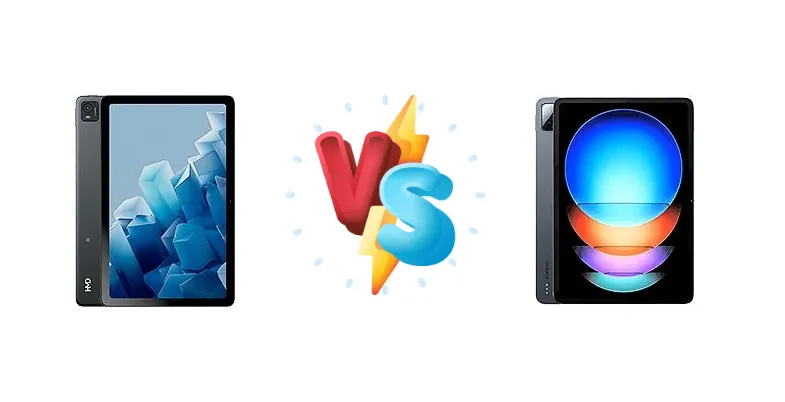
The tablet market is heating up, with options ranging from budget-friendly everyday devices to premium powerhouses. We’re pitting the HMD T21, a value-focused tablet, against the Xiaomi Pad 6S Pro 12.4, a device aiming for near-flagship performance. This comparison will dissect their key differences to help you determine which tablet best suits your needs and budget.
🏆 Quick Verdict
For the average user prioritizing performance and a premium experience, the Xiaomi Pad 6S Pro 12.4 is the clear winner. Its Snapdragon 8 Gen 2 chipset and rapid 120W charging significantly outperform the HMD T21. However, the HMD T21 remains a compelling option for those on a tighter budget who prioritize basic functionality.
| Network |
|---|
| 2G bands | GSM 850 / 900 / 1800 / 1900 | N/A |
| 3G bands | HSDPA 850 / 900 / 2100 | N/A |
| 4G bands | 1, 3, 5, 7, 8, 20, 28, 38, 40, 41 | - |
| EDGE | - | N/A |
| GPRS | - | N/A |
| Speed | HSPA, LTE | - |
| Technology | GSM / HSPA / LTE | No cellular connectivity |
| Launch |
|---|
| Announced | 2024, May 15 | 2024, February 22 |
| Status | Available. Released 2024, May 15 | Available. Released 2024, February 22 |
| Body |
|---|
| Build | Glass front, aluminum back | Glass front (Gorilla Glass 5), aluminum frame, aluminum back |
| Dimensions | 247.5 x 157.3 x 7.5 mm (9.74 x 6.19 x 0.30 in) | 278.7 x 191.6 x 6.3 mm (10.97 x 7.54 x 0.25 in) |
| SIM | Nano-SIM | No |
| Weight | 467 g (1.03 lb) | 590 g (1.30 lb) |
| Display |
|---|
| Protection | Scratch-resistant glass | Corning Gorilla Glass 5 |
| Resolution | 1200 x 2000 pixels, 5:3 ratio (~225 ppi density) | 2032 x 3048 pixels, 3:2 ratio (~295 ppi density) |
| Size | 10.36 inches, 305.5 cm2 (~78.5% screen-to-body ratio) | 12.4 inches, 457.8 cm2 (~85.7% screen-to-body ratio) |
| Type | IPS LCD, 360 nits (typ) | IPS LCD, 68B colors, 144Hz, HDR10, Dolby Vision, 900 nits (peak) |
| Platform |
|---|
| CPU | Octa-core (2x1.8 GHz Cortex-A75 & 6x1.8 GHz Cortex-A55) | Octa-core (1x3.2 GHz Cortex-X3 & 2x2.8 GHz Cortex-A715 & 2x2.8 GHz Cortex-A710 & 3x2.0 GHz Cortex-A510) |
| Chipset | Unisoc Tiger T612 (12 nm) | Qualcomm SM8550-AB Snapdragon 8 Gen 2 (4 nm) |
| GPU | Mali-G57 | Adreno 740 |
| OS | Android 13 | Android 14, up to 3 major Android upgrades, HyperOS |
| Memory |
|---|
| Card slot | microSDXC (dedicated slot) | No |
| Internal | 64GB 4GB RAM, 128GB 4GB RAM | 256GB 8GB RAM, 256GB 12GB RAM, 512GB 12GB RAM, 1TB 16GB RAM |
| Main Camera |
|---|
| Dual | - | 50 MP, f/1.8, (wide), 1/2.76", 0.64µm, PDAF
Auxiliary lens |
| Features | LED flash | LED flash, HDR, panorama |
| Single | 8 MP, AF | - |
| Video | 1080p@30fps | 4K@30/60fps, 1080p@30/60fps |
| Selfie camera |
|---|
| Single | 8 MP | 32 MP, f/2.2, (wide), 1/3.6", 0.61µm |
| Video | Yes | 1080p@30fps |
| Sound |
|---|
| 35mm jack | Yes | No |
| Loudspeaker | Yes, with stereo speakers | Yes, with stereo speakers (6 speakers) |
| Comms |
|---|
| Bluetooth | 5.0, A2DP, LE | 5.3, A2DP, LE, LHDC |
| NFC | Yes (market/region dependent) | Yes (file transfer only) |
| Positioning | GPS, GLONASS, GALILEO | No |
| Radio | FM radio | No |
| USB | USB Type-C 2.0, OTG | USB Type-C 3.2, accessory connector |
| WLAN | Wi-Fi 802.11 a/b/g/n/ac, dual-band | Wi-Fi 802.11 a/b/g/n/a/6/7, dual-band, Wi-Fi Direct |
| Features |
|---|
| Sensors | Accelerometer, proximity (accessories only) | Fingerprint (side-mounted), accelerometer, gyro, proximity (accessories only), compass |
| Battery |
|---|
| Charging | 18W wired, PD3.0 | 120W wired, PD3.0, QC4, 45% in 10 min, 100% in 35 min |
| Type | Li-Po 8200 mAh | 10000 mAh |
| Misc |
|---|
| Colors | Black Steel | Black, Blue, Green |
| Models | - | 24018RPACG |
| Price | About 300 EUR | About 700 EUR |
| SAR EU | - | 0.99 W/kg (body) |
HMD T21
- Significantly more affordable
- PD3.0 charging compatibility
- Lightweight and portable
- Underpowered Unisoc Tiger T612 chipset
- Slower charging speed (18W)
- Likely lower display quality
Xiaomi Pad 6S Pro 12.4
- Flagship Snapdragon 8 Gen 2 performance
- Ultra-fast 120W charging
- Bright and high-contrast display (848 nits, 1378:1)
- Higher price point
- Potentially heavier than the HMD T21
- May require a dedicated charger for 120W speeds
Display Comparison
The Xiaomi Pad 6S Pro 12.4 boasts a significantly more impressive display. Its measured peak brightness of 848 nits surpasses what we’d expect from the HMD T21, ensuring excellent visibility even in bright outdoor conditions. The 1378:1 contrast ratio further enhances image quality, delivering deeper blacks and more vibrant colors. While the HMD T21’s display specifications are not provided, it’s likely to feature a lower peak brightness and contrast ratio, resulting in a less immersive viewing experience. The larger screen size of the Xiaomi Pad 6S Pro also contributes to a more expansive canvas for media consumption and productivity.
Camera Comparison
Given the tablet form factor, camera performance isn't a primary concern for most users. However, the Xiaomi Pad 6S Pro is likely to offer a more refined camera experience due to its superior image signal processor (ISP) integrated within the Snapdragon 8 Gen 2. While specific camera specs for both devices are limited, the Xiaomi Pad 6S Pro’s chipset allows for more advanced image processing capabilities, potentially resulting in better dynamic range and low-light performance. We can assume the HMD T21 will offer a more basic camera experience suitable for casual snapshots.
Performance
The performance gap between these two tablets is substantial. The Xiaomi Pad 6S Pro 12.4 is powered by the Qualcomm Snapdragon 8 Gen 2 (4nm), a flagship chipset featuring a core configuration of 1x3.2 GHz Cortex-X3, 2x2.8 GHz Cortex-A715, 2x2.8 GHz Cortex-A710, and 3x2.0 GHz Cortex-A510. This is a massive leap over the Unisoc Tiger T612 (12nm) in the HMD T21, which utilizes a less powerful octa-core setup of 2x1.8 GHz Cortex-A75 & 6x1.8 GHz Cortex-A55. The 4nm process node of the Snapdragon 8 Gen 2 offers superior power efficiency and thermal management, allowing for sustained peak performance during demanding tasks. The Xiaomi Pad 6S Pro will handle graphically intensive games and multitasking with ease, while the HMD T21 will likely struggle with more demanding applications.
Battery Life
The Xiaomi Pad 6S Pro 12.4 demonstrates a clear advantage in battery charging speed. Its 120W wired charging capability can deliver a 45% charge in just 10 minutes and a full charge in 35 minutes, a significant time saver. The HMD T21, with its 18W wired charging, will take considerably longer to reach a full charge. While the Xiaomi Pad 6S Pro’s active use score of 11:14h is impressive, the HMD T21’s battery capacity is not specified. However, the more efficient Snapdragon 8 Gen 2 chipset in the Xiaomi Pad 6S Pro likely offsets any potential capacity difference, providing comparable or even superior real-world battery life.
Buying Guide
Buy the HMD T21 if you need a reliable tablet for basic tasks like web browsing, email, and light media consumption, and value affordability above all else. Buy the Xiaomi Pad 6S Pro 12.4 if you demand top-tier performance for gaming, demanding applications, and multitasking, and are willing to pay a premium for features like incredibly fast charging and a brighter, higher-contrast display.
Frequently Asked Questions
❓ Is the 120W charging on the Xiaomi Pad 6S Pro 12.4 compatible with all USB-C chargers?
While the Xiaomi Pad 6S Pro 12.4 supports PD3.0, QC4, and 120W charging, achieving the maximum charging speed requires a compatible charger capable of delivering that wattage. Standard USB-C chargers will still charge the device, but at a slower rate.
❓ Will the Unisoc Tiger T612 in the HMD T21 struggle with demanding games like Genshin Impact?
Yes, the Unisoc Tiger T612 is a budget-oriented chipset and will likely struggle to run graphically intensive games like Genshin Impact at high settings. You may experience significant frame rate drops and lag, even on lower settings.
❓ Does the Xiaomi Pad 6S Pro 12.4 support stylus input and keyboard accessories?
Yes, the Xiaomi Pad 6S Pro 12.4 is designed to be used with accessories. Xiaomi offers a dedicated Smart Pen and a keyboard cover, enhancing its productivity capabilities.
❓ What type of storage does the HMD T21 use, and is it expandable?
Unfortunately, the storage type and expandability options for the HMD T21 are not specified in the provided data. However, budget tablets often utilize eMMC storage and may or may not offer microSD card support.