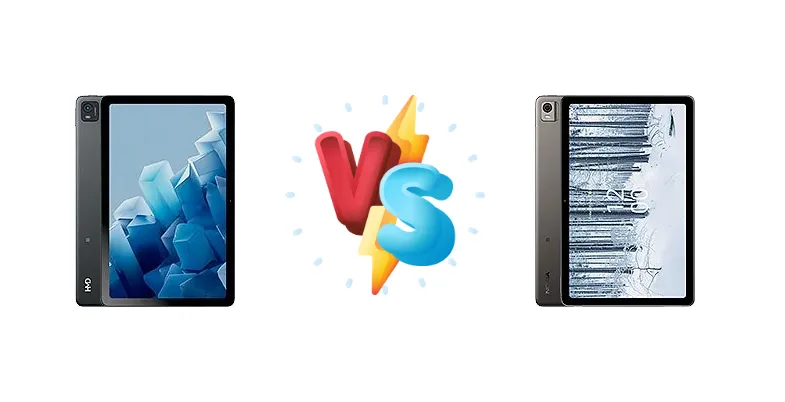
The HMD T21 and Nokia T21 present a curious case in the Android tablet space. Both devices are positioned as affordable options for everyday use, and crucially, they both utilize the same Unisoc Tiger T612 chipset. This comparison isn't about raw performance differences – they're negligible – but rather about the software experience, brand ecosystem, and subtle design choices that might sway your decision.
🏆 Quick Verdict
For the average user prioritizing a clean Android experience and potential for longer software support, the Nokia T21 edges out the HMD T21. However, the HMD T21’s focus on affordability and potential for wider availability makes it a strong contender for budget-conscious buyers.
| Network |
|---|
| 2G bands | GSM 850 / 900 / 1800 / 1900 | GSM 850 / 900 / 1800 / 1900 |
| 3G bands | HSDPA 850 / 900 / 2100 | HSDPA 850 / 900 / 1700(AWS) / 1900 / 2100 - US, LATAM |
| 4G bands | 1, 3, 5, 7, 8, 20, 28, 38, 40, 41 | 1, 2, 3, 4, 5, 7, 8, 12, 13, 17, 20, 28, 40, 66 - US, LATAM |
| Speed | HSPA, LTE | HSPA, LTE - cellular model only |
| Technology | GSM / HSPA / LTE | GSM / HSPA / LTE |
| | - | 1, 3, 5, 7, 8, 20, 28, 38, 40, 41 - International |
| Launch |
|---|
| Announced | 2024, May 15 | 2022, September 01 |
| Status | Available. Released 2024, May 15 | Available. Released 2022, September 01 |
| Body |
|---|
| Build | Glass front, aluminum back | Glass front, aluminum back |
| Dimensions | 247.5 x 157.3 x 7.5 mm (9.74 x 6.19 x 0.30 in) | 247.5 x 157.3 x 7.5 mm (9.74 x 6.19 x 0.30 in) |
| SIM | Nano-SIM | Nano-SIM (cellular model only) |
| Weight | 467 g (1.03 lb) | 466 g (1.03 lb) |
| | - | Splash resistant
Stylus support |
| Display |
|---|
| Protection | Scratch-resistant glass | Scratch-resistant glass |
| Resolution | 1200 x 2000 pixels, 5:3 ratio (~225 ppi density) | 1200 x 2000 pixels, 5:3 ratio (~224 ppi density) |
| Size | 10.36 inches, 305.5 cm2 (~78.5% screen-to-body ratio) | 10.4 inches, 307.9 cm2 (~79.1% screen-to-body ratio) |
| Type | IPS LCD, 360 nits (typ) | IPS LCD, 360 nits (typ) |
| Platform |
|---|
| CPU | Octa-core (2x1.8 GHz Cortex-A75 & 6x1.8 GHz Cortex-A55) | Octa-core (2x1.8 GHz Cortex-A75 & 6x1.8 GHz Cortex-A55) |
| Chipset | Unisoc Tiger T612 (12 nm) | Unisoc Tiger T612 (12 nm) |
| GPU | Mali-G57 | Mali-G57 |
| OS | Android 13 | Android 12, upgradable to Android 13 |
| Memory |
|---|
| Card slot | microSDXC (dedicated slot) | microSDXC (dedicated slot) |
| Internal | 64GB 4GB RAM, 128GB 4GB RAM | 64GB 4GB RAM, 128GB 4GB RAM |
| | - | eMMC 5.1 |
| Main Camera |
|---|
| Features | LED flash | LED flash |
| Single | 8 MP, AF | 8 MP, AF |
| Video | 1080p@30fps | 1080p@30fps |
| Selfie camera |
|---|
| Single | 8 MP | 8 MP |
| Video | Yes | Yes |
| Sound |
|---|
| 3.5mm jack | - | Yes |
| 35mm jack | Yes | Yes |
| Loudspeaker | Yes, with stereo speakers | Yes, with stereo speakers |
| Comms |
|---|
| Bluetooth | 5.0, A2DP, LE | 5.0, A2DP, LE |
| NFC | Yes (market/region dependent) | Yes (Wi-Fi/LTE model only / TA-1521) |
| Positioning | GPS, GLONASS, GALILEO | GPS - cellular model only |
| Radio | FM radio | FM radio |
| USB | USB Type-C 2.0, OTG | USB Type-C 2.0, OTG |
| WLAN | Wi-Fi 802.11 a/b/g/n/ac, dual-band | Wi-Fi 802.11 a/b/g/n/ac, dual-band |
| Features |
|---|
| Sensors | Accelerometer, proximity (accessories only) | Accelerometer, proximity |
| Battery |
|---|
| Charging | 18W wired, PD3.0 | 18W wired, PD3.0 |
| Type | Li-Po 8200 mAh | Li-Po 8200 mAh |
| Misc |
|---|
| Colors | Black Steel | Charcoal Grey |
| Models | - | TA-1495, TA-1521, TA-1505, TA-1487 |
| Price | About 300 EUR | About 240 EUR |
| SAR | - | 1.19 W/kg (body) |
| SAR EU | - | 1.56 W/kg (body) |
HMD T21
- Potentially lower price point
- Wider availability in some markets
- HMD’s focus on affordability
- Potentially less frequent software updates
- Software experience may be less refined
- Brand recognition is lower than Nokia
Nokia T21
- Cleaner, more stock-Android experience
- Nokia’s commitment to software updates
- Stronger brand reputation for reliability
- Likely slightly higher price
- Availability may be limited in some regions
- Software bloatware is still possible, though minimal
Display Comparison
Both the HMD T21 and Nokia T21 are expected to feature similar LCD panels, given their price bracket. The Unisoc T612 chipset supports 1080p displays, and both tablets likely target this resolution. Without specific brightness or color gamut data, it’s safe to assume display quality will be adequate for indoor use, but neither will excel in direct sunlight. The absence of features like LTPO or high refresh rates is typical for this segment, focusing instead on cost optimization.
Camera Comparison
Camera performance is unlikely to be a deciding factor for either tablet. Given the target market, both the HMD T21 and Nokia T21 will likely feature basic camera setups. Without specific sensor details, it’s reasonable to expect a primary camera around 8-13MP and a secondary depth or macro sensor. Image quality will be sufficient for casual snapshots and video calls, but don’t expect flagship-level results. The image processing algorithms employed by HMD and Nokia could lead to slightly different color profiles, but the underlying hardware limitations will be the primary constraint.
Performance
The core of both tablets is the Unisoc Tiger T612 (12 nm) chipset, featuring an octa-core CPU configuration with 2x1.8 GHz Cortex-A75 and 6x1.8 GHz Cortex-A55 cores. This means performance will be virtually identical in CPU-bound tasks. The 12nm fabrication process isn’t the most efficient, so sustained performance under heavy load might reveal some throttling, but for typical tablet workloads – web browsing, video playback, light gaming – this shouldn’t be a major concern. RAM configurations are a key differentiator, but that data is missing. However, the chipset's capabilities suggest 3-4GB of RAM is likely, impacting multitasking performance.
Battery Life
Both tablets support 18W wired charging with PD3.0, offering a standardized and relatively quick charging experience. Battery capacity is a missing spec, but given the tablet form factor and Unisoc T612’s power efficiency, a 5000-6000mAh battery is a reasonable expectation. The 18W charging should deliver a full charge in approximately 2.5-3.5 hours. Real-world battery life will depend heavily on usage patterns, but both tablets should comfortably provide a full day of moderate use.
Buying Guide
Buy the HMD T21 if you need the absolute lowest price point and are comfortable with a potentially less refined software experience. It’s ideal for users who primarily need a tablet for basic tasks like video streaming and web browsing. Buy the Nokia T21 if you prefer a cleaner, more stock-Android experience, value Nokia’s commitment to software updates, and are willing to spend a little more for a potentially smoother long-term user experience.
Frequently Asked Questions
❓ Will the Unisoc T612 struggle with demanding games like PUBG Mobile?
The Unisoc T612 is a capable chipset for casual gaming, but demanding titles like PUBG Mobile will likely require reduced graphics settings and frame rates for a smooth experience. Expect playable performance at medium settings, but don't anticipate a flagship-level gaming experience.
❓ How long can I expect software updates to be supported on the Nokia T21?
Nokia has a relatively good track record for software updates on their tablets. While a specific commitment isn't available for the T21, users can reasonably expect at least two major Android version updates and three years of security patches, providing a longer software lifespan compared to many competitors in this price range.
❓ Is the 18W charging speed sufficient for quick top-ups?
18W PD3.0 charging is adequate for a tablet of this size and battery capacity. While not the fastest charging available, it will provide a noticeable charge boost in a short amount of time, and a full charge can be achieved within a reasonable timeframe of 2.5-3.5 hours.