
HMD Skyline vs Samsung Galaxy S24 FE: Which Mid-Range Champion Reigns Supreme?
| Phones Images | |||||
|---|---|---|---|---|---|
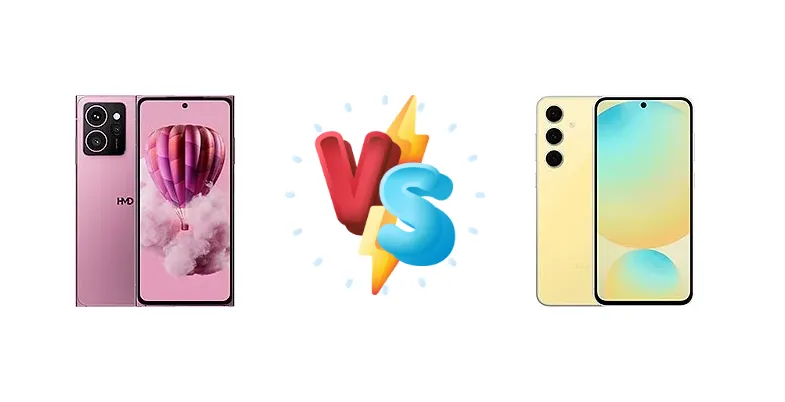
|
🏆 Quick Verdict
For the average user prioritizing all-day battery life and efficient performance, the Samsung Galaxy S24 FE emerges as the winner. Its significantly longer battery endurance (42:00h vs 10:47h) and brighter display (1372 nits) outweigh the Skyline’s more efficient chipset in most scenarios. However, the Skyline presents a compelling value proposition for those seeking a more affordable option.
| PHONES | ||
|---|---|---|
| Phone Names | HMD Skyline | Samsung Galaxy S24 FE |
| Network | ||
|---|---|---|
| 2G bands | GSM 850 / 900 / 1800 / 1900 | GSM 850 / 900 / 1800 / 1900 |
| 3G bands | HSDPA 850 / 900 / 1700(AWS) / 1900 / 2100 | HSDPA 850 / 900 / 1700(AWS) / 1900 / 2100 |
| 4G bands | 1, 2, 3, 4, 5, 7, 8, 12, 13, 17, 20, 25, 26, 28, 32, 38, 40, 41, 66, 71 | 1, 2, 3, 4, 5, 7, 8, 12, 17, 18, 19, 20, 25, 26, 28, 32, 38, 40, 41, 66 - International |
| 5G bands | 1, 2, 3, 5, 7, 8, 20, 25, 28, 38, 40, 41, 48, 66, 71, 77, 78 SA/NSA | 1, 2, 3, 5, 7, 8, 12, 20, 25, 26, 28, 38, 40, 41, 66, 75, 77, 78 SA/NSA/Sub6 - International |
| Speed | HSPA, LTE, 5G | HSPA, LTE, 5G |
| Technology | GSM / HSPA / LTE / 5G | GSM / HSPA / LTE / 5G |
| Launch | ||
|---|---|---|
| Announced | 2024, July 18 | 2024, September 26 |
| Status | Available. Released 2024, July 19 | Available. Released 2024, October 03 |
| Body | ||
|---|---|---|
| Build | Glass front (Gorilla Glass 3), aluminum frame, glass back | Glass front (Gorilla Glass Victus+), glass back (Gorilla Glass Victus+), aluminum frame |
| Dimensions | 159.8 x 76 x 8.9 mm (6.29 x 2.99 x 0.35 in) | 162 x 77.3 x 8 mm (6.38 x 3.04 x 0.31 in) |
| SIM | Nano-SIM + eSIM | · Nano-SIM· Nano-SIM + Nano-SIM· Nano-SIM + eSIM· eSIM + eSIM |
| Weight | 209.5 g (7.41 oz) | 213 g (7.51 oz) |
| Display | ||
|---|---|---|
| Protection | Corning Gorilla Glass 3 | Corning Gorilla Glass Victus+, Mohs level 5 |
| Resolution | 1080 x 2400 pixels, 20:9 ratio (~402 ppi density) | 1080 x 2340 pixels, 19.5:9 ratio (~385 ppi density) |
| Size | 6.55 inches, 103.6 cm2 (~85.3% screen-to-body ratio) | 6.7 inches, 110.2 cm2 (~88.0% screen-to-body ratio) |
| Type | P-OLED, 144Hz, 1000 nits (peak), HDR10 | Dynamic AMOLED 2X, 120Hz, HDR10+, 1900 nits (peak) |
| Platform | ||
|---|---|---|
| CPU | Octa-core (4x2.40 GHz Cortex-A78 & 4x1.95 GHz Cortex-A55) | 10-core (1x3.1 GHz + 2x2.9 GHz + 3x2.6 GHz + 4x1.95 GHz) |
| Chipset | Qualcomm SM7435-AB Snapdragon 7s Gen 2 (4 nm) | Exynos 2400e (4 nm) |
| GPU | Adreno 710 | Xclipse 940 |
| OS | Android 14, upgradable to Android 15, up to 2 major Android upgrades | Android 14, up to 7 major Android upgrades, One UI 8.0 |
| Memory | ||
|---|---|---|
| Card slot | microSDXC | No |
| Internal | 128GB 8GB RAM, 256GB 12GB RAM | 128GB 8GB RAM, 256GB 8GB RAM, 512GB 8GB RAM |
| Main Camera | ||
|---|---|---|
| Features | LED flash, HDR | LED flash, HDR, panorama |
| Triple | 108 MP, f/1.8, (wide), 1/1.67", 0.64µm, PDAF, OIS 50 MP, f/2.0, (telephoto), 1/2.76", 0.64µm, PDAF, 2x optical zoom 13 MP, f/2.5, (ultrawide), 1/3", 1.12µm | 50 MP, f/1.8, 24mm (wide), 1/1.57", 1.0µm, dual pixel PDAF, OIS 8 MP, f/2.4, 75mm (telephoto), 1/4.4", 1.0µm, PDAF, OIS, 3x optical zoom 12 MP, f/2.2, 13mm, 123˚ (ultrawide), 1/3.0", 1.12µm |
| Video | 4K@30fps, 1080p@30fps, gyro-EIS | 8K@30fps, 4K@30/60/120fps, 1080p@30/60/120/240fps |
| Selfie camera | ||
|---|---|---|
| Single | 50 MP, f/2.5, (wide), AF | 10 MP, f/2.4, 26mm (wide), 1/3.0", 1.22µm |
| Video | 1080p@30/60fps | 4K@30/60fps, 1080p@30/60fps; gyro-EIS |
| Sound | ||
|---|---|---|
| 35mm jack | No | No |
| Loudspeaker | Yes, with stereo speakers | Yes, with stereo speakers |
| Comms | ||
|---|---|---|
| Bluetooth | 5.2, A2DP, LE, aptX HD, aptX Adaptive | 5.3, A2DP, LE |
| NFC | Yes | Yes |
| Positioning | GPS (L1+L5), GALILEO, GLONASS, BDS | GPS, GLONASS, GALILEO, BDS |
| Radio | Unspecified | Unspecified |
| USB | USB Type-C 2.0, OTG | USB Type-C 3.2, OTG |
| WLAN | Wi-Fi 802.11 a/b/g/n/ac/6e, dual-band | Wi-Fi 802.11 a/b/g/n/ac/6e, dual-band or tri-band (market/region dependent), Wi-Fi Direct |
| Features | ||
|---|---|---|
| Sensors | Fingerprint (side-mounted), accelerometer, gyro, proximity, compass, barometer | Fingerprint (under display, optical), accelerometer, gyro, compass |
| Battery | ||
|---|---|---|
| Charging | 33W wired, PD3.0 PPS, QC4 15W wireless (magnetic), Qi2 5W reverse wireless | 25W wired, PD, QC2, 50% in 30 min 15W wireless Reverse wireless |
| Type | 4600 mAh, user replaceable | 4700 mAh |
| Misc | ||
|---|---|---|
| Colors | Neon Pink, Twisted Black, Blue Topaz | Blue, Graphite, Gray, Mint, Yellow |
| Models | TA-1600 | SM-S721B, SM-S721B/DS, SM-S721U1, SM-S721U, SM-S721W, SM-S7210, SM-S721N |
| Price | $ 330.00 / £ 249.95 / € 279.00 | $ 249.74 / C$ 498.99 / £ 335.00 / € 387.00 / ₹ 34,180 |
| SAR | - | 0.94 W/kg (head) 0.71 W/kg (body) |
| SAR EU | - | 0.86 W/kg (head) 1.29 W/kg (body) |
| EU LABEL | ||
|---|---|---|
| Battery | - | 42:00h endurance, 2000 cycles |
| Energy | - | Class B |
| Free fall | - | Class A (270 falls) |
| Repairability | - | Class C |
HMD Skyline
- More efficient Snapdragon 7s Gen 2 chipset
- Faster 33W wired charging with advanced protocols
- More affordable price point
- Significantly shorter battery life
- Less bright display
- Potentially less powerful camera system
Samsung Galaxy S24 FE
- Exceptional battery life (42:00h endurance)
- Brighter and potentially more color-accurate display
- More powerful Exynos 2400e processor
- Potentially more prone to thermal throttling
- Slower 25W wired charging
- Higher price
Display Comparison
The Samsung Galaxy S24 FE boasts a significantly brighter display, reaching 1372 nits compared to the HMD Skyline’s 1060 nits. This translates to superior visibility in direct sunlight. While both utilize 4nm chipsets, the S24 FE’s brighter panel will draw more power. The S24 FE’s panel technology is likely to be more advanced, potentially including LTPO for adaptive refresh rates (though not specified in the data), contributing to better power efficiency when static content is displayed. The Skyline’s display, while still respectable, will be noticeably less vibrant and may struggle more in bright outdoor conditions.
Camera Comparison
The provided data doesn’t offer sufficient detail for a comprehensive camera comparison. However, given Samsung’s history, the S24 FE likely features a more sophisticated camera system with larger sensors and advanced image processing algorithms. The absence of sensor size information for either device makes a direct comparison impossible. The Skyline’s camera is likely to be adequate for everyday photography, but the S24 FE is expected to deliver superior image quality, particularly in low-light conditions and with dynamic range. We can assume the S24 FE will have more advanced features like improved optical image stabilization (OIS).
Performance
The Galaxy S24 FE’s Exynos 2400e, with its 10-core configuration (1x3.1 GHz + 2x2.9 GHz + 3x2.6 GHz + 4x1.95 GHz), offers a substantial theoretical performance advantage over the HMD Skyline’s Snapdragon 7s Gen 2 (4x2.40 GHz Cortex-A78 & 4x1.95 GHz Cortex-A55). The Exynos’s more complex core arrangement suggests a greater capacity for handling multi-threaded workloads and demanding games. However, the Snapdragon 7s Gen 2, built on a 4nm process, is known for its excellent thermal efficiency. This means the Skyline is less likely to experience significant throttling during sustained heavy use, potentially maintaining consistent performance for longer periods. The S24 FE’s Exynos chip, while powerful, may be more prone to thermal throttling, impacting sustained performance.
Battery Life
Battery life is where the Galaxy S24 FE truly shines. Its endurance rating of 42:00h is more than four times that of the HMD Skyline’s 10:47h. While the Skyline supports faster wired charging at 33W (with PD3.0 PPS and QC4) compared to the S24 FE’s 25W (PD, QC2), the S24 FE’s significantly larger battery capacity and optimized power management more than compensate. The S24 FE also boasts a claimed 50% charge in 30 minutes, while the Skyline’s charging time is not specified. Both devices offer 15W wireless charging and reverse wireless charging, but the S24 FE’s superior battery capacity makes reverse wireless charging more practical.
Buying Guide
Buy the HMD Skyline if you need a highly efficient phone with fast charging and are comfortable with a slightly less vibrant display. It’s ideal for users who prioritize battery longevity for everyday tasks and appreciate a more budget-friendly price point. Buy the Samsung Galaxy S24 FE if you prefer a brighter, more color-accurate display, a more powerful processor for demanding tasks, and a longer-lasting battery, even if it comes at a higher cost.