
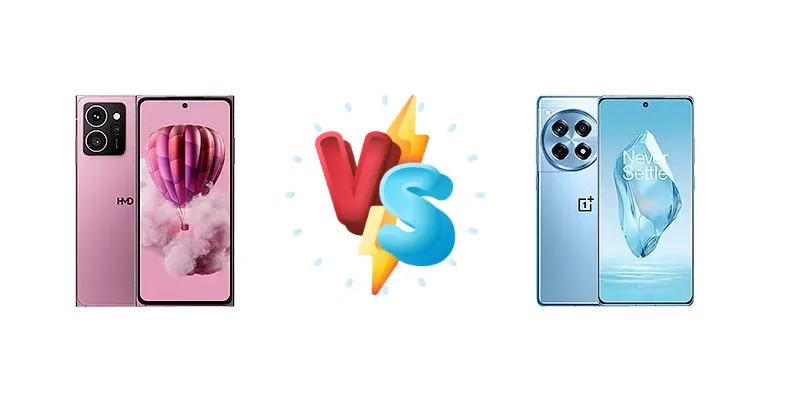
HMD Skyline vs OnePlus 12R: A Deep Dive into Performance, Battery, and Value
| Phones Images | |||||
|---|---|---|---|---|---|
|
🏆 Quick Verdict
For the average user prioritizing raw performance and incredibly fast charging, the OnePlus 12R is the clear winner. However, the HMD Skyline provides exceptional battery life and a solid overall experience for those on a tighter budget, making it a strong contender in the mid-range space.
| PHONES | ||
|---|---|---|
| Phone Names | HMD Skyline | OnePlus 12R |
| Network | ||
|---|---|---|
| 2G bands | GSM 850 / 900 / 1800 / 1900 | GSM 850 / 900 / 1800 / 1900 |
| 3G bands | HSDPA 850 / 900 / 1700(AWS) / 1900 / 2100 | HSDPA 850 / 900 / 1700(AWS) / 1900 / 2100 |
| 4G bands | 1, 2, 3, 4, 5, 7, 8, 12, 13, 17, 20, 25, 26, 28, 32, 38, 40, 41, 66, 71 | 1, 2, 3, 4, 5, 7, 8, 12, 17, 18, 19, 20, 26, 28, 32, 38, 39, 40, 41, 66 |
| 5G bands | 1, 2, 3, 5, 7, 8, 20, 25, 28, 38, 40, 41, 48, 66, 71, 77, 78 SA/NSA | 1, 2, 3, 5, 7, 8, 12, 20, 28, 38, 40, 41, 66, 77, 78 SA/NSA |
| Speed | HSPA, LTE, 5G | HSPA, LTE, 5G |
| Technology | GSM / HSPA / LTE / 5G | GSM / CDMA / HSPA / LTE / 5G |
| Launch | ||
|---|---|---|
| Announced | 2024, July 18 | 2024, January 23 |
| Status | Available. Released 2024, July 19 | Available. Released 2024, February 06 |
| Body | ||
|---|---|---|
| Build | Glass front (Gorilla Glass 3), aluminum frame, glass back | Glass front (Gorilla Glass Victus 2), aluminum frame, glass back |
| Dimensions | 159.8 x 76 x 8.9 mm (6.29 x 2.99 x 0.35 in) | 163.3 x 75.3 x 8.8 mm (6.43 x 2.96 x 0.35 in) |
| SIM | Nano-SIM + eSIM | · Nano-SIM + Nano-SIM + eSIM (max 2 at a time)· Nano-SIM + Nano-SIM |
| Weight | 209.5 g (7.41 oz) | 207 g (7.30 oz) |
| Display | ||
|---|---|---|
| Protection | Corning Gorilla Glass 3 | Corning Gorilla Glass Victus 2 |
| Resolution | 1080 x 2400 pixels, 20:9 ratio (~402 ppi density) | 1264 x 2780 pixels (~450 ppi density) |
| Size | 6.55 inches, 103.6 cm2 (~85.3% screen-to-body ratio) | 6.78 inches, 111.7 cm2 (~90.9% screen-to-body ratio) |
| Type | P-OLED, 144Hz, 1000 nits (peak), HDR10 | LTPO4 AMOLED, 1B colors, 120Hz, HDR10+, Dolby Vision, 1600 nits (HBM), 4500 nits (peak) |
| Platform | ||
|---|---|---|
| CPU | Octa-core (4x2.40 GHz Cortex-A78 & 4x1.95 GHz Cortex-A55) | Octa-core (1x3.2 GHz Cortex-X3 & 2x2.8 GHz Cortex-A715 & 2x2.8 GHz Cortex-A710 & 3x2.0 GHz Cortex-A510) |
| Chipset | Qualcomm SM7435-AB Snapdragon 7s Gen 2 (4 nm) | Qualcomm SM8550-AB Snapdragon 8 Gen 2 (4 nm) |
| GPU | Adreno 710 | Adreno 740 |
| OS | Android 14, upgradable to Android 15, up to 2 major Android upgrades | Android 14, up to 3 major Android upgrades, OxygenOS 15 |
| Memory | ||
|---|---|---|
| Card slot | microSDXC | No |
| Internal | 128GB 8GB RAM, 256GB 12GB RAM | 128GB 8GB RAM, 256GB 8GB RAM, 256GB 12GB RAM, 256GB 16GB RAM |
| Main Camera | ||
|---|---|---|
| Features | LED flash, HDR | Laser AF, color spectrum sensor, LED flash, HDR, panorama |
| Triple | 108 MP, f/1.8, (wide), 1/1.67", 0.64µm, PDAF, OIS 50 MP, f/2.0, (telephoto), 1/2.76", 0.64µm, PDAF, 2x optical zoom 13 MP, f/2.5, (ultrawide), 1/3", 1.12µm | 50 MP, f/1.8, 24mm (wide), 1/1.56", 1.0µm, multi-directional PDAF, OIS 8 MP, f/2.2, 16mm, 112˚ (ultrawide), 1/4.0", 1.12µm 2 MP (macro) |
| Video | 4K@30fps, 1080p@30fps, gyro-EIS | 4K@30/60fps, 1080p@30/60/120/240fps, gyro-EIS, OIS |
| Selfie camera | ||
|---|---|---|
| Features | - | HDR, panorama |
| Single | 50 MP, f/2.5, (wide), AF | 16 MP, f/2.4, 26mm (wide), 1/3", 1.0µm |
| Video | 1080p@30/60fps | 1080p@30fps, gyro-EIS |
| Sound | ||
|---|---|---|
| 35mm jack | No | No |
| Loudspeaker | Yes, with stereo speakers | Yes, with stereo speakers |
| Comms | ||
|---|---|---|
| Bluetooth | 5.2, A2DP, LE, aptX HD, aptX Adaptive | 5.3, A2DP, LE, aptX HD |
| Infrared port | - | Yes |
| NFC | Yes | Yes |
| Positioning | GPS (L1+L5), GALILEO, GLONASS, BDS | GPS, GALILEO, GLONASS, BDS, QZSS |
| Radio | Unspecified | No |
| USB | USB Type-C 2.0, OTG | USB Type-C 2.0 |
| WLAN | Wi-Fi 802.11 a/b/g/n/ac/6e, dual-band | Wi-Fi 802.11 a/b/g/n/ac/6/7, dual-band |
| Features | ||
|---|---|---|
| Sensors | Fingerprint (side-mounted), accelerometer, gyro, proximity, compass, barometer | Fingerprint (under display, optical), accelerometer, gyro, proximity, compass |
| Battery | ||
|---|---|---|
| Charging | 33W wired, PD3.0 PPS, QC4 15W wireless (magnetic), Qi2 5W reverse wireless | 100W wired, 100% in 26 min |
| Type | 4600 mAh, user replaceable | Li-Ion 5500 mAh |
| Misc | ||
|---|---|---|
| Colors | Neon Pink, Twisted Black, Blue Topaz | Iron Gray, Cool Blue, Electric Violet, Sunset Dune |
| Models | TA-1600 | CPH2609, CPH2585, CPH2611 |
| Price | $ 330.00 / £ 249.95 / € 279.00 | € 410.84 / $ 399.95 / £ 649.00 |
| SAR | - | 1.19 W/kg (head) 0.82 W/kg (body) |
HMD Skyline
- Exceptional battery life (10:47h active use)
- Wireless charging (Qi2 and magnetic)
- More affordable price point
- Significantly slower performance than the 12R
- Slower charging speed (33W)
OnePlus 12R
- Flagship-level performance with Snapdragon 8 Gen 2
- Incredibly fast 100W charging (26 minutes to full)
- Brighter display for better outdoor visibility
- Shorter battery life (14:32h active use)
- No wireless charging support
Display Comparison
Both devices feature 4nm chipsets, but their displays differ noticeably. The OnePlus 12R boasts a higher peak brightness of 1181 nits compared to the HMD Skyline’s 1060 nits, resulting in better visibility in direct sunlight. While both likely utilize AMOLED panels (though not explicitly stated), the 12R’s higher brightness and potentially wider color gamut offer a more vibrant viewing experience. The absence of LTPO technology in either device suggests a standard 120Hz refresh rate, potentially impacting power consumption compared to adaptive refresh rate displays.
Camera Comparison
Without detailed camera specifications, a direct comparison is limited. However, the chipset difference suggests the 12R will have a more powerful image signal processor (ISP), enabling faster image processing and potentially better low-light performance. The Snapdragon 8 Gen 2’s ISP supports more advanced features like 8K video recording and improved HDR capabilities. While the Skyline will likely produce acceptable images, the 12R is expected to offer a more refined and versatile camera experience. We assume both phones will feature a multi-camera setup, but the quality of the sensors and lenses will be key differentiators.
Performance
The performance gap is significant. The OnePlus 12R’s Snapdragon 8 Gen 2 (SM8550-AB) is a substantial upgrade over the HMD Skyline’s Snapdragon 7s Gen 2 (SM7435-AB). The 8 Gen 2 features a prime Cortex-X3 core clocked at 3.2 GHz, alongside higher-clocked Cortex-A715 and A710 cores, providing a considerable boost in CPU and GPU performance. The Skyline’s A78 cores, while capable, are a generation behind and clocked lower. This translates to faster app loading times, smoother multitasking, and a superior gaming experience on the 12R. The 12R also benefits from potentially faster LPDDR5x RAM, further enhancing performance.
Battery Life
The OnePlus 12R’s 100W wired charging is a game-changer, achieving a full charge in just 26 minutes. This is dramatically faster than the HMD Skyline’s 33W charging. However, the Skyline compensates with superior battery life, achieving 10:47h of active use compared to the 12R’s 14:32h. This suggests the Skyline’s more efficient chipset and potentially optimized software contribute to longer runtimes. The Skyline also offers 15W wireless charging (magnetic, Qi2) and 5W reverse wireless charging, features absent on the 12R.
Buying Guide
Buy the HMD Skyline if you need a phone that will reliably last through a full day and beyond, and value long-term battery health over peak performance. It’s ideal for users who prioritize efficiency and aren’t demanding gamers or power users. Buy the OnePlus 12R if you prefer a snappy, responsive experience for demanding tasks like gaming and video editing, and appreciate the convenience of incredibly fast 100W charging, even if it comes at the cost of slightly reduced battery endurance.