
HMD Skyline vs. Nothing Phone (2): A Deep Dive into Performance, Battery, and Value
| Phones Images | |||||
|---|---|---|---|---|---|
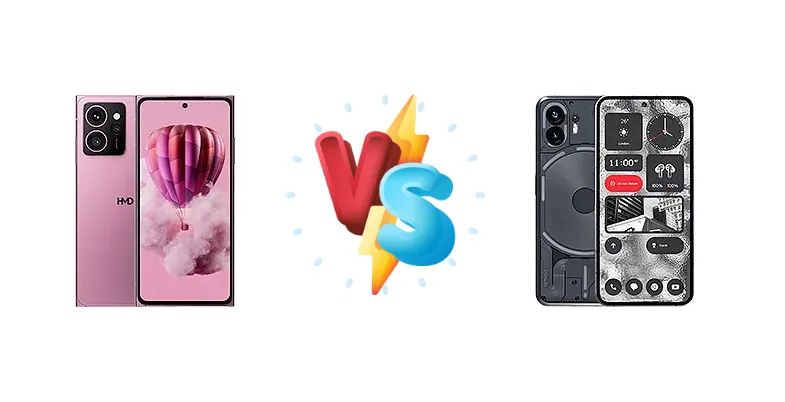
|
🏆 Quick Verdict
For the average user prioritizing battery life and value, the HMD Skyline is the stronger choice. Its 10:47h active use score and efficient Snapdragon 7s Gen 2 chipset provide all-day power without breaking the bank. However, the Nothing Phone (2) is the clear winner for power users demanding top-tier performance.
| PHONES | ||
|---|---|---|
| Phone Names | HMD Skyline | Nothing Phone (2) |
| Network | ||
|---|---|---|
| 2G bands | GSM 850 / 900 / 1800 / 1900 | GSM 850 / 900 / 1800 / 1900 |
| 3G bands | HSDPA 850 / 900 / 1700(AWS) / 1900 / 2100 | HSDPA 800 / 850 / 900 / 1700(AWS) / 1900 / 2100 |
| 4G bands | 1, 2, 3, 4, 5, 7, 8, 12, 13, 17, 20, 25, 26, 28, 32, 38, 40, 41, 66, 71 | 1, 2, 3, 4, 5, 7, 8, 12, 17, 18, 19, 20, 25, 26, 28, 30, 32, 34, 38, 39, 40, 41, 42, 48, 66, 71 |
| 5G bands | 1, 2, 3, 5, 7, 8, 20, 25, 28, 38, 40, 41, 48, 66, 71, 77, 78 SA/NSA | 1, 2, 3, 5, 7, 8, 12, 20, 25, 28, 30, 38, 40, 41, 66, 71, 75, 77, 78 SA/NSA |
| Speed | HSPA, LTE, 5G | HSPA, LTE, 5G |
| Technology | GSM / HSPA / LTE / 5G | GSM / HSPA / LTE / 5G |
| Launch | ||
|---|---|---|
| Announced | 2024, July 18 | 2023, July 11 |
| Status | Available. Released 2024, July 19 | Available. Released 2023, July 17 |
| Body | ||
|---|---|---|
| Build | Glass front (Gorilla Glass 3), aluminum frame, glass back | Glass front (Gorilla Glass 5), glass back (Gorilla Glass 5), aluminum frame |
| Dimensions | 159.8 x 76 x 8.9 mm (6.29 x 2.99 x 0.35 in) | 162.1 x 76.4 x 8.6 mm (6.38 x 3.01 x 0.34 in) |
| SIM | Nano-SIM + eSIM | Nano-SIM + Nano-SIM |
| Weight | 209.5 g (7.41 oz) | 201.2 g (7.09 oz) |
| Display | ||
|---|---|---|
| Protection | Corning Gorilla Glass 3 | Corning Gorilla Glass 5 |
| Resolution | 1080 x 2400 pixels, 20:9 ratio (~402 ppi density) | 1080 x 2412 pixels, 20:9 ratio (~394 ppi density) |
| Size | 6.55 inches, 103.6 cm2 (~85.3% screen-to-body ratio) | 6.7 inches, 108.0 cm2 (~87.2% screen-to-body ratio) |
| Type | P-OLED, 144Hz, 1000 nits (peak), HDR10 | LTPO OLED, 1B colors, 120Hz, 1920Hz PWM, HDR10+, 1600 nits (HBM), 1600 nits (peak) |
| Platform | ||
|---|---|---|
| CPU | Octa-core (4x2.40 GHz Cortex-A78 & 4x1.95 GHz Cortex-A55) | Octa-core (1x3.0 GHz Cortex-X2 & 3x2.5 GHz Cortex-A710 & 4x1.80 GHz Cortex-A510) |
| Chipset | Qualcomm SM7435-AB Snapdragon 7s Gen 2 (4 nm) | Qualcomm SM8475 Snapdragon 8+ Gen 1 (4 nm) |
| GPU | Adreno 710 | Adreno 730 |
| OS | Android 14, upgradable to Android 15, up to 2 major Android upgrades | Android 13, upgradable to Android 15, up to 3 major Android upgrades, Nothing OS 3.0 |
| Memory | ||
|---|---|---|
| Card slot | microSDXC | No |
| Internal | 128GB 8GB RAM, 256GB 12GB RAM | 128GB 8GB RAM, 256GB 12GB RAM, 512GB 12GB RAM |
| Main Camera | ||
|---|---|---|
| Dual | - | 50 MP, f/1.9, 24mm (wide), 1/1.56", 1.0µm, PDAF, OIS 50 MP, f/2.2, 114˚ (ultrawide), 1/2.76", 0.64µm, AF |
| Features | LED flash, HDR | LED flash, panorama, HDR |
| Triple | 108 MP, f/1.8, (wide), 1/1.67", 0.64µm, PDAF, OIS 50 MP, f/2.0, (telephoto), 1/2.76", 0.64µm, PDAF, 2x optical zoom 13 MP, f/2.5, (ultrawide), 1/3", 1.12µm | - |
| Video | 4K@30fps, 1080p@30fps, gyro-EIS | 4K@30/60fps, 1080p@30/60fps, gyro-EIS, live HDR, OIS |
| Selfie camera | ||
|---|---|---|
| Features | - | HDR |
| Single | 50 MP, f/2.5, (wide), AF | 32 MP, f/2.5, (wide), 1/2.74", 0.8µm |
| Video | 1080p@30/60fps | 1080p@30fps |
| Sound | ||
|---|---|---|
| 35mm jack | No | No |
| Loudspeaker | Yes, with stereo speakers | Yes, with stereo speakers |
| Comms | ||
|---|---|---|
| Bluetooth | 5.2, A2DP, LE, aptX HD, aptX Adaptive | 5.3, A2DP, LE, aptX HD, aptX Adaptive |
| NFC | Yes | Yes |
| Positioning | GPS (L1+L5), GALILEO, GLONASS, BDS | GPS (L1+L5), GLONASS (L1), BDS (B1I+B1c), GALILEO (E1), QZSS (L1), NavIC |
| Radio | Unspecified | No |
| USB | USB Type-C 2.0, OTG | USB Type-C 2.0, OTG |
| WLAN | Wi-Fi 802.11 a/b/g/n/ac/6e, dual-band | Wi-Fi 802.11 a/b/g/n/ac/6, dual-band, Wi-Fi Direct |
| Features | ||
|---|---|---|
| Sensors | Fingerprint (side-mounted), accelerometer, gyro, proximity, compass, barometer | Fingerprint (under display, optical), accelerometer, proximity, gyro, compass |
| Battery | ||
|---|---|---|
| Charging | 33W wired, PD3.0 PPS, QC4 15W wireless (magnetic), Qi2 5W reverse wireless | 45W wired, PD3.0, PPS, QC4, 100% in 55 min 15W wireless, 100% in 130 min 5W reverse wireless |
| Type | 4600 mAh, user replaceable | Li-Ion 4700 mAh |
| Misc | ||
|---|---|---|
| Colors | Neon Pink, Twisted Black, Blue Topaz | White, Dark Gray |
| Models | TA-1600 | A065 |
| Price | $ 330.00 / £ 249.95 / € 279.00 | $ 379.99 / £ 370.00 |
HMD Skyline
- Exceptional battery life (10:47h active use)
- More affordable price point
- Supports Qi2 wireless charging
- Less powerful processor
- Camera specifications are unknown and likely less advanced
Nothing Phone (2)
- Flagship-level performance (Snapdragon 8+ Gen 1)
- Faster 45W wired charging
- Superior battery life (14:21h active use)
- Higher price
- May run hotter under sustained load
Display Comparison
Both devices feature displays measured at roughly similar peak brightness, with the HMD Skyline reaching 1060 nits and the Nothing Phone (2) at 998 nits. While the difference is minimal, the Skyline’s slightly higher brightness could offer a marginal advantage in direct sunlight. Neither specification details refresh rate or panel technology (LTPO), but given the price points, the Phone (2) is more likely to have a variable refresh rate for improved efficiency. The impact of this is a smoother experience and potentially better battery life when static content is displayed.
Camera Comparison
The provided data lacks detailed camera specifications. However, the Nothing Phone (2) is known for its dual 50MP camera system, emphasizing both photo and video capabilities. Given the Phone (2)'s positioning, it likely features a larger sensor and more advanced image processing algorithms. The HMD Skyline’s camera performance is currently unknown, but its lower price suggests a more modest setup. Without sensor size or aperture information, it’s difficult to make a definitive comparison, but the Phone (2) is expected to deliver superior image quality, particularly in low-light conditions.
Performance
The core difference lies in the chipsets. The Nothing Phone (2) boasts the Snapdragon 8+ Gen 1 (4nm), featuring a Cortex-X2 prime core clocked at 3.0 GHz, alongside Cortex-A710 and A510 cores. This architecture provides a substantial performance uplift compared to the HMD Skyline’s Snapdragon 7s Gen 2 (4nm) with its Cortex-A78 and A55 cores. The 8+ Gen 1’s superior GPU will translate to significantly better gaming performance and faster video rendering. While both are built on a 4nm process, the architectural advantages of the 8+ Gen 1 mean less thermal throttling under sustained load, benefiting demanding users. The Skyline’s chipset is optimized for efficiency, but it won’t match the Phone (2)’s raw power.
Battery Life
The Nothing Phone (2) clearly wins in battery endurance, achieving an impressive 14:21h of active use compared to the HMD Skyline’s 10:47h. This nearly 4-hour difference is significant. While the Skyline supports both 33W wired and 15W wireless charging (Qi2 and magnetic), the Phone (2) offers faster 45W wired charging, reaching 100% in 55 minutes. Both offer 5W reverse wireless charging. The Phone (2)'s faster charging mitigates the impact of its slightly lower battery capacity (implied, as mAh is not provided), making it more convenient for users who need a quick top-up.
Buying Guide
Buy the HMD Skyline if you need exceptional battery life, reliable performance for everyday tasks, and a more affordable price point. It’s ideal for users who prioritize longevity and practicality. Buy the Nothing Phone (2) if you prefer a premium design, demanding gaming performance, and faster processing speeds for content creation or intensive multitasking. It caters to users who want a flagship experience without the top-tier flagship price.