
HMD Skyline vs Motorola Edge 50 Pro: A Deep Dive into Mid-Range Power
| Phones Images | |||||
|---|---|---|---|---|---|
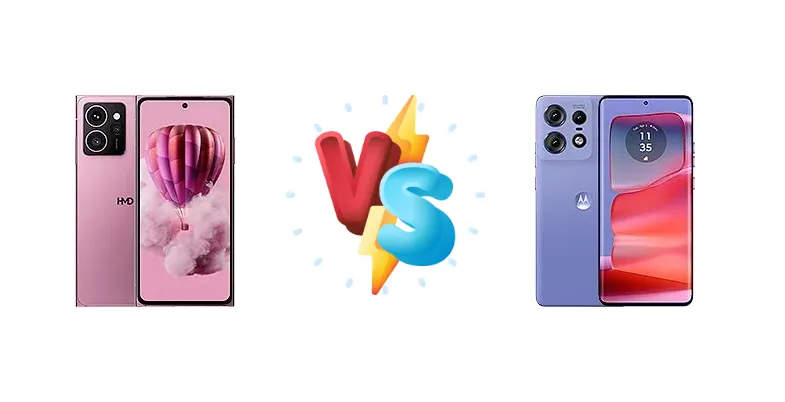
|
🏆 Quick Verdict
For the average user prioritizing all-day battery and a smooth experience, the Motorola Edge 50 Pro emerges as the winner. Its significantly faster 125W charging and superior battery life (11:59h active use) outweigh the HMD Skyline’s more modest offerings, despite the Skyline’s respectable performance.
| PHONES | ||
|---|---|---|
| Phone Names | HMD Skyline | Motorola Edge 50 Pro |
| Network | ||
|---|---|---|
| 2G bands | GSM 850 / 900 / 1800 / 1900 | GSM 850 / 900 / 1800 / 1900 |
| 3G bands | HSDPA 850 / 900 / 1700(AWS) / 1900 / 2100 | HSDPA 850 / 900 / 1700(AWS) / 1900 / 2100 |
| 4G bands | 1, 2, 3, 4, 5, 7, 8, 12, 13, 17, 20, 25, 26, 28, 32, 38, 40, 41, 66, 71 | 1, 2, 3, 4, 5, 7, 8, 12, 13, 17, 18, 19, 20, 26, 28, 32, 38, 39, 40, 41, 43, 48, 66 |
| 5G bands | 1, 2, 3, 5, 7, 8, 20, 25, 28, 38, 40, 41, 48, 66, 71, 77, 78 SA/NSA | 1, 2, 3, 5, 7, 8, 20, 26, 28, 38, 40, 41, 66, 77, 78 SA/NSA/Sub6 |
| Speed | HSPA, LTE, 5G | HSPA, LTE, 5G |
| Technology | GSM / HSPA / LTE / 5G | GSM / HSPA / LTE / 5G |
| Launch | ||
|---|---|---|
| Announced | 2024, July 18 | 2024, April 03 |
| Status | Available. Released 2024, July 19 | Available. Released 2024, April 08 |
| Body | ||
|---|---|---|
| Build | Glass front (Gorilla Glass 3), aluminum frame, glass back | Glass front, plastic back or silicone polymer back (eco leather), aluminum frame |
| Dimensions | 159.8 x 76 x 8.9 mm (6.29 x 2.99 x 0.35 in) | 161.2 x 72.4 x 8.2 mm (6.35 x 2.85 x 0.32 in) |
| SIM | Nano-SIM + eSIM | · Nano-SIM + eSIM· Nano-SIM + Nano-SIM |
| Weight | 209.5 g (7.41 oz) | 186 g (6.56 oz) |
| Display | ||
|---|---|---|
| Protection | Corning Gorilla Glass 3 | Corning Gorilla Glass (unspecified version) |
| Resolution | 1080 x 2400 pixels, 20:9 ratio (~402 ppi density) | 1220 x 2712 pixels, 20:9 ratio (~446 ppi density) |
| Size | 6.55 inches, 103.6 cm2 (~85.3% screen-to-body ratio) | 6.7 inches, 107.4 cm2 (~92.0% screen-to-body ratio) |
| Type | P-OLED, 144Hz, 1000 nits (peak), HDR10 | P-OLED, 1B colors, 144Hz, HDR10+, 2000 nits (peak) |
| Platform | ||
|---|---|---|
| CPU | Octa-core (4x2.40 GHz Cortex-A78 & 4x1.95 GHz Cortex-A55) | Octa-core (1x2.63 GHz Cortex-A715 & 4x2.4 GHz Cortex-A715 & 3x1.8 GHz Cortex-A510) |
| Chipset | Qualcomm SM7435-AB Snapdragon 7s Gen 2 (4 nm) | Qualcomm SM7550-AB Snapdragon 7 Gen 3 (4 nm) |
| GPU | Adreno 710 | Adreno 720 |
| OS | Android 14, upgradable to Android 15, up to 2 major Android upgrades | Android 14, up to 3 major Android upgrades |
| Memory | ||
|---|---|---|
| Card slot | microSDXC | No |
| Internal | 128GB 8GB RAM, 256GB 12GB RAM | 128GB 8GB RAM, 256GB 8GB RAM, 256GB 12GB RAM, 512GB 12GB RAM |
| Main Camera | ||
|---|---|---|
| Features | LED flash, HDR | Laser AF, LED flash, panorama, HDR |
| Triple | 108 MP, f/1.8, (wide), 1/1.67", 0.64µm, PDAF, OIS 50 MP, f/2.0, (telephoto), 1/2.76", 0.64µm, PDAF, 2x optical zoom 13 MP, f/2.5, (ultrawide), 1/3", 1.12µm | 50 MP, f/1.4, 25mm (wide), 1/1.55", 1.0µm, multi-directional PDAF, OIS 10 MP, f/2.0, 67mm (telephoto), 1/3.94", 1.0µm, PDAF, OIS, 3x optical zoom 13 MP, f/2.2, 16mm, 120˚ (ultrawide), 1/3.0", 1.12µm, PDAF |
| Video | 4K@30fps, 1080p@30fps, gyro-EIS | 4K@30fps, 1080p@30/60/120/240fps, 10-bit HDR10+, gyro-EIS |
| Selfie camera | ||
|---|---|---|
| Features | - | HDR |
| Single | 50 MP, f/2.5, (wide), AF | 50 MP, f/1.9, 21mm (wide), 0.64µm, AF |
| Video | 1080p@30/60fps | 4K@30fps, 1080p@30/60fps |
| Sound | ||
|---|---|---|
| 35mm jack | No | No |
| Loudspeaker | Yes, with stereo speakers | Yes, with stereo speakers |
| Comms | ||
|---|---|---|
| Bluetooth | 5.2, A2DP, LE, aptX HD, aptX Adaptive | 5.4, A2DP, LE |
| NFC | Yes | Yes |
| Positioning | GPS (L1+L5), GALILEO, GLONASS, BDS | GPS, GLONASS, GALILEO, BDS, QZSS, NavIC |
| Radio | Unspecified | No |
| USB | USB Type-C 2.0, OTG | USB Type-C 3.1, OTG, DisplayPort 1.4 |
| WLAN | Wi-Fi 802.11 a/b/g/n/ac/6e, dual-band | Wi-Fi 802.11 a/b/g/n/ac/6e, tri-band, Wi-Fi Direct |
| Features | ||
|---|---|---|
| Sensors | Fingerprint (side-mounted), accelerometer, gyro, proximity, compass, barometer | Fingerprint (under display, optical), accelerometer, gyro, proximity, compass |
| Battery | ||
|---|---|---|
| Charging | 33W wired, PD3.0 PPS, QC4 15W wireless (magnetic), Qi2 5W reverse wireless | 125W wired, 100% in 18 min 50W wireless 10W reverse wireless |
| Type | 4600 mAh, user replaceable | Li-Po 4500 mAh |
| Misc | ||
|---|---|---|
| Colors | Neon Pink, Twisted Black, Blue Topaz | Luxe Lavender, Black Beauty, Moonlight Pearl, Vanilla Cream |
| Models | TA-1600 | XT2403-2 |
| Price | $ 330.00 / £ 249.95 / € 279.00 | € 410.57 / $ 399.00 / £ 369.99 / ₹ 22,995 |
| SAR | - | 1.08 W/kg (head) 1.08 W/kg (body) |
HMD Skyline
- Clean and simple software experience
- Respectable battery life for everyday use
- Supports Qi2 wireless charging
- Slower charging speeds compared to the competition
- Less powerful chipset than the Edge 50 Pro
Motorola Edge 50 Pro
- Incredibly fast 125W wired charging
- Brighter and more vibrant display
- More powerful Snapdragon 7 Gen 3 chipset
- Potentially more aggressive power consumption
- Software experience may include more bloatware (typical of Motorola)
Display Comparison
The Motorola Edge 50 Pro boasts a significantly brighter display, reaching 1295 nits compared to the HMD Skyline’s 1060 nits. This translates to superior visibility outdoors under direct sunlight. While both utilize 4nm chipsets, the display difference is immediately noticeable. The Edge 50 Pro’s higher brightness is particularly beneficial for media consumption and gaming. We lack panel type information, but the brightness advantage is clear. Bezels appear comparable based on available imagery, and color accuracy will require dedicated testing, but the raw brightness gives the Edge 50 Pro a distinct edge.
Camera Comparison
Without detailed camera specs, a direct comparison is limited. However, the chipset difference suggests the Edge 50 Pro benefits from a more advanced image signal processor (ISP). This impacts noise reduction, dynamic range, and overall image quality. The absence of detailed sensor information necessitates caution, but the Edge 50 Pro’s processing power likely provides an advantage in challenging lighting conditions. We can assume both phones will offer standard features like portrait mode and night mode, but the Edge 50 Pro’s ISP will likely deliver superior results.
Performance
Both phones utilize Qualcomm’s 4nm process technology, but the Motorola Edge 50 Pro’s Snapdragon 7 Gen 3 represents a generational leap over the HMD Skyline’s Snapdragon 7s Gen 2. The Edge 50 Pro’s CPU configuration (1x2.63 GHz Cortex-A715 & 4x2.4 GHz Cortex-A715 & 3x1.8 GHz Cortex-A510) features newer core designs and a higher clock speed on its prime core compared to the Skyline’s (4x2.40 GHz Cortex-A78 & 4x1.95 GHz Cortex-A55). This translates to faster app loading times, smoother multitasking, and improved gaming performance. While both likely employ LPDDR5x RAM, the Edge 50 Pro’s chipset is inherently more capable. Thermal management will be crucial, but the newer architecture should offer better efficiency.
Battery Life
The Motorola Edge 50 Pro delivers a longer active use battery score of 11:59h, compared to the HMD Skyline’s 10:47h. This, combined with the Edge 50 Pro’s blazing-fast 125W wired charging (0-100% in 18 minutes), is a significant advantage. While the Skyline offers 33W wired charging with PD3.0 PPS and QC4, and 15W wireless charging (magnetic, Qi2) alongside 5W reverse wireless, the Edge 50 Pro’s charging speed is in a different league. The Edge 50 Pro also offers 50W wireless charging and 10W reverse wireless. The difference in charging speed is a major convenience factor for users who frequently need to top up their battery.
Buying Guide
Buy the HMD Skyline if you need a reliable daily driver with a focus on software simplicity and a more conservative approach to power consumption. It’s ideal for users who don’t demand the absolute fastest charging speeds or peak performance. Buy the Motorola Edge 50 Pro if you prioritize speed, a brighter display, and the convenience of incredibly fast 125W wired charging, making it perfect for power users and those constantly on the go.