
HMD Skyline vs Google Pixel 8a: A Deep Dive into Battery, Performance, and Value
| Phones Images | |||||
|---|---|---|---|---|---|
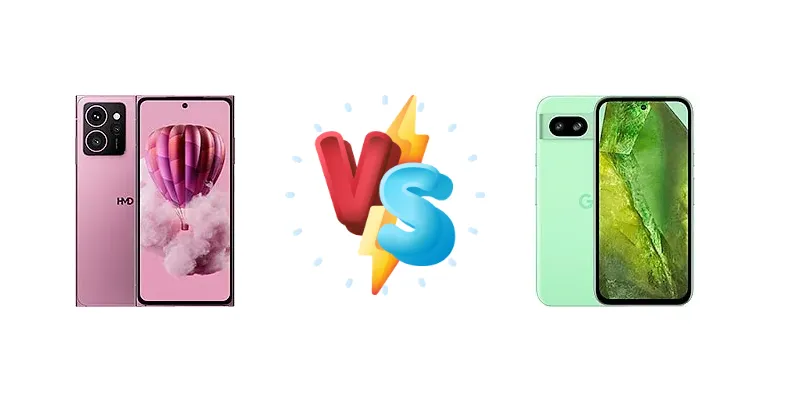
|
🏆 Quick Verdict
For the average user prioritizing all-day battery life and flexible charging options, the HMD Skyline emerges as the winner. While the Pixel 8a boasts a more powerful processor and superior display, the Skyline’s 10:47 active use score and comprehensive charging suite (including Qi2) offer a more practical experience.
| PHONES | ||
|---|---|---|
| Phone Names | HMD Skyline | Google Pixel 8a |
| Network | ||
|---|---|---|
| 2G bands | GSM 850 / 900 / 1800 / 1900 | GSM 850 / 900 / 1800 / 1900 |
| 3G bands | HSDPA 850 / 900 / 1700(AWS) / 1900 / 2100 | HSDPA 800 / 850 / 900 / 1700(AWS) / 1900 / 2100 |
| 4G bands | 1, 2, 3, 4, 5, 7, 8, 12, 13, 17, 20, 25, 26, 28, 32, 38, 40, 41, 66, 71 | 1, 2, 3, 4, 5, 7, 8, 12, 17, 18, 19, 20, 26, 28, 32, 38, 40, 41, 42, 66 - G6GPR (International) |
| 5G bands | 1, 2, 3, 5, 7, 8, 20, 25, 28, 38, 40, 41, 48, 66, 71, 77, 78 SA/NSA | 1, 2, 3, 5, 7, 8, 12, 20, 26, 28, 38, 40, 41, 66, 75, 76, 77, 78 SA/NSA/Sub6 - G6GPR (International) |
| Speed | HSPA, LTE, 5G | HSPA, LTE, 5G |
| Technology | GSM / HSPA / LTE / 5G | GSM / HSPA / LTE / 5G |
| Launch | ||
|---|---|---|
| Announced | 2024, July 18 | 2024, May 07 |
| Status | Available. Released 2024, July 19 | Available. Released 2024, May 14 |
| Body | ||
|---|---|---|
| Build | Glass front (Gorilla Glass 3), aluminum frame, glass back | Glass front (Gorilla Glass 3), aluminum frame, plastic back |
| Dimensions | 159.8 x 76 x 8.9 mm (6.29 x 2.99 x 0.35 in) | 152.1 x 72.7 x 8.9 mm (5.99 x 2.86 x 0.35 in) |
| SIM | Nano-SIM + eSIM | Nano-SIM + eSIM |
| Weight | 209.5 g (7.41 oz) | 188 g (6.63 oz) |
| Display | ||
|---|---|---|
| Protection | Corning Gorilla Glass 3 | Corning Gorilla Glass 3, Mohs level 5 |
| Resolution | 1080 x 2400 pixels, 20:9 ratio (~402 ppi density) | 1080 x 2400 pixels, 20:9 ratio (~430 ppi density) |
| Size | 6.55 inches, 103.6 cm2 (~85.3% screen-to-body ratio) | 6.1 inches, 90.3 cm2 (~81.6% screen-to-body ratio) |
| Type | P-OLED, 144Hz, 1000 nits (peak), HDR10 | OLED, HDR, 120Hz, 2000 nits (peak) |
| Platform | ||
|---|---|---|
| CPU | Octa-core (4x2.40 GHz Cortex-A78 & 4x1.95 GHz Cortex-A55) | Nona-core (1x3.0 GHz Cortex-X3 & 4x2.45 GHz Cortex-A715 & 4x2.15 GHz Cortex-A510) |
| Chipset | Qualcomm SM7435-AB Snapdragon 7s Gen 2 (4 nm) | Google Tensor G3 (4 nm) |
| GPU | Adreno 710 | Immortalis-G715s MC10 |
| OS | Android 14, upgradable to Android 15, up to 2 major Android upgrades | Android 14, upgradable to Android 16, up to 7 major Android upgrades |
| Memory | ||
|---|---|---|
| Card slot | microSDXC | No |
| Internal | 128GB 8GB RAM, 256GB 12GB RAM | 128GB 8GB RAM, 256GB 8GB RAM |
| Main Camera | ||
|---|---|---|
| Dual | - | 64 MP (16 MP eff.), f/1.9, 26mm (wide), 1/1.73", 0.8µm, dual pixel PDAF, OIS 13 MP, f/2.2, 120˚ (ultrawide), 1.12µm |
| Features | LED flash, HDR | Dual-LED flash, Pixel Shift, Ultra HDR, panorama, Best Take |
| Triple | 108 MP, f/1.8, (wide), 1/1.67", 0.64µm, PDAF, OIS 50 MP, f/2.0, (telephoto), 1/2.76", 0.64µm, PDAF, 2x optical zoom 13 MP, f/2.5, (ultrawide), 1/3", 1.12µm | - |
| Video | 4K@30fps, 1080p@30fps, gyro-EIS | 4K@30/60fps, 1080p@30/60/120/240fps, OIS |
| Selfie camera | ||
|---|---|---|
| Features | - | HDR, panorama |
| Single | 50 MP, f/2.5, (wide), AF | 13 MP, f/2.2, 20mm (ultrawide), 1.12µm |
| Video | 1080p@30/60fps | 4K@30fps, 1080p@30/60fps |
| Sound | ||
|---|---|---|
| 35mm jack | No | No |
| Loudspeaker | Yes, with stereo speakers | Yes, with stereo speakers |
| Comms | ||
|---|---|---|
| Bluetooth | 5.2, A2DP, LE, aptX HD, aptX Adaptive | 5.3, A2DP, LE |
| NFC | Yes | Yes |
| Positioning | GPS (L1+L5), GALILEO, GLONASS, BDS | GPS, GLONASS, GALILEO, BDS, QZSS, NavIC |
| Radio | Unspecified | No |
| USB | USB Type-C 2.0, OTG | USB Type-C 3.2 |
| WLAN | Wi-Fi 802.11 a/b/g/n/ac/6e, dual-band | Wi-Fi 802.11 a/b/g/n/ac/6e, dual/tri-band (market/region dependent) |
| Features | ||
|---|---|---|
| Sensors | Fingerprint (side-mounted), accelerometer, gyro, proximity, compass, barometer | Fingerprint (under display, optical), accelerometer, gyro, proximity, compass, barometer |
| Battery | ||
|---|---|---|
| Charging | 33W wired, PD3.0 PPS, QC4 15W wireless (magnetic), Qi2 5W reverse wireless | 18W wired, PD3.0 7.5W wireless Bypass charging |
| Type | 4600 mAh, user replaceable | Li-Po 4492 mAh |
| Misc | ||
|---|---|---|
| Colors | Neon Pink, Twisted Black, Blue Topaz | Obsidian, Porcelain, Bay, Aloe |
| Models | TA-1600 | GKV4X, G6GPR, G8HHN, G576D |
| Price | $ 330.00 / £ 249.95 / € 279.00 | $ 229.98 / C$ 417.99 / £ 279.00 / € 299.99 / ₹ 33,300 |
| EU LABEL | ||
|---|---|---|
| Battery | - | 40:06h endurance, 1000 cycles |
| Energy | - | Class B |
| Free fall | - | Class A (270 falls) |
| Repairability | - | Class B |
HMD Skyline
- Exceptional battery life (10:47h active use)
- Versatile charging options (33W wired, 15W wireless, 5W reverse)
- Qi2 wireless charging support
- Potentially more affordable price point
- Less powerful processor than the Pixel 8a
- Display brightness lower than the Pixel 8a
- Camera specifications are unknown
Google Pixel 8a
- Powerful Google Tensor G3 processor
- Brighter and more vibrant display (1508 nits)
- Superior camera capabilities (Google’s computational photography)
- Long-term battery health (40:06h endurance, 1000 cycles)
- Slower wired charging (18W)
- Limited wireless charging speed (7.5W)
- Slightly shorter active use battery life (11:25h)
Display Comparison
The Google Pixel 8a significantly outshines the HMD Skyline in display technology, achieving a measured peak brightness of 1508 nits compared to the Skyline’s 1060 nits. This difference translates to superior visibility in direct sunlight. While both utilize a 4nm chipset, the Pixel 8a’s display is likely to offer a more immersive viewing experience, though the Skyline’s brightness is still respectable for everyday use. Details regarding panel type (OLED vs LCD) and refresh rate are missing for the Skyline, suggesting a potential cost-saving measure by HMD.
Camera Comparison
Without detailed camera specifications for the HMD Skyline, a direct comparison is challenging. However, Google’s Pixel phones are renowned for their computational photography prowess, and the Pixel 8a is expected to continue this tradition. The Pixel 8a’s image processing capabilities, powered by the Tensor G3, will likely deliver superior dynamic range and detail in challenging lighting conditions. The Skyline will likely rely more on hardware capabilities, and without knowing sensor size or aperture, it's difficult to assess its low-light performance. We can assume the Pixel 8a will offer a more refined and consistent camera experience.
Performance
The Pixel 8a’s Google Tensor G3, a nona-core processor with a Cortex-X3 prime core, offers a clear performance advantage over the HMD Skyline’s Snapdragon 7s Gen 2. The Tensor G3’s architecture (1x3.0 GHz Cortex-X3, 4x2.45 GHz Cortex-A715, 4x2.15 GHz Cortex-A510) is designed for AI tasks and complex processing, while the Snapdragon 7s Gen 2 (4x2.40 GHz Cortex-A78 & 4x1.95 GHz Cortex-A55) focuses on efficiency. This means the Pixel 8a will handle demanding games and applications more smoothly. However, the Snapdragon 7s Gen 2’s 4nm process node contributes to excellent thermal efficiency, potentially mitigating throttling during sustained workloads.
Battery Life
The HMD Skyline delivers an impressive 10:47h active use battery score, but the Google Pixel 8a surpasses it with 11:25h. More significantly, the Pixel 8a boasts a claimed endurance rating of 40:06h and 1000 cycles, suggesting exceptional long-term battery health. While the Skyline offers faster wired charging at 33W (with PD3.0 PPS and QC4 support) compared to the Pixel 8a’s 18W (PD3.0), the Pixel 8a’s ‘bypass charging’ feature minimizes battery degradation during prolonged charging. The Skyline also includes 15W magnetic wireless charging (Qi2) and 5W reverse wireless, offering greater versatility than the Pixel 8a’s 7.5W wireless charging.
Buying Guide
Buy the HMD Skyline if you need exceptional battery life, value fast and versatile charging (wired, wireless, and reverse wireless), and prefer a more straightforward Android experience. Buy the Google Pixel 8a if you prioritize camera quality, Google’s AI features, and a brighter, more vibrant display, and are willing to compromise slightly on battery endurance.