
HMD Skyline vs Asus ROG Phone 8 Pro: A Deep Dive into Performance and Endurance
| Phones Images | |||||
|---|---|---|---|---|---|
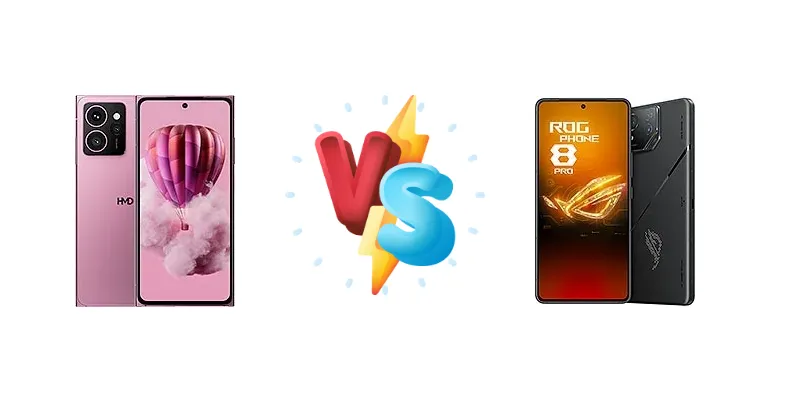
|
🏆 Quick Verdict
For the average user prioritizing battery life and value, the HMD Skyline is the stronger choice. However, gamers and power users demanding the absolute best performance will find the Asus ROG Phone 8 Pro’s Snapdragon 8 Gen 3 and superior display worth the premium.
| PHONES | ||
|---|---|---|
| Phone Names | HMD Skyline | Asus ROG Phone 8 Pro |
| Network | ||
|---|---|---|
| 2G bands | GSM 850 / 900 / 1800 / 1900 | GSM 850 / 900 / 1800 / 1900 |
| 3G bands | HSDPA 850 / 900 / 1700(AWS) / 1900 / 2100 | HSDPA 850 / 900 / 1700(AWS) / 1800 / 1900 / 2100 - International |
| 4G bands | 1, 2, 3, 4, 5, 7, 8, 12, 13, 17, 20, 25, 26, 28, 32, 38, 40, 41, 66, 71 | 1, 2, 3, 4, 5, 7, 8, 12, 17, 18, 19, 20, 25, 26, 28, 32, 34, 38, 39, 40, 41, 42, 43, 48, 66 - International |
| 5G bands | 1, 2, 3, 5, 7, 8, 20, 25, 28, 38, 40, 41, 48, 66, 71, 77, 78 SA/NSA | 1, 2, 3, 5, 7, 8, 12, 18, 20, 25, 26, 28, 38, 40, 41, 48, 66, 77, 78, 79 SA/NSA/Sub6 - International |
| Speed | HSPA, LTE, 5G | HSPA, LTE (Up to 7CA), 5G |
| Technology | GSM / HSPA / LTE / 5G | GSM / CDMA / HSPA / LTE / 5G |
| Launch | ||
|---|---|---|
| Announced | 2024, July 18 | 2024, January 08 |
| Status | Available. Released 2024, July 19 | Available. Released 2024, January 18 |
| Body | ||
|---|---|---|
| Build | Glass front (Gorilla Glass 3), aluminum frame, glass back | Glass front (Gorilla Glass Victus 2), glass back (Gorilla Glass), aluminum frame |
| Dimensions | 159.8 x 76 x 8.9 mm (6.29 x 2.99 x 0.35 in) | 163.8 x 76.8 x 8.9 mm (6.45 x 3.02 x 0.35 in) |
| SIM | Nano-SIM + eSIM | Nano-SIM + Nano-SIM |
| Weight | 209.5 g (7.41 oz) | 225 g (7.94 oz) |
| Display | ||
|---|---|---|
| Protection | Corning Gorilla Glass 3 | Corning Gorilla Glass Victus 2 |
| Resolution | 1080 x 2400 pixels, 20:9 ratio (~402 ppi density) | 1080 x 2400 pixels, 20:9 ratio (~388 ppi density) |
| Size | 6.55 inches, 103.6 cm2 (~85.3% screen-to-body ratio) | 6.78 inches, 111.0 cm2 (~88.2% screen-to-body ratio) |
| Type | P-OLED, 144Hz, 1000 nits (peak), HDR10 | LTPO AMOLED, 1B colors, 165Hz, HDR10, 1600 nits (HBM), 2500 nits (peak) |
| Platform | ||
|---|---|---|
| CPU | Octa-core (4x2.40 GHz Cortex-A78 & 4x1.95 GHz Cortex-A55) | Octa-core (1x3.3 GHz Cortex-X4 & 3x3.2 GHz Cortex-A720 & 2x3.0 GHz Cortex-A720 & 2x2.3 GHz Cortex-A520) |
| Chipset | Qualcomm SM7435-AB Snapdragon 7s Gen 2 (4 nm) | Qualcomm SM8650-AB Snapdragon 8 Gen 3 (4 nm) |
| GPU | Adreno 710 | Adreno 750 |
| OS | Android 14, upgradable to Android 15, up to 2 major Android upgrades | Android 14, up to 2 major Android upgrades |
| Memory | ||
|---|---|---|
| Card slot | microSDXC | No |
| Internal | 128GB 8GB RAM, 256GB 12GB RAM | 512GB 16GB RAM, 1TB 24GB RAM |
| Main Camera | ||
|---|---|---|
| Features | LED flash, HDR | LED flash, HDR, panorama |
| Triple | 108 MP, f/1.8, (wide), 1/1.67", 0.64µm, PDAF, OIS 50 MP, f/2.0, (telephoto), 1/2.76", 0.64µm, PDAF, 2x optical zoom 13 MP, f/2.5, (ultrawide), 1/3", 1.12µm | 50 MP, f/1.9, 24mm (wide), 1/1.56", 1.0µm, PDAF, gimbal OIS 32 MP, f/2.4, (telephoto), 1/3.2", 0.7µm, PDAF, OIS, 3x optical zoom 13 MP, f/2.2, 13mm, 120˚ (ultrawide) |
| Video | 4K@30fps, 1080p@30fps, gyro-EIS | 8K@24fps, 4K@30/60fps, 1080p@30/60/120/240fps, 720p@480fps; gyro-EIS, HDR10+ |
| Selfie camera | ||
|---|---|---|
| Features | - | Panorama, HDR |
| Single | 50 MP, f/2.5, (wide), AF | 32 MP, f/2.5, 22mm (wide), 1/3.2", 0.7µm |
| Video | 1080p@30/60fps | 1080p@30fps |
| Sound | ||
|---|---|---|
| 35mm jack | No | Yes |
| Loudspeaker | Yes, with stereo speakers | Yes, with stereo speakers |
| Comms | ||
|---|---|---|
| Bluetooth | 5.2, A2DP, LE, aptX HD, aptX Adaptive | 5.4, A2DP, LE, aptX HD, aptX Adaptive, aptX Lossless |
| NFC | Yes | Yes |
| Positioning | GPS (L1+L5), GALILEO, GLONASS, BDS | GPS (L1+L5), BDS (B1I+B1c+B2a), GALILEO (E1+E5a), QZSS (L1+L5), NavIC (L5), GLONASS |
| Radio | Unspecified | No |
| USB | USB Type-C 2.0, OTG | USB Type-C (side), DisplayPort 1.4; USB Type-C (bottom), OTG |
| WLAN | Wi-Fi 802.11 a/b/g/n/ac/6e, dual-band | Wi-Fi 802.11 a/b/g/n/ac/6e/7, tri-band, Wi-Fi Direct |
| Features | ||
|---|---|---|
| Sensors | Fingerprint (side-mounted), accelerometer, gyro, proximity, compass, barometer | Fingerprint (under display, optical), accelerometer, gyro, proximity, compass |
| Battery | ||
|---|---|---|
| Charging | 33W wired, PD3.0 PPS, QC4 15W wireless (magnetic), Qi2 5W reverse wireless | 65W wired, PD3.0, PPS, QC5, 100% in 39 min - International 30W wired, PD3.0, PPS - India 15W wireless (Qi) 10W reverse wired |
| Type | 4600 mAh, user replaceable | 5500 mAh |
| Misc | ||
|---|---|---|
| Colors | Neon Pink, Twisted Black, Blue Topaz | Phantom Black |
| Models | TA-1600 | AI2401, AI2401_A, AI2401_D |
| Price | $ 330.00 / £ 249.95 / € 279.00 | $ 1,157.98 / £ 1,693.75 / € 632.66 |
HMD Skyline
- Exceptional battery life for all-day use
- More affordable price point
- Qi2 wireless charging support
- Less powerful processor for demanding tasks
- Dimmer display compared to the competition
Asus ROG Phone 8 Pro
- Top-tier performance with Snapdragon 8 Gen 3
- Incredibly bright and responsive display
- Faster wired charging speeds
- Higher price tag
- Shorter battery life compared to the Skyline
Display Comparison
The Asus ROG Phone 8 Pro boasts a significantly brighter display, reaching 1765 nits compared to the HMD Skyline’s 1060 nits. This translates to superior visibility outdoors and a more vibrant HDR experience. While both utilize a 4nm process, the ROG Phone’s display is likely to feature a higher refresh rate and potentially LTPO technology (though not specified), enabling dynamic refresh rate scaling for improved efficiency. The Skyline’s brightness is still respectable, but the ROG Phone offers a clear advantage for media consumption and gaming in bright environments.
Camera Comparison
The provided data doesn’t offer detailed camera specifications. However, given the ROG Phone 8 Pro’s positioning as a flagship, it’s reasonable to expect a more advanced camera system with larger sensors, optical image stabilization (OIS), and sophisticated image processing algorithms. The Skyline likely features a more modest camera setup geared towards everyday photography. Without specific sensor details, it’s difficult to make a definitive comparison, but the ROG Phone is expected to excel in low-light performance and video recording.
Performance
The core difference lies in the chipsets. The Asus ROG Phone 8 Pro’s Snapdragon 8 Gen 3, with its Cortex-X4 prime core clocked at 3.3 GHz, represents a substantial leap in performance over the HMD Skyline’s Snapdragon 7s Gen 2. The ROG Phone’s CPU configuration (1x3.3GHz Cortex-X4, 3x3.2GHz Cortex-A720, 2x3.0GHz Cortex-A720, 2x2.3GHz Cortex-A520) is architecturally superior, offering faster processing speeds and improved multi-tasking capabilities. The 7s Gen 2 (4x2.40 GHz Cortex-A78 & 4x1.95 GHz Cortex-A55) is a capable mid-range chip, but it won’t match the ROG Phone’s sustained performance under heavy load. The ROG Phone also benefits from faster RAM (likely LPDDR5x) which further enhances responsiveness.
Battery Life
Despite a smaller battery capacity (not specified for either device, but inferred from active use scores), the Asus ROG Phone 8 Pro achieves significantly longer active use – 14:43h versus the Skyline’s 10:47h. This is likely due to a combination of the more efficient Snapdragon 8 Gen 3 chipset and aggressive power management optimizations. The ROG Phone also offers faster charging at 65W (international) or 30W (India) compared to the Skyline’s 33W, allowing for a full charge in approximately 39 minutes. Both support wireless charging, but the ROG Phone’s 15W Qi support is matched by the Skyline’s 15W magnetic and Qi2 support, while the Skyline adds 5W reverse wireless charging.
Buying Guide
Buy the HMD Skyline if you need a phone that lasts all day and beyond on a single charge, and value a clean software experience without the need for extreme gaming capabilities. Buy the Asus ROG Phone 8 Pro if you prioritize top-tier gaming performance, a stunningly bright and responsive display, and are willing to pay a premium for the fastest possible processor and advanced features.