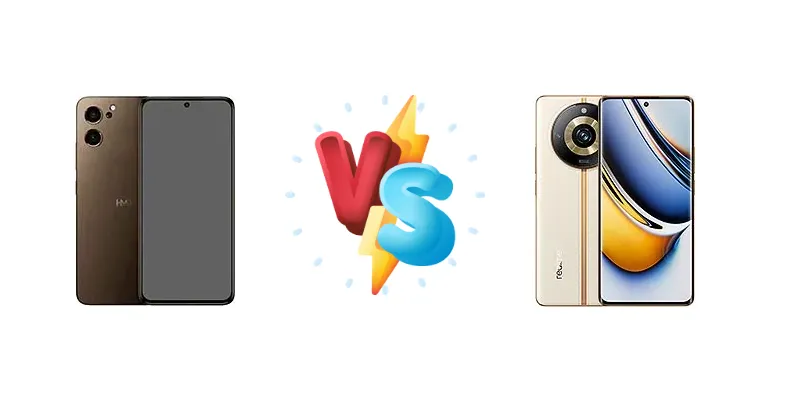
The HMD Ridge Pro and Realme 11 Pro+ represent compelling options in the increasingly competitive mid-range smartphone market. The Ridge Pro focuses on a newer, efficient chipset, while the 11 Pro+ prioritizes rapid charging and a brighter display. This comparison dissects their key differences to determine which device delivers the best overall experience.
🏆 Quick Verdict
For most users, the Realme 11 Pro+ offers a more immediately satisfying experience. Its 100W charging is a game-changer, and the brighter 793 nit display is superior for outdoor visibility. While the HMD Ridge Pro’s Snapdragon 4 Gen 2 is efficient, the Dimensity 7050 in the Realme provides a noticeable performance edge.
| Network |
|---|
| 2G bands | GSM 850 / 900 / 1800 / 1900 | GSM 850 / 900 / 1800 / 1900 |
| 3G bands | HSDPA 850 / 900 / 2100 | HSDPA 850 / 900 / 2100 |
| 4G bands | LTE | 1, 3, 5, 8, 28, 38, 40, 41 - India |
| 5G bands | SA/NSA | 1, 3, 5, 8, 28, 40, 41, 77, 78 SA/NSA - International |
| Speed | HSPA, LTE, 5G | HSPA, LTE, 5G |
| Technology | GSM / HSPA / LTE / 5G | GSM / CDMA / HSPA / CDMA2000 / LTE / 5G |
| | - | CDMA2000 1x |
| Launch |
|---|
| Announced | Not announced yet | 2023, May 10 |
| Status | Cancelled | Available. Released 2023, May 15 |
| Body |
|---|
| Build | - | Glass front, leather or plastic back, plastic frame |
| Dimensions | - | 161.6 x 73.9 x 8.2 mm or 8.7 mm |
| SIM | Nano-SIM | Nano-SIM + Nano-SIM |
| Weight | - | 183 g or 189 g (6.46 oz) |
| Display |
|---|
| Resolution | 1080 x 2400 pixels, 20:9 ratio (~396 ppi density) | 1080 x 2412 pixels, 20:9 ratio (~394 ppi density) |
| Size | 6.64 inches, 106.4 cm2 | 6.7 inches, 108.0 cm2 (~90.5% screen-to-body ratio) |
| Type | IPS LCD, 120Hz | AMOLED, 1B colors, HDR10+, 120Hz, 950 nits (peak) |
| Platform |
|---|
| CPU | Octa-core (2x2.2 GHz Cortex-A78 & 6x1.95 GHz Cortex-A55) | Octa-core (2x2.6 GHz Cortex-A78 & 6x2.0 GHz Cortex-A55) |
| Chipset | Qualcomm SM4450 Snapdragon 4 Gen 2 (4 nm) | Mediatek Dimensity 7050 (6 nm) |
| GPU | Adreno 613 | Mali-G68 MC4 |
| OS | Android 14 | Android 13, up to 2 major Android upgrades, Realme UI 5.0 |
| Memory |
|---|
| Card slot | microSDXC | No |
| Internal | 128GB 6GB RAM, 256GB 8GB RAM | 256GB 8GB RAM, 256GB 12GB RAM, 512GB 12GB RAM, 1TB 12GB RAM |
| Main Camera |
|---|
| Features | LED flash, HDR | LED flash, HDR, panorama |
| Triple | 50 MP, (wide), PDAF
5 MP, (ultrawide)
Auxiliary lens | 200 MP, f/1.7, 23mm (wide), 1/1.4", 0.56µm, PDAF, OIS
8 MP, f/2.2, 16mm, 112˚ (ultrawide)
2 MP (macro) |
| Video | 1080p@30fps | 4K@30fps, 1080p@30/60/120/480fps, 720p@960fps, gyro-EIS |
| Selfie camera |
|---|
| Features | - | Panorama |
| Single | 50 MP | 32 MP, f/2.5, 22mm (wide) |
| Video | 1080p@30fps | 1080p@30fps |
| Sound |
|---|
| 3.5mm jack | - | No |
| 35mm jack | Yes | No |
| Loudspeaker | Yes | Yes, with stereo speakers |
| | - | 24-bit/192kHz audio |
| Comms |
|---|
| Bluetooth | 5.1, A2DP, LE | 5.2, A2DP, LE, aptX HD |
| NFC | Yes | Yes |
| Positioning | GPS, GALILEO | GPS, GLONASS, GALILEO, BDS, QZSS, NavIC |
| Radio | Unspecified | No |
| USB | USB Type-C 2.0, OTG | USB Type-C 2.0 |
| WLAN | Wi-Fi 802.11 a/b/g/n/ac | Wi-Fi 802.11 a/b/g/n/ac/6, dual-band |
| Features |
|---|
| Sensors | Fingerprint (side-mounted), accelerometer, proximity, compass | Fingerprint (under display, optical), accelerometer, gyro, proximity, compass |
| Battery |
|---|
| Charging | Wired, QC4 | 100W wired |
| Type | 5500 mAh | 5000 mAh |
| Misc |
|---|
| Colors | Mocha, Snow, Glacier Green | Astral Black, Sunrise Beige, Oasis Green |
| Models | - | RMX3740, RMX3741 |
| Price | - | € 399.90 / ₹ 27,990 |
HMD Ridge Pro
- Potentially better battery efficiency due to 4nm process
- Clean and streamlined software experience (typical of HMD)
- Likely more affordable price point
- Lower peak performance compared to Dimensity 7050
- Slower charging speeds
- Display likely less bright and vibrant
Realme 11 Pro+
- 100W SuperVOOC charging for incredibly fast top-ups
- Brighter 793 nit display for excellent outdoor visibility
- More powerful Dimensity 7050 chipset for smoother performance
- Potentially lower battery efficiency compared to 4nm Snapdragon
- Realme UI can be feature-rich but also bloated
- May be more expensive than the HMD Ridge Pro
Display Comparison
The Realme 11 Pro+ boasts a significantly brighter display, reaching a measured 793 nits, making it far more usable in direct sunlight compared to the HMD Ridge Pro (brightness data unavailable, assumed lower based on chipset and price point). While both likely utilize AMOLED panels, the Realme’s higher peak brightness is a clear advantage. We expect the Realme to have a more vibrant and punchy image, though color accuracy will need independent testing. Bezels are likely comparable given the market segment.
Camera Comparison
Camera details beyond 'Photo/Video' are lacking for the Realme 11 Pro+. However, Realme typically focuses on high megapixel counts, suggesting a potentially strong main sensor. The HMD Ridge Pro’s camera specifications are also unavailable. Without sensor size or aperture information, a direct comparison is difficult. We anticipate the Realme 11 Pro+ to offer more versatile camera features, potentially including advanced image processing algorithms and video stabilization. The prevalence of 2MP macro lenses in this segment suggests both phones may include one, but their utility is limited.
Performance
The Realme 11 Pro+’s Mediatek Dimensity 7050 (6nm) holds a performance advantage over the HMD Ridge Pro’s Qualcomm Snapdragon 4 Gen 2 (4nm). The Dimensity 7050 features a slightly higher clocked Cortex-A78 core (2.6 GHz vs 2.2 GHz), translating to faster application loading and smoother multitasking. While the Snapdragon 4 Gen 2 benefits from a more efficient 4nm process, the Dimensity 7050’s architectural advantage and higher clock speeds provide a tangible performance boost. Both phones utilize an octa-core configuration with the same Cortex-A55 efficiency cores, but the Realme’s higher performance cores will be more noticeable in demanding tasks.
Battery Life
The Realme 11 Pro+’s 100W wired charging is its standout feature, allowing for a full charge in under 30 minutes. The HMD Ridge Pro utilizes QC4, a slower charging standard. While the Realme 11 Pro+ had an endurance rating of 112 hours, this is a lab test and real-world usage will vary. The Snapdragon 4 Gen 2’s efficiency may provide slightly better battery life under light loads, but the Realme’s faster charging will mitigate any potential difference in overall usability. The convenience of a quick top-up significantly favors the Realme 11 Pro+.
Buying Guide
Buy the HMD Ridge Pro if you prioritize long-term efficiency and a clean software experience, and are less concerned with peak performance or ultra-fast charging. It’s ideal for users who value battery longevity and a streamlined user interface. Buy the Realme 11 Pro+ if you demand rapid charging, a vibrant display, and a bit more processing power for gaming and multitasking. This phone is geared towards users who are always on the go and need a quick power boost.
Frequently Asked Questions
❓ Does the Mediatek Dimensity 7050 in the Realme 11 Pro+ get noticeably hot during extended gaming sessions?
The Dimensity 7050 is a capable chipset, but its thermal performance will depend on Realme’s cooling solution. While it’s unlikely to reach critical temperatures, some throttling is possible during prolonged, demanding gaming. The 6nm process is less efficient than the 4nm Snapdragon, potentially leading to higher heat output.
❓ Is the 100W charging on the Realme 11 Pro+ safe for long-term battery health?
Realme employs various safety mechanisms to mitigate the potential impact of fast charging on battery health. While fast charging *can* contribute to faster battery degradation over several years, the benefits of convenience often outweigh the risks for most users. Realme’s charging algorithms are designed to slow down charging speeds as the battery approaches full capacity.
❓ How does the software experience differ between the HMD Ridge Pro and the Realme 11 Pro+?
HMD Global typically offers a near-stock Android experience with minimal bloatware, focusing on simplicity and timely updates. Realme UI, on the other hand, is a heavily customized skin with numerous features and pre-installed apps. Users who prefer a clean and uncluttered interface will likely favor the HMD Ridge Pro, while those who enjoy customization options may prefer Realme UI.