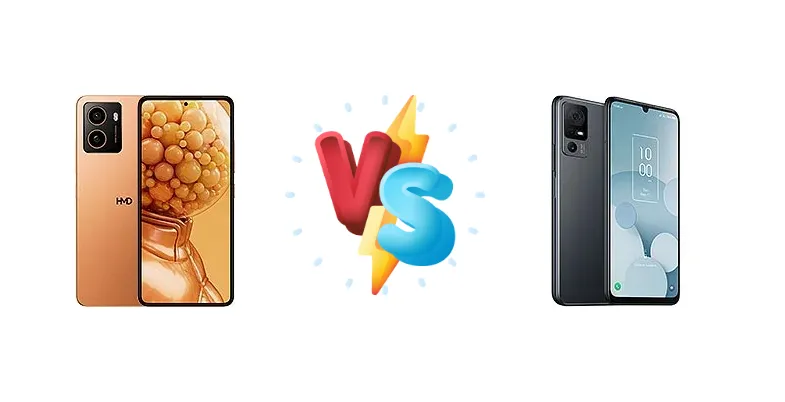
The HMD Pulse+ and TCL 40 XL represent compelling options in the ultra-budget smartphone space, but cater to slightly different priorities. The Pulse+ aims for a clean Android experience and broad availability, while the TCL 40 XL focuses on a larger display and faster charging. This comparison dissects their core components to determine which delivers the best value.
🏆 Quick Verdict
For most users, the TCL 40 XL emerges as the better choice. Its MediaTek Helio G37 chipset, while utilizing older Cortex-A53 cores, boasts a higher clock speed, translating to noticeably snappier performance in everyday tasks. The 18W charging also significantly reduces downtime compared to the Pulse+'s 10W charging.
| Network |
|---|
| 2G bands | GSM 850 / 900 / 1800 / 1900 | GSM 850 / 900 / 1800 / 1900 |
| 3G bands | HSDPA 850 / 900 / 2100 | HSDPA 850 / 1700(AWS) / 1900 - USA |
| 4G bands | 1, 3, 5, 7, 8, 20, 28, 38, 40 | 2, 4, 5, 12, 13, 25, 26, 41, 66, 71 - USA |
| Speed | HSPA, LTE | HSPA, LTE |
| Technology | GSM / HSPA / LTE | GSM / HSPA / LTE |
| Launch |
|---|
| Announced | 2024, April 24 | 2023, February 26 |
| Status | Available. Released 2024, April 29 | Available. Released 2023, May |
| Body |
|---|
| Build | - | Glass front, plastic frame, plastic back |
| Dimensions | 163.2 x 75 x 8.5 mm (6.43 x 2.95 x 0.33 in) | 167.9 x 76.5 x 8.8 mm (6.61 x 3.01 x 0.35 in) |
| SIM | Nano-SIM | · Nano-SIM + eSIM· Nano-SIM + Nano-SIM |
| Weight | 187 g (6.60 oz) | 195 g (6.88 oz) |
| Display |
|---|
| Resolution | 720 x 1612 pixels, 20:9 ratio (~265 ppi density) | 720 x 1600 pixels, 20:9 ratio (~260 ppi density) |
| Size | 6.65 inches, 106.2 cm2 (~86.8% screen-to-body ratio) | 6.75 inches, 110.0 cm2 (~85.6% screen-to-body ratio) |
| Type | IPS LCD, 90Hz, 480 nits (typ), 600 nits (HBM) | IPS LCD, 90Hz |
| Platform |
|---|
| CPU | Octa-core (2x1.6 GHz Cortex-A75 & 6x1.6 GHz Cortex-A55) | Octa-core (4x2.3 GHz Cortex-A53 & 4x1.8 GHz Cortex-A53) |
| Chipset | Unisoc T606 (12 nm) | Mediatek MT6765 Helio G37 (12 nm) |
| GPU | Mali-G57 MP1 | PowerVR GE8320 |
| OS | Android 14 | Android 13, TCL UI |
| Memory |
|---|
| Card slot | microSDXC | microSDXC |
| Internal | 128GB 4GB RAM, 128GB 6GB RAM, 128GB 8GB RAM | 128GB 4GB RAM, 256GB 6GB RAM |
| Main Camera |
|---|
| Features | LED flash, HDR | LED flash, HDR, panorama |
| Single | 50 MP, (wide), AF
Auxiliary lens | 8 MP, (wide) |
| Triple | - | 50 MP, (wide), PDAF
2 MP (macro)
Auxiliary lens |
| Video | 1080p@30fps | 1080p@30fps |
| Selfie camera |
|---|
| Single | 8 MP | 8 MP, (wide) |
| Video | Yes | 1080p@30fps |
| Sound |
|---|
| 3.5mm jack | - | Yes |
| 35mm jack | Yes | Yes |
| Loudspeaker | Yes | Yes, with dual speakers |
| Comms |
|---|
| Bluetooth | 5.0, A2DP, LE | 5.1, A2DP, LE |
| NFC | Yes | No |
| Positioning | GPS, GALILEO | GPS |
| Radio | Unspecified | FM radio |
| USB | USB Type-C 2.0, OTG | USB Type-C 2.0 |
| WLAN | Wi-Fi 802.11 a/b/g/n/ac | Wi-Fi 802.11 a/b/g/n/ac, dual-band, Wi-Fi Direct |
| Features |
|---|
| Sensors | Fingerprint (side-mounted), accelerometer, proximity, compass | Fingerprint (side-mounted), accelerometer, gyro, proximity, compass, barometer |
| Battery |
|---|
| Charging | 10W wired | 18W wired |
| Type | 5000 mAh, user replaceable | Li-Ion 5000 mAh |
| Misc |
|---|
| Colors | Apricot Crush, Midnight Blue, Glacier Green | Dark Gray |
| Models | - | T608M |
| Price | About 90 EUR | About 140 EUR |
HMD Pulse+
- Potential for longer software support from HMD
- Clean Android experience
- Potentially better power efficiency with Unisoc T606
- Slower 10W charging
- Less powerful chipset for demanding tasks
- Likely lower responsiveness in everyday use
TCL 40 XL
- Faster 18W charging
- Higher clocked CPU for better responsiveness
- Likely smoother performance in common apps
- Older Cortex-A53 CPU architecture
- Potentially less frequent software updates
- May have less efficient power management
Display Comparison
Neither device boasts a standout display. Both utilize 12nm chipsets, suggesting similar power constraints impacting display capabilities. While specific panel technologies aren't provided, the TCL 40 XL's larger size likely offers a more immersive viewing experience. However, without knowing the peak brightness or color gamut coverage, it's difficult to definitively declare a winner. Expect both to be adequate for basic consumption, but not ideal for outdoor use in direct sunlight.
Camera Comparison
Without detailed sensor information, a direct camera comparison is challenging. Both phones likely feature budget-oriented camera setups. The absence of OIS on either device suggests image stabilization will rely heavily on software processing. Lens apertures are unknown, but larger apertures generally improve low-light performance. Given the price point, expect both to produce acceptable photos in good lighting conditions, but struggle in challenging environments. The TCL 40 XL may have a slight edge if it incorporates a larger main sensor, but this is speculative.
Performance
The core difference lies in the chipsets. The HMD Pulse+ features the Unisoc T606, employing a mix of Cortex-A75 and A55 cores. While the A75 cores offer higher individual performance, the TCL 40 XL’s Helio G37 utilizes four Cortex-A53 cores clocked at a significantly higher 2.3 GHz. This higher clock speed, despite the older architecture, likely results in better responsiveness for common tasks like browsing and social media. The Unisoc T606’s architecture is more modern, potentially offering better efficiency, but the TCL 40 XL’s raw clock speed advantage is likely more noticeable in real-world use. Both devices will struggle with demanding games, but the TCL 40 XL may offer slightly smoother performance.
Battery Life
Battery capacity isn't specified, but the charging wattage difference is significant. The TCL 40 XL’s 18W charging is a clear advantage over the HMD Pulse+'s 10W charging. This translates to a much faster 0-100% charge time, reducing downtime. Even with a similar battery capacity, the faster charging speed makes the TCL 40 XL more convenient for users who frequently need to top up their phone throughout the day. The Unisoc T606’s potentially better efficiency might offset some of this, but the charging speed difference is substantial.
Buying Guide
Buy the HMD Pulse+ if you prioritize a guaranteed software update path and a minimalist Android experience. It's a solid choice for users who value simplicity and long-term support. Buy the TCL 40 XL if you need a phone that feels more responsive for daily use, and if faster charging is a critical factor. It’s better suited for users who frequently use apps and want a quicker top-up.
Frequently Asked Questions
❓ Will the TCL 40 XL's Helio G37 struggle with popular games like PUBG Mobile?
Yes, the Helio G37 is not a gaming-focused chipset. While it may run PUBG Mobile at lower settings, expect frame drops and lag, especially during intense action. The HMD Pulse+ will likely offer a similar gaming experience, neither phone is ideal for serious mobile gaming.
❓ How long will it take to fully charge each phone from 0%?
With 18W charging, the TCL 40 XL should fully charge in approximately 2-3 hours, depending on battery capacity. The HMD Pulse+'s 10W charging will likely take 4-5 hours for a full charge, making it less convenient for users who need a quick top-up.
❓ Does either phone support any form of fast charging protocols beyond standard USB Power Delivery?
Neither HMD nor TCL explicitly advertise support for proprietary fast charging protocols like Quick Charge or VOOC. Both rely on standard USB Power Delivery, meaning the 18W charger for the TCL 40 XL will only deliver 18W if a compatible charger and cable are used.
❓ Which phone is likely to receive more Android version updates?
HMD Global has a better track record of providing software updates for its phones, even budget models. While not guaranteed, the HMD Pulse+ is more likely to receive at least one major Android version update compared to the TCL 40 XL.