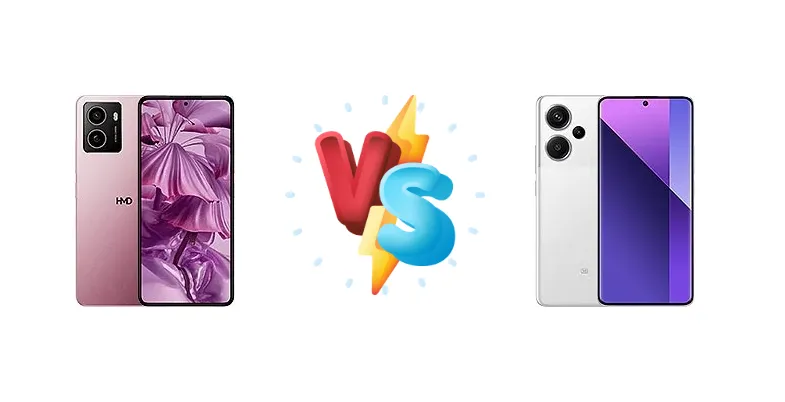
The smartphone market is flooded with options, but finding the right balance between price and performance can be challenging. We pit the HMD Pulse, a newcomer focused on essential functionality, against the Xiaomi Redmi Note 13 Pro+, a feature-packed device aiming for a more premium experience. This comparison will dissect their core components to determine which phone best suits your needs.
🏆 Quick Verdict
For the average user prioritizing speed, display quality, and rapid charging, the Xiaomi Redmi Note 13 Pro+ is the clear winner. Its Dimensity 7200 Ultra chipset and 120W charging significantly outperform the HMD Pulse's Unisoc T606 and 10W charging, justifying the price difference.
| Network |
|---|
| 2G bands | GSM 850 / 900 / 1800 / 1900 | GSM 850 / 900 / 1800 / 1900 |
| 3G bands | HSDPA 850 / 900 / 2100 | HSDPA 800 / 850 / 900 / 1700(AWS) / 1900 / 2100 - International |
| 4G bands | 1, 3, 5, 7, 8, 20, 28, 38, 40 | 1, 2, 3, 4, 5, 7, 8, 12, 13, 17, 18, 19, 20, 26, 28, 32, 38, 40, 41, 66 - International |
| 5G bands | - | 1, 3, 5, 7, 8, 20, 28, 38, 40, 41, 66, 77, 78 SA/NSA- International |
| Speed | HSPA, LTE | HSPA, LTE, 5G |
| Technology | GSM / HSPA / LTE | GSM / CDMA / HSPA / EVDO / LTE / 5G |
| Launch |
|---|
| Announced | 2024, April 24 | 2023, September 21 |
| Status | Available. Released 2024, April 24 | Available. Released 2023, September 21 |
| Body |
|---|
| Build | - | Glass front (Gorilla Glass Victus), glass back or silicone polymer back (eco leather) |
| Dimensions | 163.2 x 75 x 8.5 mm (6.43 x 2.95 x 0.33 in) | 161.4 x 74.2 x 8.9 mm (6.35 x 2.92 x 0.35 in) |
| SIM | Nano-SIM | · Nano-SIM + eSIM· Nano-SIM + Nano-SIM |
| Weight | 187 g (6.60 oz) | 199 g or 204.5 g (7.02 oz) |
| Display |
|---|
| Protection | - | Corning Gorilla Glass Victus |
| Resolution | 720 x 1612 pixels, 20:9 ratio (~265 ppi density) | 1220 x 2712 pixels, 20:9 ratio (~446 ppi density) |
| Size | 6.65 inches, 106.2 cm2 (~86.8% screen-to-body ratio) | 6.67 inches, 107.4 cm2 (~89.7% screen-to-body ratio) |
| Type | IPS LCD, 90Hz, 480 nits (typ), 600 nits (HBM) | AMOLED, 68B colors, 120Hz, 1920Hz PWM, Dolby Vision, HDR10+, 1800 nits (peak) |
| Platform |
|---|
| CPU | Octa-core (2x1.6 GHz Cortex-A75 & 6x1.6 GHz Cortex-A55) | Octa-core (2x2.8 GHz Cortex-A715 & 6x2.0 GHz Cortex-A510) |
| Chipset | Unisoc T606 (12 nm) | Mediatek Dimensity 7200 Ultra (4 nm) |
| GPU | Mali-G57 MP1 | Mali-G610 MC4 |
| OS | Android 14 | Android 13, up to 3 major Android upgrades, HyperOS |
| Memory |
|---|
| Card slot | microSDXC | No |
| Internal | 64GB 4GB RAM, 64GB 6GB RAM | 256GB 8GB RAM, 256GB 12GB RAM, 512GB 8GB RAM, 512GB 12GB RAM, 512GB 16GB RAM |
| Main Camera |
|---|
| Features | LED flash, HDR | Dual-LED dual-tone flash, HDR, panorama |
| Single | 13 MP, (wide), AF
Auxiliary lens | - |
| Triple | - | 200 MP, f/1.7, 23mm (wide), 1/1.4", 0.56µm, multi-directional PDAF, OIS
8 MP, f/2.2, 16mm, 120˚ (ultrawide), 1/4.0", 1.12µm
2 MP (macro) |
| Video | 1080p@30fps | 4K@24/30fps, 1080p@30/60/120fps, gyro-EIS |
| Selfie camera |
|---|
| Features | - | HDR, panorama |
| Single | 8 MP | 16 MP, f/2.4, (wide) |
| Video | Yes | 1080p@30/60fps |
| Sound |
|---|
| 35mm jack | Yes | No |
| Loudspeaker | Yes | Yes, with stereo speakers |
| Comms |
|---|
| Bluetooth | 5.0, A2DP, LE | 5.3, A2DP, LE |
| Infrared port | - | Yes |
| NFC | Yes | Yes (market/region dependent) |
| Positioning | GPS, GALILEO | GPS, GLONASS, BDS, GALILEO, QZSS |
| Radio | Unspecified | No |
| USB | USB Type-C 2.0, OTG | USB Type-C 2.0, OTG |
| WLAN | Wi-Fi 802.11 a/b/g/n/ac | Wi-Fi 802.11 a/b/g/n/ac/6, dual-band, Wi-Fi Direct |
| Features |
|---|
| Sensors | Fingerprint (side-mounted), accelerometer, proximity, compass | Fingerprint (under display, optical), accelerometer, gyro, proximity, compass |
| Battery |
|---|
| Charging | 10W wired | 120W wired, PD3.0, 100% in 19 min |
| Type | 5000 mAh, user replaceable | Li-Po 5000 mAh |
| Misc |
|---|
| Colors | Meteor Black, Dreamy Pink, Atmos Blue | Midnight Black (Fushion Black), Moonlight White (Fushion White), Aurora Purple, Fushion Purple, Camo Green |
| Models | - | 23090RA98C, 23090RA98G, 23090RA98I |
| Price | About 90 EUR | $ 299.98 / £ 299.00 / € 208.98 / ₹ 24,999 |
| SAR | - | 1.09 W/kg (head) 0.85 W/kg (body) |
| SAR EU | - | 0.98 W/kg (head) 1.00 W/kg (body) |
HMD Pulse
- Extremely affordable price point
- Clean and simple software experience
- Potential for long-term software support (HMD's promise)
- Slow 10W charging
- Underpowered Unisoc T606 chipset
- Likely lower display quality
Xiaomi Redmi Note 13 Pro+
- Blazing-fast 120W charging
- Powerful Mediatek Dimensity 7200 Ultra chipset
- Bright and vibrant display (1283 nits)
- Higher price tag
- Potential for software bloat (Xiaomi's MIUI)
- Larger size and weight
Display Comparison
The Xiaomi Redmi Note 13 Pro+ boasts a significantly brighter display, reaching a measured peak of 1283 nits, compared to the HMD Pulse’s unspecified brightness. This higher brightness translates to better visibility outdoors under direct sunlight. While the HMD Pulse’s panel technology isn’t specified, the Redmi Note 13 Pro+ likely utilizes an AMOLED panel, offering superior contrast and color accuracy. The Redmi Note 13 Pro+’s display is geared towards media consumption and gaming, while the HMD Pulse is likely optimized for power efficiency.
Camera Comparison
Without detailed camera specifications for the HMD Pulse, a direct comparison is limited. However, the Redmi Note 13 Pro+ likely features a more advanced camera system, potentially including a higher resolution main sensor and optical image stabilization (OIS). The Redmi Note 13 Pro+’s image processing capabilities, driven by the Dimensity 7200 Ultra’s ISP, will likely deliver superior image quality, especially in low-light conditions. While the HMD Pulse may suffice for casual snapshots, the Redmi Note 13 Pro+ caters to users who prioritize photography.
Performance
The performance gap between these two devices is substantial. The Xiaomi Redmi Note 13 Pro+ is powered by the Mediatek Dimensity 7200 Ultra, a 4nm chipset featuring Cortex-A715 cores clocked at 2.8 GHz. This architecture provides a significant leap in CPU and GPU performance compared to the HMD Pulse’s Unisoc T606 (12nm) with its Cortex-A75 cores at 1.6 GHz. The 4nm process node of the Dimensity 7200 Ultra also contributes to better thermal efficiency, reducing the likelihood of performance throttling during extended use. The Redmi Note 13 Pro+ is designed for demanding applications and gaming, while the HMD Pulse is better suited for everyday tasks.
Battery Life
The Redmi Note 13 Pro+ excels in battery charging, supporting 120W wired charging, capable of reaching 100% in just 19 minutes. This is a massive advantage over the HMD Pulse’s slow 10W charging. While the Redmi Note 13 Pro+’s battery capacity isn’t specified, its active use score of 10:38h demonstrates excellent battery life. The HMD Pulse, lacking fast charging, will require significantly longer to replenish its battery, making the Redmi Note 13 Pro+ the preferred choice for users who need quick top-ups.
Buying Guide
Buy the HMD Pulse if you need a simple, reliable smartphone for basic tasks like calls, texts, and light social media use, and prioritize affordability above all else. You'll appreciate its clean software experience and long-term software support promises. Buy the Xiaomi Redmi Note 13 Pro+ if you prefer a vibrant display, fast performance for gaming and multitasking, and the convenience of incredibly fast charging – even if it means a higher upfront cost.
Frequently Asked Questions
❓ Is the 120W charging on the Redmi Note 13 Pro+ safe for the battery's long-term health?
Xiaomi employs multiple layers of safety protocols, including temperature monitoring and optimized charging algorithms, to mitigate the potential impact of fast charging on battery health. While all batteries degrade over time, the Redmi Note 13 Pro+'s charging system is designed to minimize this effect.
❓ How does the Unisoc T606 in the HMD Pulse handle multitasking and app switching?
The Unisoc T606 is a capable chipset for basic multitasking, such as switching between messaging apps and web browsing. However, it may struggle with demanding applications or running multiple resource-intensive apps simultaneously. Expect some slowdowns when pushing the HMD Pulse to its limits.
❓ Does the Redmi Note 13 Pro+ support popular gaming titles like PUBG Mobile and Genshin Impact?
Yes, the Redmi Note 13 Pro+’s Dimensity 7200 Ultra chipset is powerful enough to run PUBG Mobile and Genshin Impact at medium to high settings. While it may not achieve the highest frame rates, it provides a smooth and enjoyable gaming experience.
❓ What kind of software updates can HMD Pulse users expect?
HMD Global has committed to providing a certain number of years of software updates and security patches for the HMD Pulse. This commitment is a key selling point for users who prioritize long-term software support and security.