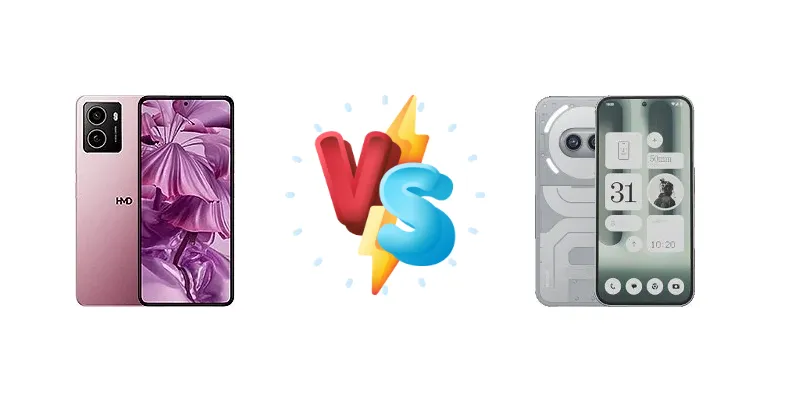
The HMD Pulse and Nothing Phone (2a) Plus represent distinct approaches to the affordable smartphone market. The HMD Pulse aims for extreme value, while the Nothing Phone (2a) Plus attempts to deliver a more refined experience with a focus on performance and faster charging. This comparison dissects their key differences to determine which device best suits your priorities.
🏆 Quick Verdict
For the average user prioritizing performance and a smoother overall experience, the Nothing Phone (2a) Plus is the clear winner. Its significantly more powerful Dimensity 7350 Pro chipset and 50W charging capability justify the price difference, offering a substantial upgrade over the HMD Pulse's Unisoc T606.
| Network |
|---|
| 2G bands | GSM 850 / 900 / 1800 / 1900 | GSM 850 / 900 / 1800 / 1900 |
| 3G bands | HSDPA 850 / 900 / 2100 | HSDPA 800 / 850 / 900 / 1700(AWS) / 1900 / 2100 |
| 4G bands | 1, 3, 5, 7, 8, 20, 28, 38, 40 | 1, 3, 4, 5, 7, 8, 18, 19, 20, 26, 28, 38, 39, 40, 41, 42, 66 |
| 5G bands | - | 1, 3, 5, 7, 8, 20, 28, 38, 40, 41, 66, 77, 78 SA/NSA |
| Speed | HSPA, LTE | HSPA, LTE, 5G |
| Technology | GSM / HSPA / LTE | GSM / HSPA / LTE / 5G |
| Launch |
|---|
| Announced | 2024, April 24 | 2024, July 31 |
| Status | Available. Released 2024, April 24 | Available. Released 2024, August 03 |
| Body |
|---|
| Build | - | Glass front (Gorilla Glass 5), plastic frame, plastic back |
| Dimensions | 163.2 x 75 x 8.5 mm (6.43 x 2.95 x 0.33 in) | 161.7 x 76.3 x 8.5 mm (6.37 x 3.00 x 0.33 in) |
| SIM | Nano-SIM | Nano-SIM + Nano-SIM |
| Weight | 187 g (6.60 oz) | 190 g (6.70 oz) |
| Display |
|---|
| Protection | - | Corning Gorilla Glass 5 |
| Resolution | 720 x 1612 pixels, 20:9 ratio (~265 ppi density) | 1080 x 2412 pixels, 20:9 ratio (~395 ppi density) |
| Size | 6.65 inches, 106.2 cm2 (~86.8% screen-to-body ratio) | 6.7 inches, 107.5 cm2 (~87.1% screen-to-body ratio) |
| Type | IPS LCD, 90Hz, 480 nits (typ), 600 nits (HBM) | AMOLED, 1B colors, 120Hz, 2160Hz PWM, HDR10+, 700 nits (typ), 1100 nits (HBM), 1300 nits (peak) |
| Platform |
|---|
| CPU | Octa-core (2x1.6 GHz Cortex-A75 & 6x1.6 GHz Cortex-A55) | Octa-core (2x3.0 GHz Cortex-A715 & 6x 2.0 GHz Cortex-A510) |
| Chipset | Unisoc T606 (12 nm) | Mediatek Dimensity 7350 Pro (4 nm) |
| GPU | Mali-G57 MP1 | Mali-G610 MC4 |
| OS | Android 14 | Android 14, up to 3 major Android upgrades, Nothing OS 3.0 |
| Memory |
|---|
| Card slot | microSDXC | No |
| Internal | 64GB 4GB RAM, 64GB 6GB RAM | 256GB 8GB RAM, 256GB 12GB RAM |
| Main Camera |
|---|
| Dual | - | 50 MP, f/1.9, 24mm (wide), 1/1.57", 1.0µm, PDAF, OIS
50 MP, f/2.2, 114˚ (ultrawide), 1/2.76", 0.64µm |
| Features | LED flash, HDR | LED flash, panorama, HDR |
| Single | 13 MP, (wide), AF
Auxiliary lens | - |
| Video | 1080p@30fps | 4K@30fps, 1080p@60/120fps, gyro-EIS |
| Selfie camera |
|---|
| Features | - | HDR |
| Single | 8 MP | 50 MP, f/2.2, (wide), 1/2.76" |
| Video | Yes | 4K@30fps |
| Sound |
|---|
| 35mm jack | Yes | No |
| Loudspeaker | Yes | Yes, with stereo speakers |
| Comms |
|---|
| Bluetooth | 5.0, A2DP, LE | 5.3, A2DP, LE |
| NFC | Yes | Yes, 360˚ |
| Positioning | GPS, GALILEO | GPS, GALILEO, GLONASS, BDS, QZSS |
| Radio | Unspecified | No |
| USB | USB Type-C 2.0, OTG | USB Type-C 2.0, OTG |
| WLAN | Wi-Fi 802.11 a/b/g/n/ac | Wi-Fi 802.11 a/b/g/n/ac/6, dual-band, Wi-Fi Direct |
| Features |
|---|
| Sensors | Fingerprint (side-mounted), accelerometer, proximity, compass | Fingerprint (under display, optical), accelerometer, gyro, proximity, compass |
| Battery |
|---|
| Charging | 10W wired | 50W wired, 50% in 21 min, 100% in 56 min |
| Type | 5000 mAh, user replaceable | 5000 mAh |
| Misc |
|---|
| Colors | Meteor Black, Dreamy Pink, Atmos Blue | Black, Grey |
| Models | - | A142P |
| Price | About 90 EUR | € 269.90 / ₹ 22,599 |
HMD Pulse
- Extremely affordable price point
- Potentially longer battery life due to less powerful chipset
- Simple and straightforward user experience
- Significantly slower performance
- Slow 10W charging
- Likely lower quality display
Nothing Phone (2a) Plus
- Much faster performance with Dimensity 7350 Pro
- Rapid 50W charging
- Brighter and higher quality display
- Higher price compared to HMD Pulse
- May not offer significantly longer battery life than HMD Pulse
- More complex software experience (depending on user preference)
Display Comparison
The Nothing Phone (2a) Plus boasts a significantly brighter display, reaching a measured peak of 1097 nits. This is crucial for outdoor visibility, a clear advantage over the HMD Pulse, which lacks published brightness data and likely offers a considerably dimmer panel. While both likely utilize LCD technology given their price points, the Nothing Phone (2a) Plus’s higher brightness and potentially better color calibration contribute to a more enjoyable viewing experience. The HMD Pulse’s display specifications are currently unknown, making a detailed comparison difficult, but it’s safe to assume it will be less vibrant and harder to see in direct sunlight.
Camera Comparison
Without detailed camera specifications for the HMD Pulse, a direct comparison is limited. However, the Nothing Phone (2a) Plus is expected to feature a more capable camera system, benefiting from the processing power of the Dimensity 7350 Pro. While megapixel counts aren't everything, the Nothing Phone (2a) Plus likely incorporates features like improved image stabilization and more sophisticated image processing algorithms. The HMD Pulse will likely offer a basic camera experience suitable for casual snapshots, but will fall short in low-light conditions and detail capture.
Performance
The performance gap between these two devices is substantial. The Nothing Phone (2a) Plus is powered by the Mediatek Dimensity 7350 Pro, a 4nm chipset featuring a powerful octa-core CPU with 2x3.0 GHz Cortex-A715 cores and 6x2.0 GHz Cortex-A510 cores. This contrasts sharply with the HMD Pulse’s Unisoc T606 (12nm), which utilizes older Cortex-A75 and A55 cores clocked at 1.6 GHz. The Dimensity 7350 Pro’s newer architecture and smaller fabrication node translate to significantly improved CPU and GPU performance, resulting in faster app launches, smoother multitasking, and better gaming capabilities. The HMD Pulse will struggle with demanding applications and may exhibit noticeable lag.
Battery Life
The Nothing Phone (2a) Plus excels in charging speed, supporting 50W wired charging, achieving 50% charge in just 21 minutes and a full charge in 56 minutes. The HMD Pulse, with its 10W wired charging, is significantly slower, requiring considerably longer to reach a full charge. While the HMD Pulse’s battery capacity is unknown, the Nothing Phone (2a) Plus’s active use score of 16:34h suggests excellent battery life, and the faster charging mitigates any potential concerns about needing to top up frequently. The HMD Pulse will require more planning around charging.
Buying Guide
Buy the HMD Pulse if you need a functional, extremely affordable smartphone for basic tasks like calls, texts, and light social media use, and battery life is paramount. You're willing to compromise on performance and charging speed for the lowest possible price. Buy the Nothing Phone (2a) Plus if you prefer a more responsive user experience, faster app loading times, and the convenience of rapid 50W charging, even if it means spending more upfront. This is the choice for users who value performance and future-proofing.
Frequently Asked Questions
❓ Is the Unisoc T606 in the HMD Pulse sufficient for playing modern mobile games?
The Unisoc T606 is a budget chipset and will struggle with graphically demanding games. While it can handle simpler titles, expect low frame rates and significant lag in popular games like PUBG or Genshin Impact. The Nothing Phone (2a) Plus’s Dimensity 7350 Pro is far better suited for gaming.
❓ How does the 50W charging on the Nothing Phone (2a) Plus compare to standard charging?
50W charging is significantly faster than standard charging (typically 10-15W). The Nothing Phone (2a) Plus can reach 50% charge in just 21 minutes and 100% in 56 minutes, minimizing downtime. The HMD Pulse’s 10W charging will take several hours to fully charge the device.
❓ Will the HMD Pulse receive software updates and security patches?
HMD Global has historically provided reasonable software support for its devices, but the longevity of updates for the HMD Pulse remains uncertain. The Nothing Phone (2a) Plus, being a newer device from a more established brand, is likely to receive more frequent and longer-term software support.