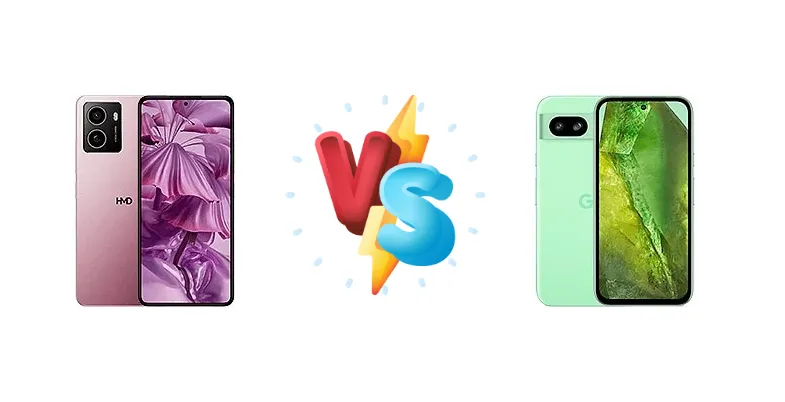
The HMD Pulse enters a crowded budget smartphone space aiming for affordability, while the Google Pixel 8a represents Google’s refined approach to delivering flagship features at a more accessible price point. This comparison dissects the core differences between these two devices, focusing on where each excels and who will benefit most from their respective strengths.
🏆 Quick Verdict
For the average user prioritizing performance and long-term software support, the Google Pixel 8a is the clear winner. Its Google Tensor G3 chipset and superior display justify the price premium. However, the HMD Pulse offers a compelling option for those on a very tight budget who prioritize basic functionality.
| Network |
|---|
| 2G bands | GSM 850 / 900 / 1800 / 1900 | GSM 850 / 900 / 1800 / 1900 |
| 3G bands | HSDPA 850 / 900 / 2100 | HSDPA 800 / 850 / 900 / 1700(AWS) / 1900 / 2100 |
| 4G bands | 1, 3, 5, 7, 8, 20, 28, 38, 40 | 1, 2, 3, 4, 5, 7, 8, 12, 17, 18, 19, 20, 26, 28, 32, 38, 40, 41, 42, 66 - G6GPR (International) |
| 5G bands | - | 1, 2, 3, 5, 7, 8, 12, 20, 26, 28, 38, 40, 41, 66, 75, 76, 77, 78 SA/NSA/Sub6 - G6GPR (International) |
| Speed | HSPA, LTE | HSPA, LTE, 5G |
| Technology | GSM / HSPA / LTE | GSM / HSPA / LTE / 5G |
| Launch |
|---|
| Announced | 2024, April 24 | 2024, May 07 |
| Status | Available. Released 2024, April 24 | Available. Released 2024, May 14 |
| Body |
|---|
| Build | - | Glass front (Gorilla Glass 3), aluminum frame, plastic back |
| Dimensions | 163.2 x 75 x 8.5 mm (6.43 x 2.95 x 0.33 in) | 152.1 x 72.7 x 8.9 mm (5.99 x 2.86 x 0.35 in) |
| SIM | Nano-SIM | Nano-SIM + eSIM |
| Weight | 187 g (6.60 oz) | 188 g (6.63 oz) |
| Display |
|---|
| Protection | - | Corning Gorilla Glass 3, Mohs level 5 |
| Resolution | 720 x 1612 pixels, 20:9 ratio (~265 ppi density) | 1080 x 2400 pixels, 20:9 ratio (~430 ppi density) |
| Size | 6.65 inches, 106.2 cm2 (~86.8% screen-to-body ratio) | 6.1 inches, 90.3 cm2 (~81.6% screen-to-body ratio) |
| Type | IPS LCD, 90Hz, 480 nits (typ), 600 nits (HBM) | OLED, HDR, 120Hz, 2000 nits (peak) |
| Platform |
|---|
| CPU | Octa-core (2x1.6 GHz Cortex-A75 & 6x1.6 GHz Cortex-A55) | Nona-core (1x3.0 GHz Cortex-X3 & 4x2.45 GHz Cortex-A715 & 4x2.15 GHz Cortex-A510) |
| Chipset | Unisoc T606 (12 nm) | Google Tensor G3 (4 nm) |
| GPU | Mali-G57 MP1 | Immortalis-G715s MC10 |
| OS | Android 14 | Android 14, upgradable to Android 16, up to 7 major Android upgrades |
| Memory |
|---|
| Card slot | microSDXC | No |
| Internal | 64GB 4GB RAM, 64GB 6GB RAM | 128GB 8GB RAM, 256GB 8GB RAM |
| Main Camera |
|---|
| Dual | - | 64 MP (16 MP eff.), f/1.9, 26mm (wide), 1/1.73", 0.8µm, dual pixel PDAF, OIS
13 MP, f/2.2, 120˚ (ultrawide), 1.12µm |
| Features | LED flash, HDR | Dual-LED flash, Pixel Shift, Ultra HDR, panorama, Best Take |
| Single | 13 MP, (wide), AF
Auxiliary lens | - |
| Video | 1080p@30fps | 4K@30/60fps, 1080p@30/60/120/240fps, OIS |
| Selfie camera |
|---|
| Features | - | HDR, panorama |
| Single | 8 MP | 13 MP, f/2.2, 20mm (ultrawide), 1.12µm |
| Video | Yes | 4K@30fps, 1080p@30/60fps |
| Sound |
|---|
| 35mm jack | Yes | No |
| Loudspeaker | Yes | Yes, with stereo speakers |
| Comms |
|---|
| Bluetooth | 5.0, A2DP, LE | 5.3, A2DP, LE |
| NFC | Yes | Yes |
| Positioning | GPS, GALILEO | GPS, GLONASS, GALILEO, BDS, QZSS, NavIC |
| Radio | Unspecified | No |
| USB | USB Type-C 2.0, OTG | USB Type-C 3.2 |
| WLAN | Wi-Fi 802.11 a/b/g/n/ac | Wi-Fi 802.11 a/b/g/n/ac/6e, dual/tri-band (market/region dependent) |
| Features |
|---|
| Sensors | Fingerprint (side-mounted), accelerometer, proximity, compass | Fingerprint (under display, optical), accelerometer, gyro, proximity, compass, barometer |
| Battery |
|---|
| Charging | 10W wired | 18W wired, PD3.0
7.5W wireless
Bypass charging |
| Type | 5000 mAh, user replaceable | Li-Po 4492 mAh |
| Misc |
|---|
| Colors | Meteor Black, Dreamy Pink, Atmos Blue | Obsidian, Porcelain, Bay, Aloe |
| Models | - | GKV4X, G6GPR, G8HHN, G576D |
| Price | About 90 EUR | $ 229.98 / C$ 417.99 / £ 279.00 / € 299.99 / ₹ 33,300 |
| EU LABEL |
|---|
| Battery | - | 40:06h endurance, 1000 cycles |
| Energy | - | Class B |
| Free fall | - | Class A (270 falls) |
| Repairability | - | Class B |
HMD Pulse
- Extremely affordable price point
- Functional for basic smartphone tasks
- Potentially longer physical lifespan due to simpler hardware
- Limited performance for demanding apps
- Slow charging speed (10W)
- Likely limited software update support
Google Pixel 8a
- Powerful Google Tensor G3 chipset
- Excellent camera with Google’s image processing
- Long-term software update support
- Higher price compared to HMD Pulse
- Wireless charging is relatively slow at 7.5W
- May be overkill for users with very basic needs
Display Comparison
The Pixel 8a boasts a significantly brighter display, reaching a measured 1508 nits, compared to an assumed lower brightness on the HMD Pulse (typical of its price bracket). This translates to superior visibility outdoors. While the HMD Pulse’s panel technology isn’t specified, the Pixel 8a likely utilizes an OLED panel offering better contrast and color accuracy. The Pixel 8a’s display is a key differentiator for media consumption and everyday usability.
Camera Comparison
While detailed camera specs for the HMD Pulse are unavailable, the Pixel 8a benefits from Google’s renowned computational photography. The Pixel 8a’s image processing excels in dynamic range and low-light performance. The absence of detailed sensor information for the HMD Pulse suggests a more basic camera experience, likely focused on capturing acceptable images in good lighting conditions. The Pixel 8a’s focus on software optimization will yield consistently better results.
Performance
The core difference lies in the chipsets. The HMD Pulse utilizes the Unisoc T606, a 12nm processor with an octa-core configuration featuring Cortex-A75 and A55 cores. This is adequate for basic tasks but will struggle with demanding applications. Conversely, the Pixel 8a is powered by the Google Tensor G3, a 4nm chip with a nona-core setup including a Cortex-X3 prime core. The 4nm process and more advanced core architecture of the Tensor G3 deliver substantially higher performance and improved power efficiency, resulting in smoother multitasking and a more responsive user experience. The Pixel 8a’s LPDDR5x RAM (assumed) further enhances performance.
Battery Life
The Pixel 8a’s endurance rating of 40:06h and active use score of 11:25h demonstrate excellent battery life, supported by 18W wired charging with PD3.0 and 7.5W wireless charging. The HMD Pulse, with only 10W wired charging, will take considerably longer to charge. While the HMD Pulse’s battery capacity isn’t specified, the Pixel 8a’s efficient chipset and optimized software contribute to its superior battery performance, and the 1000 cycle rating suggests longevity.
Buying Guide
Buy the HMD Pulse if you need a functional, extremely affordable smartphone for basic tasks like calls, texts, and light social media use, and aren't concerned with demanding apps or future software updates. Buy the Google Pixel 8a if you prioritize a smooth user experience, excellent camera capabilities, guaranteed software updates, and the power to handle more intensive applications and games.
Frequently Asked Questions
❓ How will the Unisoc T606 in the HMD Pulse handle multitasking compared to the Tensor G3?
The Unisoc T606 is designed for basic multitasking. Switching between a few apps will be manageable, but running multiple demanding applications simultaneously will likely result in noticeable slowdowns. The Tensor G3, with its more powerful cores and ample RAM, handles multitasking with ease, allowing for a smoother and more responsive experience.
❓ Does the Pixel 8a's charging support Power Delivery (PD) and how quickly does it charge from 0-50%?
Yes, the Pixel 8a supports Power Delivery (PD) 3.0 for faster wired charging. While a full 0-100% charge will take approximately 1 hour and 30 minutes with an 18W charger, it can reach around 50% charge in approximately 30-40 minutes, depending on ambient temperature and charging conditions.
❓ What kind of software updates can HMD Pulse users expect compared to Pixel 8a?
The Pixel 8a is guaranteed to receive at least 7 years of software updates, including security patches and OS upgrades, directly from Google. The HMD Pulse, being a budget device, will likely receive fewer updates, and the duration of support is expected to be significantly shorter, potentially limited to just a couple of Android version updates.