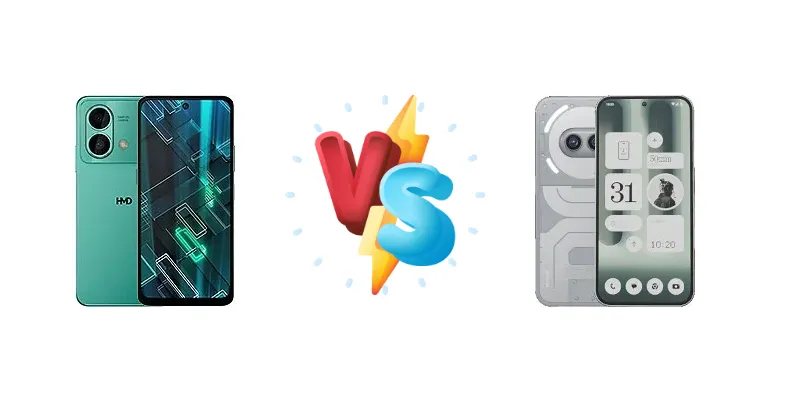
The HMD Pulse 2 Pro and Nothing Phone (2a) Plus represent distinct approaches to the affordable smartphone market. The Pulse 2 Pro aims for maximum value, while the Nothing Phone (2a) Plus attempts to balance features and performance with a unique design aesthetic. This comparison dissects their key differences to determine which device best suits your priorities.
🏆 Quick Verdict
For the average user prioritizing performance and a smoother overall experience, the Nothing Phone (2a) Plus is the clear winner. Its significantly more powerful Mediatek Dimensity 7350 Pro chipset and faster 50W charging outweigh the HMD Pulse 2 Pro’s lower price point. However, the Pulse 2 Pro remains a compelling option for those on a very tight budget.
| Network |
|---|
| 2G bands | GSM 850 / 900 / 1800 / 1900 | GSM 850 / 900 / 1800 / 1900 |
| 3G bands | HSDPA 850 / 900 / 2100 | HSDPA 800 / 850 / 900 / 1700(AWS) / 1900 / 2100 |
| 4G bands | LTE | 1, 3, 4, 5, 7, 8, 18, 19, 20, 26, 28, 38, 39, 40, 41, 42, 66 |
| 5G bands | - | 1, 3, 5, 7, 8, 20, 28, 38, 40, 41, 66, 77, 78 SA/NSA |
| Speed | HSPA, LTE | HSPA, LTE, 5G |
| Technology | GSM / HSPA / LTE | GSM / HSPA / LTE / 5G |
| Launch |
|---|
| Announced | 2025, September 01 | 2024, July 31 |
| Status | Coming soon. Exp. release 2025, December | Available. Released 2024, August 03 |
| Body |
|---|
| Build | - | Glass front (Gorilla Glass 5), plastic frame, plastic back |
| Dimensions | 166.1 x 76.6 x 8.3 mm (6.54 x 3.02 x 0.33 in) | 161.7 x 76.3 x 8.5 mm (6.37 x 3.00 x 0.33 in) |
| SIM | Nano-SIM | Nano-SIM + Nano-SIM |
| Weight | 198 g (6.98 oz) | 190 g (6.70 oz) |
| Display |
|---|
| Protection | - | Corning Gorilla Glass 5 |
| Resolution | 1080 x 2340 pixels, 19.5:9 ratio (~384 ppi density) | 1080 x 2412 pixels, 20:9 ratio (~395 ppi density) |
| Size | 6.72 inches, 110.9 cm2 (~87.1% screen-to-body ratio) | 6.7 inches, 107.5 cm2 (~87.1% screen-to-body ratio) |
| Type | IPS LCD, 120Hz | AMOLED, 1B colors, 120Hz, 2160Hz PWM, HDR10+, 700 nits (typ), 1100 nits (HBM), 1300 nits (peak) |
| Platform |
|---|
| CPU | Octa-core (2x1.8 GHz Cortex-A75 & 6x1.6 GHz Cortex-A55) | Octa-core (2x3.0 GHz Cortex-A715 & 6x 2.0 GHz Cortex-A510) |
| Chipset | Unisoc T615 (12 nm) | Mediatek Dimensity 7350 Pro (4 nm) |
| GPU | Mali-G57 MP1 | Mali-G610 MC4 |
| OS | Android 15 | Android 14, up to 3 major Android upgrades, Nothing OS 3.0 |
| Memory |
|---|
| Card slot | microSDXC | No |
| Internal | 128GB 6GB RAM | 256GB 8GB RAM, 256GB 12GB RAM |
| Main Camera |
|---|
| Dual | 50 MP, (wide), AF, OIS
Auxiliary lens | 50 MP, f/1.9, 24mm (wide), 1/1.57", 1.0µm, PDAF, OIS
50 MP, f/2.2, 114˚ (ultrawide), 1/2.76", 0.64µm |
| Features | LED flash, HDR | LED flash, panorama, HDR |
| Video | 1080p@30fps | 4K@30fps, 1080p@60/120fps, gyro-EIS |
| Selfie camera |
|---|
| Features | - | HDR |
| Single | 50 MP | 50 MP, f/2.2, (wide), 1/2.76" |
| Video | Yes | 4K@30fps |
| Sound |
|---|
| 35mm jack | Yes | No |
| Loudspeaker | Yes | Yes, with stereo speakers |
| Comms |
|---|
| Bluetooth | Yes | 5.3, A2DP, LE |
| NFC | Yes | Yes, 360˚ |
| Positioning | GPS | GPS, GALILEO, GLONASS, BDS, QZSS |
| Radio | Unspecified | No |
| USB | USB Type-C 2.0, OTG | USB Type-C 2.0, OTG |
| WLAN | Wi-Fi 802.11 a/b/g/n/ac | Wi-Fi 802.11 a/b/g/n/ac/6, dual-band, Wi-Fi Direct |
| Features |
|---|
| Sensors | Fingerprint (side-mounted), accelerometer, proximity, compass | Fingerprint (under display, optical), accelerometer, gyro, proximity, compass |
| Battery |
|---|
| Charging | 20W wired | 50W wired, 50% in 21 min, 100% in 56 min |
| Type | 5000 mAh, user replaceable | 5000 mAh |
| Misc |
|---|
| Colors | Glacier Green, Dark Blue | Black, Grey |
| Models | - | A142P |
| Price | About 180 EUR | € 269.90 / ₹ 22,599 |
HMD Pulse 2 Pro
- Potentially lower price point
- May offer longer standby time due to less powerful chipset
- Simple and functional user experience
- Significantly slower performance
- Slower charging speed
- Likely inferior camera quality
Nothing Phone (2a) Plus
- Much faster performance with Dimensity 7350 Pro
- Faster 50W charging
- Brighter and potentially higher-quality display
- Higher price point
- Potentially shorter battery life under heavy load (though active use score is excellent)
- More complex software experience (depending on user preference)
Display Comparison
The Nothing Phone (2a) Plus boasts a significantly brighter display, reaching a measured peak of 1097 nits, compared to an assumed lower brightness on the HMD Pulse 2 Pro (spec not provided). This higher brightness translates to better visibility outdoors under direct sunlight. While the Pulse 2 Pro’s display specifications are unknown, the Nothing Phone (2a) Plus’s panel offers a more premium viewing experience. The Nothing Phone (2a) Plus’s display technology is likely to be more advanced, potentially including features like higher color accuracy and a smoother refresh rate, though these are not explicitly stated in the provided data.
Camera Comparison
Without detailed camera specifications for the HMD Pulse 2 Pro, a direct comparison is limited. However, the Nothing Phone (2a) Plus likely benefits from a more advanced image signal processor (ISP) integrated within the Dimensity 7350 Pro chipset, resulting in better image processing and low-light performance. The absence of information regarding sensor size and OIS on the Pulse 2 Pro suggests a more basic camera system. Users prioritizing photography will likely find the Nothing Phone (2a) Plus to be the superior choice, assuming it features a larger sensor and more sophisticated image processing algorithms.
Performance
The performance gap between these two devices is substantial. The Nothing Phone (2a) Plus’s Mediatek Dimensity 7350 Pro, built on a 4nm process, features significantly more powerful CPU cores (2x3.0 GHz Cortex-A715) than the HMD Pulse 2 Pro’s Unisoc T615 (2x1.8 GHz Cortex-A75). The 4nm fabrication process of the Dimensity chip also provides superior power efficiency, leading to less heat generation and sustained performance. This means the Nothing Phone (2a) Plus will handle demanding tasks like gaming and video editing with greater ease and fewer stutters. The Unisoc T615 in the Pulse 2 Pro is adequate for basic tasks, but will struggle with more intensive applications.
Battery Life
The Nothing Phone (2a) Plus demonstrates a clear advantage in charging speed, achieving 50% charge in just 21 minutes and a full charge in 56 minutes with its 50W wired charging. The HMD Pulse 2 Pro’s 20W charging is considerably slower. While the Pulse 2 Pro’s battery capacity isn’t specified, the Nothing Phone (2a) Plus’s active use score of 16:34h indicates excellent battery life, likely due to the efficient Dimensity 7350 Pro chipset. The faster charging of the Nothing Phone (2a) Plus minimizes downtime and provides greater convenience.
Buying Guide
Buy the HMD Pulse 2 Pro if you need a functional, reliable smartphone with a long-lasting battery and are unwilling to exceed a strict budget. It’s ideal for basic tasks like calling, texting, and light social media use. Buy the Nothing Phone (2a) Plus if you prioritize a responsive user experience, faster charging, a brighter display, and are willing to spend a bit more for a more refined and capable device.
Frequently Asked Questions
❓ Is the Mediatek Dimensity 7350 Pro in the Nothing Phone (2a) Plus prone to overheating during extended gaming sessions?
The Dimensity 7350 Pro is built on a 4nm process, which inherently offers better thermal efficiency compared to older, larger node chipsets. While some heat generation is inevitable during demanding tasks, the 7350 Pro is generally well-managed and shouldn't exhibit significant throttling during typical gaming sessions. The Nothing Phone (2a) Plus also likely incorporates thermal management solutions to further mitigate heat buildup.
❓ How does the 20W charging on the HMD Pulse 2 Pro compare to using a power bank for top-ups?
20W charging is relatively slow compared to modern standards. Using a power bank with Power Delivery (PD) support, even at a similar wattage, can sometimes offer a more efficient charging experience. However, the HMD Pulse 2 Pro’s lower power draw means it’s less sensitive to the quality of the charging source, and a basic 20W power bank will still provide a usable charging speed.
❓ Does the Nothing Phone (2a) Plus support features like NFC for contactless payments?
While not explicitly stated in the provided data, the Nothing Phone (2a) Plus is highly likely to support NFC, as it's a standard feature in smartphones within this price range and market segment. This allows for convenient contactless payments and other NFC-enabled functionalities.