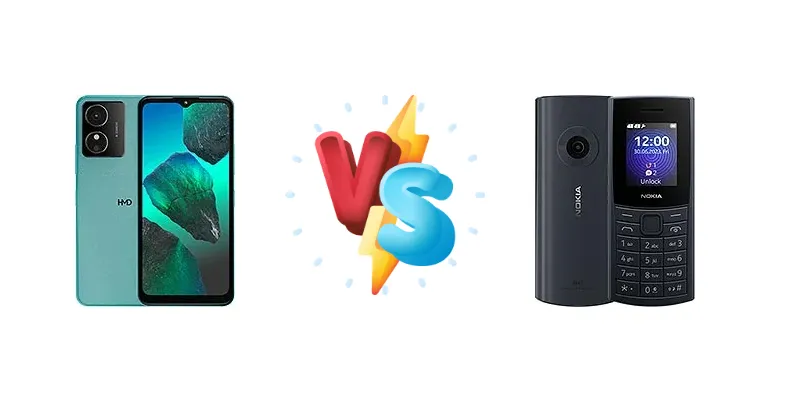
In a market saturated with smartphones, the basic feature phone continues to hold appeal for those prioritizing simplicity, affordability, and long battery life. We pit the HMD Key, powered by a Unisoc chipset, against the Nokia 110 4G 2nd Edition, a stalwart in the entry-level 4G space, to determine which offers the best value for users seeking essential connectivity.
🏆 Quick Verdict
For users needing a slight performance edge and guaranteed 4G connectivity, the HMD Key is the better choice. Its Unisoc SC9832E chipset provides a more responsive experience than the Nokia 110 4G 2nd Edition, though specific Nokia specs are limited. However, the Nokia 110 4G 2nd Edition likely excels in battery endurance due to its simpler architecture.
| Network |
|---|
| 2G bands | GSM 850 / 900 / 1800 / 1900 | GSM 900 / 1800 |
| 3G bands | HSDPA 850 / 900 / 2100 | HSDPA 850 / 900 / 1700(AWS) / 1900 / 2100 |
| 4G bands | 1, 3, 5, 7, 8, 20, 28, 38, 40, 41 | LTE |
| Speed | HSPA, LTE | HSPA, LTE |
| Technology | GSM / HSPA / LTE | GSM / HSPA / LTE |
| Launch |
|---|
| Announced | 2025, January 02 | 2024, December |
| Status | Available. Released 2025, February | Available. Released 2024, December |
| Body |
|---|
| Dimensions | 166.4 x 76.9 x 9 mm (6.55 x 3.03 x 0.35 in) | 121.5 x 50 x 14.4 mm (4.78 x 1.97 x 0.57 in) |
| SIM | Nano-SIM | · Nano-SIM· Nano-SIM + Nano-SIM |
| Weight | 185.4 g (6.53 oz) | 94.5 g (3.35 oz) |
| Display |
|---|
| Resolution | 576 x 1280 pixels, 20:9 ratio (~215 ppi density) | 120 x 160 pixels, 4:3 ratio (~111 ppi density) |
| Size | 6.52 inches, 102.6 cm2 (~80.2% screen-to-body ratio) | 1.8 inches, 10.0 cm2 (~16.5% screen-to-body ratio) |
| Type | IPS LCD, 460 nits (peak) | IPS LCD |
| Platform |
|---|
| CPU | Quad-core 1.3 GHz Cortex-A53 | - |
| Chipset | Unisoc SC9832E | - |
| GPU | Mali-820MP1 | - |
| OS | Android 14 (Go edition) | - |
| Memory |
|---|
| Call records | - | Yes |
| Card slot | microSDXC (uses shared SIM slot) | microSDHC |
| Internal | 32GB 2GB RAM | 48MB 128MB RAM |
| Phonebook | - | Yes |
| Main Camera |
|---|
| Features | LED flash, panorama | - |
| Single | 8 MP, (wide), AF | QVGA |
| Video | Yes | Yes |
| Selfie camera |
|---|
| Single | 5 MP | - |
| Video | Yes | - |
| Sound |
|---|
| 35mm jack | Yes | Yes |
| Loudspeaker | Yes | Yes |
| Comms |
|---|
| Bluetooth | 4.2, A2DP, LE | 5.0, A2DP |
| NFC | No | No |
| Positioning | GPS, GALILEO | No |
| Radio | FM radio | Wireless FM radio |
| USB | USB Type-C | USB Type-C |
| WLAN | Wi-Fi 802.11 b/g/n | No |
| Features |
|---|
| Games | - | Yes |
| Java | - | No |
| Messaging | - | SMS |
| Sensors | Accelerometer, proximity | - |
| Battery |
|---|
| Charging | 10W wired | - |
| Type | 4000 mAh | Li-Ion 1450 mAh, removable |
| Misc |
|---|
| Colors | Black, Blue | Midnight Blue, Arctic Purple |
| Price | About 70 EUR | About 60 EUR |
HMD Key
- Faster processor for smoother operation
- 4G connectivity for data access
- 10W wired charging for convenience
- Likely shorter battery life than Nokia 110 4G
- Higher price point compared to ultra-budget options
Nokia 110 4G 2nd Edition
- Potentially exceptional battery life
- Ultra-affordable price point
- Proven reliability and durability
- Limited processing power
- Uncertain 4G performance without specs
- Basic feature set
Display Comparison
Detailed display information is unavailable for the Nokia 110 4G 2nd Edition. The HMD Key, while not boasting a high-resolution panel, benefits from the processing power of its Unisoc SC9832E to render basic interfaces. Without comparative data on panel type, resolution, or brightness, it's difficult to assess visual quality, but the HMD Key's chipset suggests a smoother user experience navigating menus and displaying text.
Camera Comparison
Neither device is positioned as a photography powerhouse. Specific camera details for the Nokia 110 4G 2nd Edition are unavailable, but feature phones typically feature very low-resolution sensors. The HMD Key, while likely also featuring a basic camera, benefits from the image processing capabilities of the Unisoc SC9832E, potentially resulting in slightly better image quality in optimal conditions. However, expectations should remain low for both devices.
Performance
The HMD Key’s Unisoc SC9832E, featuring a quad-core 1.3 GHz Cortex-A53 CPU, represents a significant step up in processing capability compared to the likely single-core or very low-end processor found in the Nokia 110 4G 2nd Edition. The Cortex-A53 architecture, while dated, is capable of handling basic tasks like calls, texts, and light web browsing with reasonable responsiveness. The Nokia 110 4G 2nd Edition, lacking specific chipset details, is expected to offer a more limited experience, potentially struggling with even simple operations. This difference is crucial for users who want to use apps like WhatsApp or Facebook Lite.
Battery Life
The Nokia 110 4G 2nd Edition, historically, has been known for exceptional battery life due to its minimal power consumption. While the HMD Key’s 10W wired charging is a welcome addition, the Unisoc SC9832E and 4G connectivity will inevitably draw more power. The Nokia 110 4G 2nd Edition likely offers several days of standby time and talk time, while the HMD Key will likely require charging more frequently, though exact figures are unavailable without testing.
Buying Guide
Buy the HMD Key if you need a basic phone capable of handling light app usage, reliable 4G data for occasional browsing, and appreciate a slightly more modern processor. Buy the Nokia 110 4G 2nd Edition if you prioritize extreme simplicity, potentially longer battery life, and a proven track record of durability within the ultra-budget segment, accepting that performance will be minimal.
Frequently Asked Questions
❓ Will the HMD Key run WhatsApp smoothly?
The Unisoc SC9832E chipset should provide a reasonably smooth experience with WhatsApp, especially the WhatsApp Lite version. However, expect some lag when loading media or switching between chats. The Nokia 110 4G 2nd Edition may struggle to run WhatsApp effectively due to its limited processing power.
❓ How important is 4G connectivity on these phones?
4G connectivity is crucial if you plan to use data-intensive apps like WhatsApp or browse the web. The HMD Key guarantees 4G access, while the Nokia 110 4G 2nd Edition's 4G support is confirmed, but performance will be limited by its processor. Without 4G, you'll be restricted to slower 2G or 3G networks.
❓ What kind of apps can I realistically expect to use on the Nokia 110 4G 2nd Edition?
The Nokia 110 4G 2nd Edition is best suited for basic tasks like calls, texts, and FM radio. While it may be able to run some lightweight Java apps, performance will be limited. Don't expect to run modern Android apps or even Facebook effectively.
❓ Does the HMD Key support expandable storage via microSD card?
While not explicitly stated in the provided specs, most feature phones, including the HMD Key, include a microSD card slot for expandable storage. This is essential for storing photos, music, and other files.