
HMD Ivalo XE vs Google Pixel 6a: Which Android Phone Delivers More?
| Phones Images | |||||
|---|---|---|---|---|---|
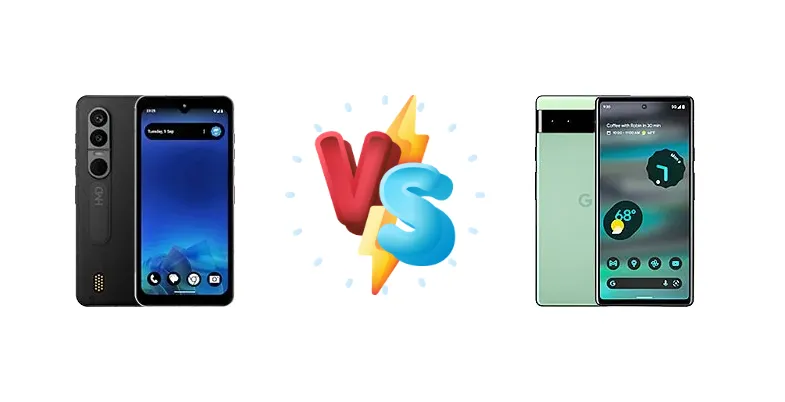
|
🏆 Quick Verdict
For users prioritizing raw processing power and potential for sustained performance, the HMD Ivalo XE emerges as the winner. Its 4nm Qualcomm Dragonwing Q-6690 chipset offers a theoretical edge over the 5nm Google Tensor, particularly in demanding tasks. However, the Pixel 6a’s software experience and camera capabilities remain strong contenders.
| PHONES | ||
|---|---|---|
| Phone Names | HMD Ivalo XE | Google Pixel 6a |
| Network | ||
|---|---|---|
| 2G bands | GSM 850 / 900 / 1800 / 1900 | GSM 850 / 900 / 1800 / 1900 |
| 3G bands | HSDPA 850 / 900 / 1700(AWS) / 1900 / 2100 | HSDPA 800 / 850 / 900 / 1700(AWS) / 1900 / 2100 |
| 4G bands | LTE | 1, 2, 3, 4, 5, 7, 8, 12, 13, 14, 17, 18, 19, 20, 25, 26, 28, 29, 30, 38, 39, 40, 41, 42, 48, 66, 71 - GX7AS, GB62Z (USA/Canada) |
| 5G bands | SA/NSA | 1, 2, 3, 5, 7, 8, 12, 20, 25, 28, 30, 38, 40, 41, 48, 66, 71, 77, 78 SA/NSA/Sub6 - GX7AS (USA/Canada) |
| Speed | HSPA, LTE, 5G | HSPA, LTE, 5G |
| Technology | GSM / HSPA / LTE / 5G | GSM / HSPA / LTE / 5G |
| - | 1, 2, 3, 5, 7, 8, 12, 20, 25, 28, 30, 40, 48, 66, 71, 77, 78 SA/NSA/Sub6 - G1AZG (International) | |
| Launch | ||
|---|---|---|
| Announced | 2025, September 09 | 2022, May 11 |
| Status | Coming soon. Exp. release 2025, Q4 | Available. Released 2022, July 21 |
| Body | ||
|---|---|---|
| Build | Glass front (Gorilla Glass Victus 2), aluminum frame (6000 series), fiber-reinforced plastic back | Glass front (Gorilla Glass 3), aluminum frame, plastic back |
| Dimensions | - | 152.2 x 71.8 x 8.9 mm (5.99 x 2.83 x 0.35 in) |
| SIM | Nano-SIM + Nano-SIM | Nano-SIM + eSIM |
| Weight | - | 178 g (6.28 oz) |
| - | IP67 dust/water resistant (up to 1m for 30 min) | |
| Display | ||
|---|---|---|
| Protection | Corning Gorilla Glass Victus 2 | Corning Gorilla Glass 3 |
| Resolution | 1080 x 2400 pixels*, 20:9 ratio (~416 ppi density) | 1080 x 2400 pixels, 20:9 ratio (~429 ppi density) |
| Size | 6.32 inches, 96.4 cm2 | 6.1 inches, 90.7 cm2 (~83.0% screen-to-body ratio) |
| Type | IPS LCD, 120Hz, 1000 nits (HBM) | OLED, HDR |
| - | Always-on display | |
| Platform | ||
|---|---|---|
| CPU | Octa-core (1x2.9 GHz Kryo Gold Prime & 3x2.7 GHz Kryo Gold & 4x2.0 GHz Kryo Silver) | Octa-core (2x2.80 GHz Cortex-X1 & 2x2.25 GHz Cortex-A76 & 4x1.80 GHz Cortex-A55) |
| Chipset | Qualcomm Dragonwing Q-6690 (4 nm) | Google Tensor (5 nm) |
| GPU | - | Mali-G78 MP20 |
| OS | Android | Android 12, upgradable to Android 15, up to 5 major Android upgrades |
| Memory | ||
|---|---|---|
| Card slot | Unspecified | No |
| Internal | 256GB 12GB RAM | 128GB 6GB RAM |
| - | UFS 3.1 | |
| Main Camera | ||
|---|---|---|
| Dual | 50 MP, (wide), PDAF 50 MP, 120˚, (ultrawide) | 12.2 MP, f/1.7, 27mm, (wide), 1/2.55", 1.4µm, dual pixel PDAF, OIS 12 MP, f/2.2, 17mm, 114˚ (ultrawide), 1.25µm |
| Features | Laser AF, LED flash, HDR, panorama | Dual-LED flash, Pixel Shift, Auto-HDR, panorama |
| Single | - | 8 MP, f/2.0, 24mm (wide), 1.12µm |
| Video | 4K, 1080p, HDR, gyro-EIS | 4K@30/60fps, 1080p@30/60/120/240fps; gyro-EIS, OIS |
| Selfie camera | ||
|---|---|---|
| Features | - | HDR, panorama |
| Single | 32 MP, (wide) | 8 MP, f/2.0, 24mm (wide), 1.12µm |
| Video | 1080p | 1080p@30fps |
| Sound | ||
|---|---|---|
| 3.5mm jack | - | No |
| 35mm jack | Yes | No |
| Loudspeaker | Yes | Yes, with stereo speakers |
| Comms | ||
|---|---|---|
| Bluetooth | 5.4, A2DP, LE | 5.2, A2DP, LE |
| NFC | Yes | Yes |
| Positioning | GPS, GALILEO, GLONASS, BDS, QZSS | GPS, GLONASS, GALILEO, QZSS |
| Radio | Unspecified | No |
| USB | USB Type-C, OTG, accessory connector pins | USB Type-C 3.1 |
| WLAN | Wi-Fi 802.11 a/b/g/n/ac/6/7, dual-band | Wi-Fi 802.11 a/b/g/n/ac/6e, dual-band, Wi-Fi Direct |
| Features | ||
|---|---|---|
| Sensors | Fingerprint (side-mounted), accelerometer, gyro, proximity, compass, barometer | Fingerprint (under display, optical), accelerometer, gyro, proximity, compass, barometer |
| Battery | ||
|---|---|---|
| Charging | - | 18W wired, PD3.0 |
| Type | 4500 mAh | Li-Po 4410 mAh |
| Misc | ||
|---|---|---|
| Colors | Black | Chalk, Charcoal, Sage |
| Models | - | GX7AS, GB62Z, G1AZG, GB17L |
| Price | - | $ 138.99 / C$ 228.74 / ₹ 23,999 |
| Tests | ||
|---|---|---|
| Battery life | - | Endurance rating 94h |
| Display | - | Contrast ratio: Infinite (nominal) |
HMD Ivalo XE
- Potentially superior CPU performance with the Dragonwing Q-6690
- 4nm process for improved thermal efficiency
- Likely more affordable price point
- Camera performance is unknown and potentially inferior to the Pixel 6a
- Software support and updates may be less frequent than the Pixel 6a
Google Pixel 6a
- Exceptional camera quality and computational photography
- Guaranteed software updates and long-term support from Google
- Bright and vibrant OLED display
- Google Tensor chip may throttle under sustained heavy load
- Potentially higher price compared to the HMD Ivalo XE
- Charging speed is relatively slow at 18W
Display Comparison
Both the HMD Ivalo XE and Google Pixel 6a offer comparable endurance ratings of 94 hours, suggesting similar battery optimization. However, the Pixel 6a boasts a measured peak brightness of 876 nits, a significant advantage for outdoor visibility. While the Ivalo XE’s display specifications are currently unavailable, the Pixel 6a’s ‘Infinite’ contrast ratio (nominal) indicates a high-quality OLED panel. The absence of high refresh rate information for the Ivalo XE suggests the Pixel 6a may offer a smoother visual experience if it supports a higher refresh rate.
Camera Comparison
The Pixel 6a is renowned for its computational photography prowess, leveraging Google’s image processing algorithms. While specific camera specs for the Ivalo XE are missing, the Pixel 6a’s image processing pipeline is a significant advantage. The Pixel 6a’s sensor size and aperture are critical factors, but without comparable data for the Ivalo XE, it’s difficult to assess the raw image quality. The Pixel 6a’s strength lies in its ability to produce consistently excellent photos in various conditions, a feature often prioritized by mainstream users.
Performance
The core difference lies in the chipsets. The HMD Ivalo XE’s Qualcomm Dragonwing Q-6690 (4nm) features an octa-core configuration with a 2.9 GHz Kryo Gold Prime core, suggesting a focus on peak performance. The Google Pixel 6a’s Google Tensor (5nm) utilizes a different architecture – 2x2.80 GHz Cortex-X1 cores for demanding tasks, paired with Cortex-A76 and A55 cores for efficiency. The 4nm process of the Dragonwing Q-6690 *should* translate to better thermal efficiency compared to the 5nm Tensor, potentially reducing throttling during prolonged heavy use. The Ivalo XE’s CPU configuration appears geared towards sustained high performance, while the Tensor prioritizes AI and machine learning tasks.
Battery Life
Both devices achieve an endurance rating of 94 hours, indicating comparable battery life under similar usage patterns. The Pixel 6a supports 18W wired charging with PD3.0, offering a standardized and relatively quick charging solution. The Ivalo XE’s charging specifications are currently unknown, but the comparable endurance rating suggests it doesn’t significantly lag behind in battery capacity or efficiency. The real-world 0-100% charging time will depend on the Ivalo XE’s charging wattage and battery capacity.
Buying Guide
Buy the HMD Ivalo XE if you need a phone capable of handling intensive gaming, video editing, or multitasking without significant throttling. Its more powerful CPU configuration and newer chipset architecture are geared towards performance enthusiasts. Buy the Google Pixel 6a if you prioritize a seamless software experience, exceptional camera quality, and long-term software support, even if it means sacrificing some raw processing power.