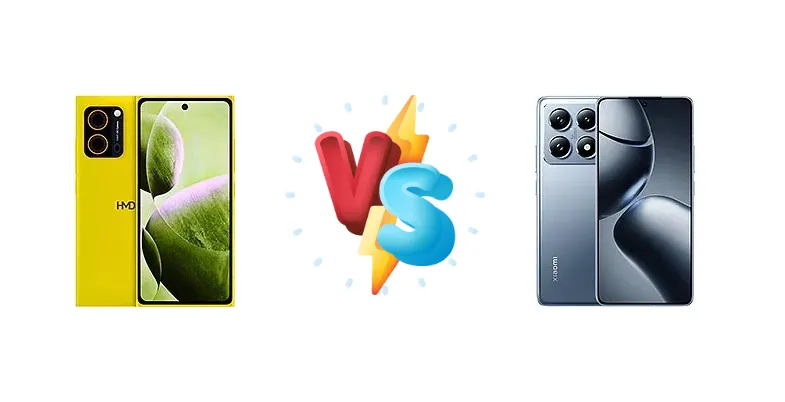
The mid-range smartphone market is fiercely competitive, and the HMD Hyper and Xiaomi 14T Pro represent compelling options. The HMD Hyper aims for affordability with a Snapdragon 6 Gen 1, while the Xiaomi 14T Pro throws down a flagship-level Dimensity 9300+ and blazing-fast charging. This comparison dissects their strengths and weaknesses to determine which device best suits your priorities.
🏆 Quick Verdict
For most users, the Xiaomi 14T Pro is the clear winner. Its significantly more powerful Mediatek Dimensity 9300+ chipset, coupled with 120W charging and a brighter display, justifies the likely price premium. However, the HMD Hyper offers a viable alternative for budget-conscious buyers prioritizing simplicity.
| Network |
|---|
| 2G bands | GSM 850 / 900 / 1800 / 1900 | GSM 850 / 900 / 1800 / 1900 |
| 3G bands | HSDPA 850 / 900 / 1700(AWS) / 1900 / 2100 | HSDPA 800 / 850 / 900 / 1700(AWS) / 1900 / 2100 |
| 4G bands | LTE | 1, 2, 3, 4, 5, 7, 8, 12, 13, 17, 18, 19, 20, 25, 26, 28, 32, 38, 39, 40, 41, 42, 48, 66 |
| 5G bands | SA/NSA | 1, 2, 3, 5, 7, 8, 12, 20, 25, 26, 28, 38, 40, 41, 48, 66, 75, 77, 78 SA/NSA |
| Speed | HSPA, LTE, 5G | HSPA, LTE, 5G |
| Technology | GSM / HSPA / LTE / 5G | GSM / HSPA / LTE / 5G |
| Launch |
|---|
| Announced | Not announced yet | 2024, September 26 |
| Status | Cancelled | Available. Released 2024, September 26 |
| Body |
|---|
| Build | - | Glass front (Gorilla Glass 5), aluminum frame, glass back (Panda X) |
| Dimensions | - | 160.4 x 75.1 x 8.4 mm (6.31 x 2.96 x 0.33 in) |
| SIM | Nano-SIM + eSIM | · Nano-SIM + eSIM· eSIM + eSIM· Nano-SIM + Nano-SIM |
| Weight | - | 209 g (7.37 oz) |
| Display |
|---|
| Protection | - | Corning Gorilla Glass 5 |
| Resolution | 1080 x 2400 pixels, 20:9 ratio (~402 ppi density) | 1220 x 2712 pixels, 20:9 ratio (~446 ppi density) |
| Size | 6.55 inches, 103.6 cm2 | 6.67 inches, 107.4 cm2 (~89.1% screen-to-body ratio) |
| Type | OLED, 120Hz | AMOLED, 68B colors, 144Hz, 3840Hz PWM, Dolby Vision, HDR10+, 1600 nits (HBM), 4000 nits (peak) |
| Platform |
|---|
| CPU | Octa-core (4x2.2 GHz Cortex-A78 & 4x1.8 GHz Cortex-A55) | Octa-core (1x3.4 GHz Cortex-X4 & 3x2.85 GHz Cortex-X4 & 4x2.0 GHz Cortex-A720) |
| Chipset | Qualcomm SM6450 Snapdragon 6 Gen 1 (4 nm) | Mediatek Dimensity 9300+ (4 nm) |
| GPU | Adreno 710 | Immortalis-G720 MC12 |
| OS | Android 14, up to 2 major Android upgrades | Android 14, HyperOS |
| Memory |
|---|
| Card slot | microSDXC | No |
| Internal | 128GB 8GB RAM, 256GB 8GB RAM | 256GB 12GB RAM, 512GB 12GB RAM, 512GB 16GB RAM, 1TB 12GB RAM |
| Main Camera |
|---|
| Features | LED flash, HDR | Leica lens, Ultra HDR, LED flash, HDR, panorama |
| Triple | 50 MP, (wide), PDAF, OIS
13 MP, (telephoto), PDAF, 2x optical zoom
8 MP, (ultrawide) | 50 MP, f/1.6, 23mm (wide), 1/1.31", 1.2µm, PDAF, OIS
50 MP, f/2.0, 60mm (telephoto), 1/2.88", 0.61µm, PDAF, 2.6x optical zoom
12 MP, f/2.2, 15mm (ultrawide), 1/3.06", 1.12µm |
| Video | 4K@30fps, 1080p@30/60fps, gyro-EIS | 8K@24/30fps, 4K@24/30/60fps, 1080p@30/60/120/240/960fps, gyro-EIS, 10-bit Rec. 2020, HDR10+ |
| Selfie camera |
|---|
| Features | - | HDR |
| Single | 50 MP, (wide), AF | 32 MP, f/2.0, 25mm (wide), 1/3.44", 0.64µm |
| Video | 1080p@30fps | 4K@30fps, 1080p@30/60fps, HDR10+ |
| Sound |
|---|
| 35mm jack | Unspecified | No |
| Loudspeaker | Yes, with stereo speakers | Yes, with stereo speakers |
| Comms |
|---|
| Bluetooth | 5.2, A2DP, LE | 5.4, A2DP, LE, LHDC |
| Infrared port | - | Yes |
| NFC | Yes | Yes (market/region dependent) |
| Positioning | GPS, GALILEO, GLONASS, BDS | GPS (L1+L5), BDS (B1I+B1C+B2a+B2b), GALILEO (E1+E5a+E5b), QZSS (L1+L5), NavIC (L5), GLONASS |
| Radio | Unspecified | No |
| USB | USB Type-C 2.0 | USB Type-C 2.0, OTG |
| WLAN | Wi-Fi 802.11 a/b/g/n/ac, dual-band | Wi-Fi 802.11 a/b/g/n/ac/6e/7, dual-band, Wi-Fi Direct |
| Features |
|---|
| Sensors | Fingerprint (side-mounted), accelerometer, gyro, proximity, compass | Fingerprint (under display, optical), accelerometer, gyro, proximity, compass |
| Battery |
|---|
| Charging | 33W wired | 120W wired, PD3.0, QC4, 100% in 19 min
50W wireless, 100% in 45 min |
| Type | 4700 mAh, user replaceable | Li-Po 5000 mAh |
| Misc |
|---|
| Colors | Yellow | Titan Gray, Titan Blue, Titan Black |
| Models | - | 2407FPN8EG |
| Price | - | $ 550.00 / £ 498.00 / € 539.99 |
| SAR EU | - | 0.99 W/kg (head) 1.00 W/kg (body) |
HMD Hyper
- More affordable price point
- Clean and simple software experience (likely)
- Efficient Snapdragon 6 Gen 1 chipset for basic tasks
- Significantly weaker performance compared to the Xiaomi 14T Pro
- Slower 33W charging
- Likely lower display brightness and quality
Xiaomi 14T Pro
- Exceptional performance with the Dimensity 9300+
- Ultra-fast 120W wired and 50W wireless charging
- Bright and vibrant display (1228 nits)
- Higher price tag
- Potentially more complex software experience (Xiaomi's MIUI)
- May run hotter under sustained load
Display Comparison
The Xiaomi 14T Pro boasts a significantly brighter display, reaching a measured peak of 1228 nits, ensuring excellent visibility even in direct sunlight. While the HMD Hyper’s display specs are not provided, it’s reasonable to assume it falls considerably short of this peak brightness. The Xiaomi 14T Pro’s panel likely benefits from a higher contrast ratio and potentially a higher refresh rate (though not specified), contributing to a more immersive viewing experience. The lack of LTPO technology in either device suggests both will rely on adaptive refresh rate scaling rather than variable refresh rates for power efficiency.
Camera Comparison
Without detailed camera specifications for the HMD Hyper, a direct comparison is limited. However, the Xiaomi 14T Pro is likely to offer a more versatile and capable camera system, benefiting from the processing power of the Dimensity 9300+. The Xiaomi 14T Pro likely features a larger main sensor and more advanced image processing algorithms, resulting in better low-light performance and dynamic range. The absence of information regarding OIS on the HMD Hyper suggests it may lack this crucial stabilization feature, impacting video recording and low-light photography.
Performance
The performance gap between these devices is substantial. The Xiaomi 14T Pro’s Mediatek Dimensity 9300+ features a 1x3.4 GHz Cortex-X4 prime core, alongside 3x2.85 GHz Cortex-X4 cores and 4x2.0 GHz Cortex-A720 efficiency cores, representing a significant leap in CPU and GPU capabilities compared to the HMD Hyper’s Qualcomm SM6450 Snapdragon 6 Gen 1. The Snapdragon 6 Gen 1, with its 4x2.2 GHz Cortex-A78 and 4x1.8 GHz Cortex-A55 configuration, is geared towards efficient everyday tasks, while the Dimensity 9300+ is designed for demanding gaming and multitasking. The 4nm process node is shared by both chipsets, but the architectural advantages of the Dimensity 9300+ will translate to a much smoother and more responsive user experience.
Battery Life
The Xiaomi 14T Pro’s charging capabilities are a standout feature, offering 120W wired charging, capable of reaching 100% in just 19 minutes. It also supports 50W wireless charging, reaching full charge in 45 minutes. The HMD Hyper’s 33W wired charging is significantly slower in comparison. While the Xiaomi 14T Pro’s active use score of 12:32h is provided, the HMD Hyper’s battery capacity and endurance are unknown. However, the faster charging of the Xiaomi 14T Pro mitigates concerns about battery life, allowing for quick top-ups throughout the day.
Buying Guide
Buy the HMD Hyper if you need a reliable, straightforward smartphone experience with a focus on affordability and don't demand top-tier performance. It's ideal for everyday tasks and light usage. Buy the Xiaomi 14T Pro if you prioritize performance for gaming and demanding apps, require incredibly fast charging, and appreciate a brighter, more vibrant display. This is the choice for power users and those who value future-proofing.
Frequently Asked Questions
❓ Does the Xiaomi 14T Pro's Dimensity 9300+ chipset generate excessive heat during prolonged gaming sessions?
While the Dimensity 9300+ is a powerful chip, Mediatek has made significant strides in thermal management. The 4nm process node helps, but sustained gaming will inevitably generate heat. The Xiaomi 14T Pro likely incorporates vapor chamber cooling or other thermal solutions to mitigate throttling, but some performance reduction is still possible during extended gameplay.
❓ How does the 33W charging on the HMD Hyper compare to typical charging speeds for similarly priced smartphones?
33W charging is fairly standard for smartphones in the HMD Hyper’s price range. However, it’s considerably slower than the 120W charging offered by the Xiaomi 14T Pro. Expect a full charge to take around 1.5 to 2 hours with the HMD Hyper, while the Xiaomi 14T Pro can achieve a full charge in under 20 minutes.
❓ Is the lack of detailed camera specs on the HMD Hyper indicative of a significantly inferior camera experience?
Generally, yes. Without information on sensor size, aperture, or OIS, it's safe to assume the HMD Hyper's camera will not compete with the Xiaomi 14T Pro. The Xiaomi 14T Pro’s powerful chipset allows for more sophisticated image processing, and a larger sensor will capture more light, resulting in better image quality, especially in low-light conditions.