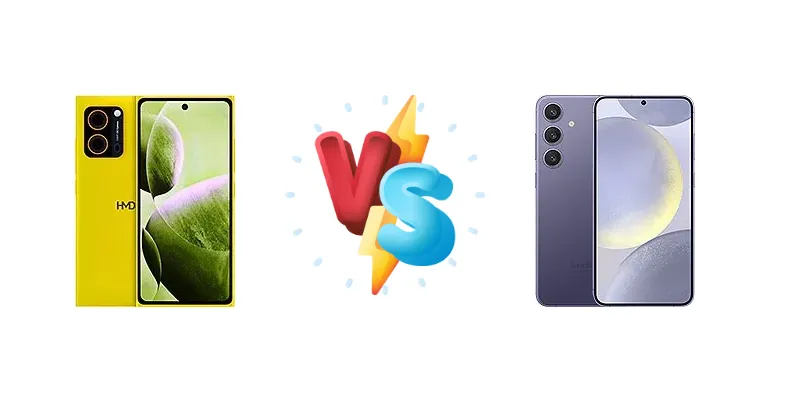
The smartphone landscape is increasingly segmented. The HMD Hyper aims to deliver a modern Android experience at a significantly lower price point than established flagships like the Samsung Galaxy S24+. This comparison dissects the core differences between these two devices, focusing on performance, display quality, camera capabilities, and overall value to determine which phone best suits your needs.
🏆 Quick Verdict
For the average user prioritizing raw performance, a vibrant display, and a refined camera experience, the Samsung Galaxy S24+ is the clear winner. However, the HMD Hyper presents a compelling option for budget-conscious consumers who value a clean Android experience and acceptable performance for everyday tasks.
| Network |
|---|
| 2G bands | GSM 850 / 900 / 1800 / 1900 | GSM 850 / 900 / 1800 / 1900 |
| 3G bands | HSDPA 850 / 900 / 1700(AWS) / 1900 / 2100 | HSDPA 850 / 900 / 1700(AWS) / 1900 / 2100 |
| 4G bands | LTE | 1, 2, 3, 4, 5, 7, 8, 12, 13, 17, 18, 19, 20, 25, 26, 28, 32, 38, 39, 40, 41, 66 - International |
| 5G bands | SA/NSA | 1, 2, 3, 5, 7, 8, 12, 20, 25, 26, 28, 38, 40, 41, 66, 75, 77, 78 SA/NSA/Sub6 - International |
| Speed | HSPA, LTE, 5G | HSPA, LTE (up to 7CA), 5G |
| Technology | GSM / HSPA / LTE / 5G | GSM / CDMA / HSPA / EVDO / LTE / 5G |
| Launch |
|---|
| Announced | Not announced yet | 2024, January 17 |
| Status | Cancelled | Available. Released 2024, January 24 |
| Body |
|---|
| Build | - | Glass front (Gorilla Glass Victus 2), glass back (Gorilla Glass Victus 2), aluminum frame |
| Dimensions | - | 158.5 x 75.9 x 7.7 mm (6.24 x 2.99 x 0.30 in) |
| SIM | Nano-SIM + eSIM | · Nano-SIM + Nano-SIM + eSIM + eSIM (max 2 at a time) - INT· Nano-SIM + eSIM + eSIM (max 2 at a time) - USA· Nano-SIM + Nano-SIM - CN |
| Weight | - | 196 g or 197 g (6.91 oz) |
| Display |
|---|
| Protection | - | Corning Gorilla Glass Victus 2 |
| Resolution | 1080 x 2400 pixels, 20:9 ratio (~402 ppi density) | 1440 x 3120 pixels, 19.5:9 ratio (~513 ppi density) |
| Size | 6.55 inches, 103.6 cm2 | 6.7 inches, 110.2 cm2 (~91.6% screen-to-body ratio) |
| Type | OLED, 120Hz | Dynamic LTPO AMOLED 2X, 120Hz, HDR10+, 2600 nits (peak) |
| Platform |
|---|
| CPU | Octa-core (4x2.2 GHz Cortex-A78 & 4x1.8 GHz Cortex-A55) | 8-core (1x3.39GHz Cortex-X4 & 3x3.1GHz Cortex-A720 & 2x2.9GHz Cortex-A720 & 2x2.2GHz Cortex-A520)10-core (1x3.2GHz Cortex-X4 & 2x2.9GHz Cortex-A720 & 3x2.6GHz Cortex-A720 & 4x1.95GHz Cortex-A520) |
| Chipset | Qualcomm SM6450 Snapdragon 6 Gen 1 (4 nm) | Qualcomm SM8650-AC Snapdragon 8 Gen 3 (4 nm) - USA/Canada/ChinaExynos 2400 (4 nm) - International |
| GPU | Adreno 710 | Adreno 750 (1 GHz) - USA/Canada/ChinaXclipse 940 - International |
| OS | Android 14, up to 2 major Android upgrades | Android 14, up to 7 major Android upgrades, One UI 8.0 |
| Memory |
|---|
| Card slot | microSDXC | No |
| Internal | 128GB 8GB RAM, 256GB 8GB RAM | 256GB 12GB RAM, 512GB 12GB RAM |
| Main Camera |
|---|
| Features | LED flash, HDR | LED flash, auto-HDR, panorama |
| Triple | 50 MP, (wide), PDAF, OIS
13 MP, (telephoto), PDAF, 2x optical zoom
8 MP, (ultrawide) | 50 MP, f/1.8, 24mm (wide), 1/1.56", 1.0µm, dual pixel PDAF, OIS
10 MP, f/2.4, 67mm (telephoto), 1/3.94", 1.0µm, PDAF, OIS, 3x optical zoom
12 MP, f/2.2, 13mm, 120˚ (ultrawide), 1/2.55" 1.4µm, Super Steady video |
| Video | 4K@30fps, 1080p@30/60fps, gyro-EIS | 8K@24/30fps, 4K@30/60fps, 1080p@30/60/120/240fps, HDR10+, stereo sound rec., gyro-EIS |
| Selfie camera |
|---|
| Features | - | HDR, HDR10+ |
| Single | 50 MP, (wide), AF | 12 MP, f/2.2, 26mm (wide), 1/3.2", 1.12µm, dual pixel PDAF |
| Video | 1080p@30fps | 4K@30/60fps, 1080p@30fps |
| Sound |
|---|
| 35mm jack | Unspecified | No |
| Loudspeaker | Yes, with stereo speakers | Yes, with stereo speakers |
| Comms |
|---|
| Bluetooth | 5.2, A2DP, LE | 5.3, A2DP, LE |
| NFC | Yes | Yes |
| Positioning | GPS, GALILEO, GLONASS, BDS | GPS, GLONASS, BDS, GALILEO, QZSS |
| Radio | Unspecified | No |
| USB | USB Type-C 2.0 | USB Type-C 3.2, DisplayPort 1.2, OTG |
| WLAN | Wi-Fi 802.11 a/b/g/n/ac, dual-band | Wi-Fi 802.11 a/b/g/n/ac/6e, tri-band, Wi-Fi Direct |
| Features |
|---|
| Sensors | Fingerprint (side-mounted), accelerometer, gyro, proximity, compass | Fingerprint (under display, ultrasonic), accelerometer, gyro, proximity, compass, barometer |
| Battery |
|---|
| Charging | 33W wired | 45W wired, PD3.0, 65% in 30 min
15W wireless (Qi)
4.5W reverse wireless |
| Type | 4700 mAh, user replaceable | Li-Ion 4900 mAh |
| Misc |
|---|
| Colors | Yellow | Onyx Black, Marble Grey, Cobalt Violet, Amber Yellow, Jade Green, Sandstone Orange, Sapphire Blue |
| Models | - | SM-S926B, SM-S926B/DS, SM-S926U, SM-S926U1, SM-S926W, SM-S926N, SM-S9260, SM-S926E, SM-S926E/DS |
| Price | - | $ 429.50 / € 549.00 / £ 445.98 |
| SAR | - | 1.16 W/kg (head) 0.84 W/kg (body) |
| SAR EU | - | 0.74 W/kg (head) 1.25 W/kg (body) |
HMD Hyper
- Significantly more affordable
- Clean Android experience
- Acceptable performance for basic tasks
- Substantially slower processor
- Inferior display quality
- Less capable camera system
Samsung Galaxy S24+
- Exceptional performance with Snapdragon 8 Gen 3 or Exynos 2400
- Bright and vibrant display with LTPO technology
- Versatile and high-quality camera system
- Significantly higher price
- Potential for Exynos variant to exhibit thermal throttling
- Software bloat (typical of Samsung)
Display Comparison
The Samsung Galaxy S24+ boasts a significantly brighter display, reaching a measured peak of 1452 nits, ensuring excellent visibility even in direct sunlight. While the HMD Hyper’s display specifications are not provided, it’s reasonable to assume it falls considerably short of this peak brightness. The S24+ likely utilizes an LTPO panel, enabling adaptive refresh rates for improved power efficiency and smoother scrolling, a feature likely absent in the HMD Hyper. The S24+'s superior panel technology translates to a more immersive and enjoyable viewing experience.
Camera Comparison
The Samsung Galaxy S24+’s camera system is expected to be a significant step above the HMD Hyper’s. While specific sensor details are missing for both, Samsung’s flagship typically features a large main sensor with optical image stabilization (OIS) and advanced image processing algorithms. The HMD Hyper’s camera is likely more basic, potentially lacking OIS and offering less sophisticated image processing. The S24+'s video capabilities will also be superior, offering higher resolutions and frame rates. The presence of a 2MP macro camera on the HMD Hyper is unlikely to provide a meaningful improvement in image quality.
Performance
The performance disparity is substantial. The Samsung Galaxy S24+ utilizes either the Qualcomm SM8650-AC Snapdragon 8 Gen 3 (USA/Canada/China) or the Exynos 2400 (International), both built on a 4nm process. These chips feature a complex core configuration – the Snapdragon with a 1x3.39GHz Cortex-X4 prime core and the Exynos with a 1x3.2GHz Cortex-X4 – alongside multiple Cortex-A720 and A520 cores. In contrast, the HMD Hyper is powered by the Qualcomm SM6450 Snapdragon 6 Gen 1, a 4nm chip with a simpler octa-core configuration (4x2.2 GHz Cortex-A78 & 4x1.8 GHz Cortex-A55). This translates to a massive performance advantage for the S24+ in CPU-intensive tasks and gaming. The S24+'s LPDDR5x RAM further enhances performance, while the HMD Hyper's RAM specifications are unknown but likely slower.
Battery Life
The Samsung Galaxy S24+ achieves a commendable 12:30h of active use, demonstrating efficient power management despite its powerful hardware. It supports 45W wired charging, reaching 65% charge in 30 minutes, alongside 15W wireless and 4.5W reverse wireless charging. The HMD Hyper, with its 33W wired charging, will likely take longer to fully charge. While the HMD Hyper’s battery capacity is unknown, the S24+'s combination of battery life and faster charging provides a more convenient user experience.
Buying Guide
Buy the HMD Hyper if you need a reliable, affordable smartphone for basic communication, social media, and light web browsing. Its focus is on providing a functional Android experience without breaking the bank. Buy the Samsung Galaxy S24+ if you demand top-tier performance for gaming and demanding applications, a superior display for media consumption, and a versatile camera system capable of capturing high-quality photos and videos.
Frequently Asked Questions
❓ Does the Exynos 2400 chip in the international Samsung Galaxy S24+ overheat during prolonged gaming sessions?
Early reports suggest the Exynos 2400 can exhibit thermal throttling under sustained heavy load, potentially leading to reduced performance during extended gaming. The Snapdragon 8 Gen 3 variant generally performs better in this regard, offering more consistent performance.
❓ Is the 33W charging on the HMD Hyper fast enough for daily use?
While 33W charging is adequate, it will take considerably longer to fully charge the HMD Hyper compared to the Samsung Galaxy S24+'s 45W charging. Expect a full charge to take well over an hour, potentially requiring overnight charging for optimal convenience.
❓ How does the Snapdragon 6 Gen 1 handle graphically demanding games like Genshin Impact or Call of Duty Mobile?
The Snapdragon 6 Gen 1 will be able to run these games, but you'll likely need to lower the graphics settings to medium or low to achieve a playable frame rate. Expect some stuttering and reduced visual fidelity compared to the experience on the Snapdragon 8 Gen 3.
❓ What kind of software updates can HMD Hyper users expect?
HMD Global has committed to providing 3 years of Android OS upgrades and 4 years of security updates for the HMD Hyper, which is a competitive level of support for a device in this price range.