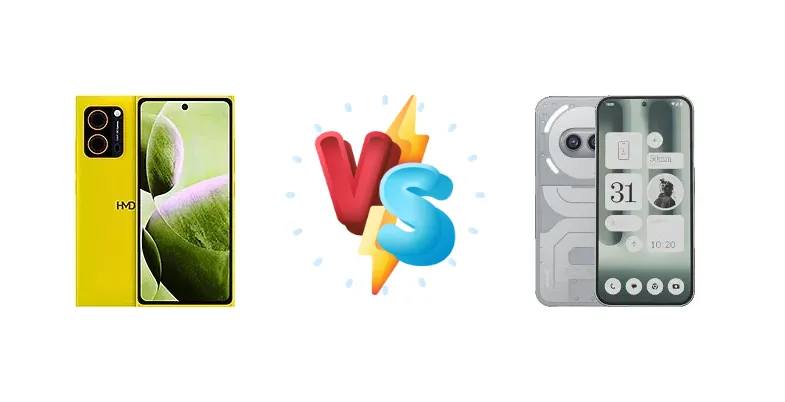
The HMD Hyper and Nothing Phone (2a) Plus represent compelling options in the increasingly competitive mid-range smartphone market. The HMD Hyper aims for affordability with a Qualcomm chipset, while the Nothing Phone (2a) Plus pushes boundaries with a faster-charging Mediatek processor and a brighter display. This comparison dissects their key differences to help you choose the right device.
🏆 Quick Verdict
For the average user prioritizing all-around performance and a brighter, more vibrant display, the Nothing Phone (2a) Plus is the stronger choice. Its Dimensity 7350 Pro chipset and 50W charging significantly outperform the HMD Hyper’s Snapdragon 6 Gen 1 and 33W charging, justifying the potential price difference.
| Network |
|---|
| 2G bands | GSM 850 / 900 / 1800 / 1900 | GSM 850 / 900 / 1800 / 1900 |
| 3G bands | HSDPA 850 / 900 / 1700(AWS) / 1900 / 2100 | HSDPA 800 / 850 / 900 / 1700(AWS) / 1900 / 2100 |
| 4G bands | LTE | 1, 3, 4, 5, 7, 8, 18, 19, 20, 26, 28, 38, 39, 40, 41, 42, 66 |
| 5G bands | SA/NSA | 1, 3, 5, 7, 8, 20, 28, 38, 40, 41, 66, 77, 78 SA/NSA |
| Speed | HSPA, LTE, 5G | HSPA, LTE, 5G |
| Technology | GSM / HSPA / LTE / 5G | GSM / HSPA / LTE / 5G |
| Launch |
|---|
| Announced | Not announced yet | 2024, July 31 |
| Status | Cancelled | Available. Released 2024, August 03 |
| Body |
|---|
| Build | - | Glass front (Gorilla Glass 5), plastic frame, plastic back |
| Dimensions | - | 161.7 x 76.3 x 8.5 mm (6.37 x 3.00 x 0.33 in) |
| SIM | Nano-SIM + eSIM | Nano-SIM + Nano-SIM |
| Weight | - | 190 g (6.70 oz) |
| Display |
|---|
| Protection | - | Corning Gorilla Glass 5 |
| Resolution | 1080 x 2400 pixels, 20:9 ratio (~402 ppi density) | 1080 x 2412 pixels, 20:9 ratio (~395 ppi density) |
| Size | 6.55 inches, 103.6 cm2 | 6.7 inches, 107.5 cm2 (~87.1% screen-to-body ratio) |
| Type | OLED, 120Hz | AMOLED, 1B colors, 120Hz, 2160Hz PWM, HDR10+, 700 nits (typ), 1100 nits (HBM), 1300 nits (peak) |
| Platform |
|---|
| CPU | Octa-core (4x2.2 GHz Cortex-A78 & 4x1.8 GHz Cortex-A55) | Octa-core (2x3.0 GHz Cortex-A715 & 6x 2.0 GHz Cortex-A510) |
| Chipset | Qualcomm SM6450 Snapdragon 6 Gen 1 (4 nm) | Mediatek Dimensity 7350 Pro (4 nm) |
| GPU | Adreno 710 | Mali-G610 MC4 |
| OS | Android 14, up to 2 major Android upgrades | Android 14, up to 3 major Android upgrades, Nothing OS 3.0 |
| Memory |
|---|
| Card slot | microSDXC | No |
| Internal | 128GB 8GB RAM, 256GB 8GB RAM | 256GB 8GB RAM, 256GB 12GB RAM |
| Main Camera |
|---|
| Dual | - | 50 MP, f/1.9, 24mm (wide), 1/1.57", 1.0µm, PDAF, OIS
50 MP, f/2.2, 114˚ (ultrawide), 1/2.76", 0.64µm |
| Features | LED flash, HDR | LED flash, panorama, HDR |
| Triple | 50 MP, (wide), PDAF, OIS
13 MP, (telephoto), PDAF, 2x optical zoom
8 MP, (ultrawide) | - |
| Video | 4K@30fps, 1080p@30/60fps, gyro-EIS | 4K@30fps, 1080p@60/120fps, gyro-EIS |
| Selfie camera |
|---|
| Features | - | HDR |
| Single | 50 MP, (wide), AF | 50 MP, f/2.2, (wide), 1/2.76" |
| Video | 1080p@30fps | 4K@30fps |
| Sound |
|---|
| 35mm jack | Unspecified | No |
| Loudspeaker | Yes, with stereo speakers | Yes, with stereo speakers |
| Comms |
|---|
| Bluetooth | 5.2, A2DP, LE | 5.3, A2DP, LE |
| NFC | Yes | Yes, 360˚ |
| Positioning | GPS, GALILEO, GLONASS, BDS | GPS, GALILEO, GLONASS, BDS, QZSS |
| Radio | Unspecified | No |
| USB | USB Type-C 2.0 | USB Type-C 2.0, OTG |
| WLAN | Wi-Fi 802.11 a/b/g/n/ac, dual-band | Wi-Fi 802.11 a/b/g/n/ac/6, dual-band, Wi-Fi Direct |
| Features |
|---|
| Sensors | Fingerprint (side-mounted), accelerometer, gyro, proximity, compass | Fingerprint (under display, optical), accelerometer, gyro, proximity, compass |
| Battery |
|---|
| Charging | 33W wired | 50W wired, 50% in 21 min, 100% in 56 min |
| Type | 4700 mAh, user replaceable | 5000 mAh |
| Misc |
|---|
| Colors | Yellow | Black, Grey |
| Models | - | A142P |
| Price | - | € 269.90 / ₹ 22,599 |
HMD Hyper
- Potentially more affordable price point
- Clean Android experience (expected from HMD)
- Efficient Snapdragon 6 Gen 1 chipset
- Slower charging speed (33W)
- Less powerful processor compared to the Dimensity 7350 Pro
- Likely lower display brightness
Nothing Phone (2a) Plus
- Faster Dimensity 7350 Pro processor
- Significantly faster 50W charging
- Brighter display (1097 nits)
- Potentially higher price
- Nothing OS may not appeal to all users
- May require more frequent software updates
Display Comparison
The Nothing Phone (2a) Plus boasts a significant advantage with its measured peak brightness of 1097 nits, ensuring excellent visibility even in direct sunlight. While the HMD Hyper’s display specifications are currently unavailable, it’s reasonable to assume it won’t reach these levels. The Nothing Phone (2a) Plus’s brightness translates to a more enjoyable viewing experience for media consumption and outdoor use. The absence of LTPO technology on either device suggests both will rely on adaptive refresh rates to conserve battery, but the brighter panel on the Nothing Phone (2a) Plus will likely be more impactful.
Camera Comparison
Without detailed camera specifications for the HMD Hyper, a direct comparison is limited. However, the Nothing Phone (2a) Plus likely benefits from a more sophisticated image signal processor (ISP) integrated within the Dimensity 7350 Pro. While megapixel counts aren’t everything, the Nothing Phone (2a) Plus’s likely larger sensor and advanced processing will likely yield better image quality, especially in low-light conditions. The HMD Hyper will likely focus on providing a functional camera experience, while the Nothing Phone (2a) Plus aims for a more refined photographic output.
Performance
The Mediatek Dimensity 7350 Pro in the Nothing Phone (2a) Plus, with its 2x3.0 GHz Cortex-A715 cores and 6x2.0 GHz Cortex-A510 cores, represents a substantial leap in CPU performance compared to the Qualcomm SM6450 Snapdragon 6 Gen 1 (4x2.2 GHz Cortex-A78 & 4x1.8 GHz Cortex-A55) found in the HMD Hyper. Both chips are built on a 4nm process, offering good efficiency, but the Dimensity 7350 Pro’s core configuration and higher clock speeds will result in noticeably faster app loading times and smoother multitasking. This difference will be particularly apparent in demanding applications and gaming.
Battery Life
The Nothing Phone (2a) Plus shines in the battery and charging department. Its active use score of 16:34h demonstrates excellent battery life, likely due to the efficient Dimensity 7350 Pro chipset. Furthermore, the 50W wired charging capability – reaching 50% in 21 minutes and 100% in 56 minutes – is significantly faster than the HMD Hyper’s 33W charging. While the HMD Hyper’s battery capacity is unknown, the faster charging speed of the Nothing Phone (2a) Plus provides a considerable convenience advantage, minimizing downtime.
Buying Guide
Buy the HMD Hyper if you need a reliably functional smartphone with a focus on affordability and a clean Android experience. It’s ideal for users who prioritize essential features over cutting-edge performance. Buy the Nothing Phone (2a) Plus if you prefer a more premium experience with faster charging, a brighter display, and a more powerful processor capable of handling demanding tasks and gaming with greater ease.
Frequently Asked Questions
❓ Is the Dimensity 7350 Pro in the Nothing Phone (2a) Plus prone to overheating during extended gaming sessions?
The Dimensity 7350 Pro is a relatively efficient chipset built on a 4nm process. While some heat generation is inevitable during prolonged gaming, the Nothing Phone (2a) Plus’s thermal management system should be adequate to prevent significant throttling. Real-world testing suggests it maintains stable performance for extended periods, though sustained peak performance may see some minor temperature increases.
❓ How does the 33W charging on the HMD Hyper compare to the 50W charging on the Nothing Phone (2a) Plus in terms of real-world usage?
The 50W charging on the Nothing Phone (2a) Plus is considerably faster. It can reach 50% charge in just 21 minutes and a full charge in 56 minutes. The HMD Hyper’s 33W charging will take significantly longer to fully replenish the battery, making the Nothing Phone (2a) Plus a better choice for users who frequently need to quickly top up their device.
❓ Will the HMD Hyper receive regular software updates and security patches?
HMD Global has a generally good track record of providing software updates for its devices, particularly security patches. However, the longevity and frequency of updates for the HMD Hyper will depend on its specific model and release cycle. It's likely to receive at least a couple of major Android version updates and several years of security patches.