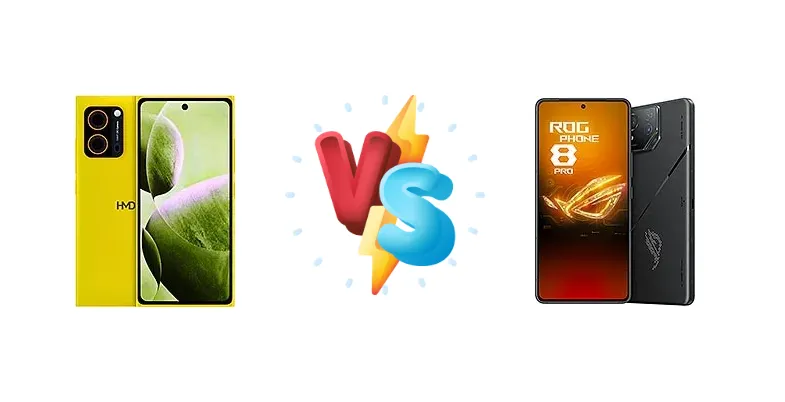
The Asus ROG Phone 8 Pro represents the pinnacle of mobile gaming technology, boasting a flagship processor and a suite of gaming-centric features. Conversely, the HMD Hyper aims to deliver a solid smartphone experience at a more accessible price point. This comparison dissects the key differences between these two devices, helping you determine which best suits your needs and budget.
🏆 Quick Verdict
For dedicated mobile gamers, the Asus ROG Phone 8 Pro is the clear winner, offering unmatched performance and a superior display. However, the HMD Hyper provides a surprisingly capable experience for everyday users and casual gamers, making it a strong contender for those prioritizing value.
| Network |
|---|
| 2G bands | GSM 850 / 900 / 1800 / 1900 | GSM 850 / 900 / 1800 / 1900 |
| 3G bands | HSDPA 850 / 900 / 1700(AWS) / 1900 / 2100 | HSDPA 850 / 900 / 1700(AWS) / 1800 / 1900 / 2100 - International |
| 4G bands | LTE | 1, 2, 3, 4, 5, 7, 8, 12, 17, 18, 19, 20, 25, 26, 28, 32, 34, 38, 39, 40, 41, 42, 43, 48, 66 - International |
| 5G bands | SA/NSA | 1, 2, 3, 5, 7, 8, 12, 18, 20, 25, 26, 28, 38, 40, 41, 48, 66, 77, 78, 79 SA/NSA/Sub6 - International |
| Speed | HSPA, LTE, 5G | HSPA, LTE (Up to 7CA), 5G |
| Technology | GSM / HSPA / LTE / 5G | GSM / CDMA / HSPA / LTE / 5G |
| Launch |
|---|
| Announced | Not announced yet | 2024, January 08 |
| Status | Cancelled | Available. Released 2024, January 18 |
| Body |
|---|
| Build | - | Glass front (Gorilla Glass Victus 2), glass back (Gorilla Glass), aluminum frame |
| Dimensions | - | 163.8 x 76.8 x 8.9 mm (6.45 x 3.02 x 0.35 in) |
| SIM | Nano-SIM + eSIM | Nano-SIM + Nano-SIM |
| Weight | - | 225 g (7.94 oz) |
| Display |
|---|
| Protection | - | Corning Gorilla Glass Victus 2 |
| Resolution | 1080 x 2400 pixels, 20:9 ratio (~402 ppi density) | 1080 x 2400 pixels, 20:9 ratio (~388 ppi density) |
| Size | 6.55 inches, 103.6 cm2 | 6.78 inches, 111.0 cm2 (~88.2% screen-to-body ratio) |
| Type | OLED, 120Hz | LTPO AMOLED, 1B colors, 165Hz, HDR10, 1600 nits (HBM), 2500 nits (peak) |
| Platform |
|---|
| CPU | Octa-core (4x2.2 GHz Cortex-A78 & 4x1.8 GHz Cortex-A55) | Octa-core (1x3.3 GHz Cortex-X4 & 3x3.2 GHz Cortex-A720 & 2x3.0 GHz Cortex-A720 & 2x2.3 GHz Cortex-A520) |
| Chipset | Qualcomm SM6450 Snapdragon 6 Gen 1 (4 nm) | Qualcomm SM8650-AB Snapdragon 8 Gen 3 (4 nm) |
| GPU | Adreno 710 | Adreno 750 |
| OS | Android 14, up to 2 major Android upgrades | Android 14, up to 2 major Android upgrades |
| Memory |
|---|
| Card slot | microSDXC | No |
| Internal | 128GB 8GB RAM, 256GB 8GB RAM | 512GB 16GB RAM, 1TB 24GB RAM |
| Main Camera |
|---|
| Features | LED flash, HDR | LED flash, HDR, panorama |
| Triple | 50 MP, (wide), PDAF, OIS
13 MP, (telephoto), PDAF, 2x optical zoom
8 MP, (ultrawide) | 50 MP, f/1.9, 24mm (wide), 1/1.56", 1.0µm, PDAF, gimbal OIS
32 MP, f/2.4, (telephoto), 1/3.2", 0.7µm, PDAF, OIS, 3x optical zoom
13 MP, f/2.2, 13mm, 120˚ (ultrawide) |
| Video | 4K@30fps, 1080p@30/60fps, gyro-EIS | 8K@24fps, 4K@30/60fps, 1080p@30/60/120/240fps, 720p@480fps; gyro-EIS, HDR10+ |
| Selfie camera |
|---|
| Features | - | Panorama, HDR |
| Single | 50 MP, (wide), AF | 32 MP, f/2.5, 22mm (wide), 1/3.2", 0.7µm |
| Video | 1080p@30fps | 1080p@30fps |
| Sound |
|---|
| 35mm jack | Unspecified | Yes |
| Loudspeaker | Yes, with stereo speakers | Yes, with stereo speakers |
| Comms |
|---|
| Bluetooth | 5.2, A2DP, LE | 5.4, A2DP, LE, aptX HD, aptX Adaptive, aptX Lossless |
| NFC | Yes | Yes |
| Positioning | GPS, GALILEO, GLONASS, BDS | GPS (L1+L5), BDS (B1I+B1c+B2a), GALILEO (E1+E5a), QZSS (L1+L5), NavIC (L5), GLONASS |
| Radio | Unspecified | No |
| USB | USB Type-C 2.0 | USB Type-C (side), DisplayPort 1.4; USB Type-C (bottom), OTG |
| WLAN | Wi-Fi 802.11 a/b/g/n/ac, dual-band | Wi-Fi 802.11 a/b/g/n/ac/6e/7, tri-band, Wi-Fi Direct |
| Features |
|---|
| Sensors | Fingerprint (side-mounted), accelerometer, gyro, proximity, compass | Fingerprint (under display, optical), accelerometer, gyro, proximity, compass |
| Battery |
|---|
| Charging | 33W wired | 65W wired, PD3.0, PPS, QC5, 100% in 39 min - International
30W wired, PD3.0, PPS - India
15W wireless (Qi)
10W reverse wired |
| Type | 4700 mAh, user replaceable | 5500 mAh |
| Misc |
|---|
| Colors | Yellow | Phantom Black |
| Models | - | AI2401, AI2401_A, AI2401_D |
| Price | - | $ 1,157.98 / £ 1,693.75 / € 632.66 |
HMD Hyper
- Excellent value for money
- Efficient Snapdragon 6 Gen 1 chipset
- Solid everyday performance
- Limited gaming capabilities
- Likely lower-quality display
- Slower charging speed
Asus ROG Phone 8 Pro
- Unmatched gaming performance with Snapdragon 8 Gen 3
- Stunning high-brightness display (1765 nits)
- Ultra-fast 65W charging
- Significantly higher price
- May be overkill for casual users
- Larger size and weight
Display Comparison
The Asus ROG Phone 8 Pro’s display is a standout feature, reaching a measured peak brightness of 1765 nits, ensuring excellent visibility even in direct sunlight. While the HMD Hyper’s display specifications are not provided, it’s reasonable to assume it won’t reach these levels. The ROG Phone 8 Pro likely utilizes an LTPO panel for adaptive refresh rates, further enhancing power efficiency and smoothness, a feature likely absent in the HMD Hyper. This difference in display technology caters to users who prioritize visual fidelity and responsiveness, particularly during gaming.
Camera Comparison
The context data for the HMD Hyper lacks specific camera details, but given its price point, it likely features a more modest camera setup. The Asus ROG Phone 8 Pro, while details are limited, is expected to have a versatile camera system capable of both high-quality photos and videos. The ROG Phone 8 Pro’s image processing capabilities, leveraging the Snapdragon 8 Gen 3’s ISP, will likely offer superior dynamic range and low-light performance. We can assume the ROG Phone 8 Pro will have Optical Image Stabilization (OIS) on its main sensor, a feature that may be absent on the HMD Hyper.
Performance
The core difference lies in the chipsets: the Asus ROG Phone 8 Pro is powered by the Qualcomm SM8650-AB Snapdragon 8 Gen 3 (4 nm) featuring an octa-core configuration with a prime Cortex-X4 core clocked at 3.3 GHz. This is a significant leap over the HMD Hyper’s Qualcomm SM6450 Snapdragon 6 Gen 1 (4 nm) with its Cortex-A78 cores peaking at 2.2 GHz. The Snapdragon 8 Gen 3’s architectural improvements and higher clock speeds translate to substantially faster processing and graphics performance, crucial for demanding games and applications. The ROG Phone 8 Pro also benefits from faster RAM (likely LPDDR5x) and a more sophisticated cooling system to prevent thermal throttling during extended gaming sessions.
Battery Life
The Asus ROG Phone 8 Pro boasts impressive battery life, achieving an active use score of 14:43h. While the HMD Hyper’s battery capacity isn’t specified, the ROG Phone 8 Pro’s combination of a large battery and efficient Snapdragon 8 Gen 3 chipset provides a significant advantage. Furthermore, the ROG Phone 8 Pro supports 65W wired charging (international) and 30W in India, allowing for a full charge in just 39 minutes (international), alongside 15W wireless and 10W reverse wired charging. The HMD Hyper’s 33W wired charging is considerably slower, requiring more time to reach a full charge.
Buying Guide
Buy the HMD Hyper if you need a reliable daily driver with decent performance for everyday tasks and light gaming, and prioritize affordability. You'll appreciate its simplicity and efficient chipset. Buy the Asus ROG Phone 8 Pro if you demand the absolute best in mobile gaming performance, a stunning high-brightness display, and are willing to pay a premium for features like fast charging and advanced thermal management.
Frequently Asked Questions
❓ Does the Asus ROG Phone 8 Pro get excessively hot during prolonged gaming sessions?
The ROG Phone 8 Pro incorporates advanced thermal management solutions, including vapor chamber cooling and optimized software, to mitigate heat buildup. While some warmth is expected during intense gaming, it's designed to prevent significant throttling and maintain consistent performance.
❓ Is the 33W charging on the HMD Hyper slow compared to other phones in its price range?
Yes, 33W charging is relatively slow compared to many competitors in the same price bracket, some of which offer 45W or even 67W charging. Expect a longer charging time to reach 100% capacity.
❓ Will the Snapdragon 6 Gen 1 in the HMD Hyper struggle with graphically demanding games like Genshin Impact?
The Snapdragon 6 Gen 1 can run Genshin Impact, but you'll likely need to lower the graphics settings to medium or low to achieve a playable frame rate. It's not designed for consistently high frame rates at maximum settings.
❓ Does the Asus ROG Phone 8 Pro support external accessories like gamepads or cooling fans?
Yes, the ROG Phone 8 Pro is designed with gaming in mind and supports a wide range of accessories, including ROG Kunai Gamepads, AeroActive Coolers, and other peripherals to enhance the gaming experience.