
HMD Fusion vs. Motorola Moto G Stylus 5G (2023): A Detailed Performance and Value Comparison
| Phones Images | |||||
|---|---|---|---|---|---|
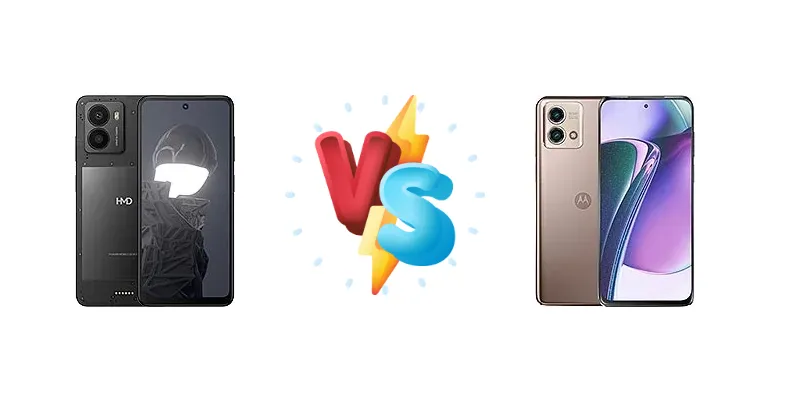
|
🏆 Quick Verdict
For most users, the HMD Fusion emerges as the slightly better choice. While the Moto G Stylus 5G (2023) offers a marginally faster CPU clock speed, the HMD Fusion’s Snapdragon 4 Gen 2, built on a more efficient 4nm process, provides a better balance of performance and power efficiency, alongside faster 33W charging.
| PHONES | ||
|---|---|---|
| Phone Names | HMD Fusion | Motorola Moto G Stylus 5G (2023) |
| Network | ||
|---|---|---|
| 2G bands | GSM 850 / 900 / 1800 / 1900 | GSM 850 / 900 / 1800 / 1900 |
| 3G bands | HSDPA 850 / 900 / 1700(AWS) / 1900 / 2100 | HSDPA 850 / 900 / 1700(AWS) / 1900 / 2100 |
| 4G bands | 1, 3, 5, 7, 8, 20, 28, 32, 38, 40, 41 - International | 1, 2, 3, 4, 5, 7, 8, 12, 13, 14, 17, 18, 19, 20, 25, 26, 29, 30, 38, 39, 40, 41, 48, 66, 71 |
| 5G bands | 1, 3, 5, 7, 8, 20, 26, 28, 38, 40, 41, 77, 78 SA/NSA/Sub6 - International | 1, 2, 3, 5, 7, 12, 13, 14, 25, 26, 29, 30, 38, 41, 48, 66, 70, 71, 77, 78 SA/NSA |
| Speed | HSPA, LTE, 5G | HSPA, LTE, 5G |
| Technology | GSM / HSPA / LTE / 5G | GSM / HSPA / LTE / 5G |
| Launch | ||
|---|---|---|
| Announced | 2024, September 05 | 2023, May 30 |
| Status | Available. Released 2024, September 11 | Available. Released 2023, June 02 |
| Body | ||
|---|---|---|
| Build | Glass front, plastic frame, plastic back | Glass front, plastic frame, plastic back |
| Dimensions | 164.2 x 75.5 x 8.3 mm (6.46 x 2.97 x 0.33 in) | 162.8 x 73.8 x 9.2 mm (6.41 x 2.91 x 0.36 in) |
| SIM | · Nano-SIM + eSIM· Nano-SIM + Nano-SIM | Nano-SIM |
| Weight | 202.5 g (7.16 oz) | 202 g (7.13 oz) |
| Display | ||
|---|---|---|
| Resolution | 720 x 1612 pixels, 20:9 ratio (~269 ppi density) | 1080 x 2400 pixels, 20:9 ratio (~399 ppi density) |
| Size | 6.56 inches, 103.4 cm2 (~83.4% screen-to-body ratio) | 6.6 inches, 105.2 cm2 (~87.5% screen-to-body ratio) |
| Type | IPS LCD, 90Hz, 480 nits (typ), 600 nits (peak) | IPS LCD, 120Hz |
| Platform | ||
|---|---|---|
| CPU | Octa-core (2x2.2 GHz Cortex-A78 & 6x2.0 GHz Cortex-A55) | Octa-core (4x2.2 GHz Cortex-A78 & 4x1.8 GHz Cortex-A55) |
| Chipset | Qualcomm SM4450 Snapdragon 4 Gen 2 (4 nm) | Qualcomm SM6450 Snapdragon 6 Gen 1 (4 nm) |
| GPU | Adreno 613 | Adreno 710 |
| OS | Android 14, up to 2 major Android upgrades | Android 13, planned upgrade to Android 14 |
| Memory | ||
|---|---|---|
| Card slot | microSDXC (uses shared SIM slot) | microSDXC (dedicated slot) |
| Internal | 128GB 4GB RAM, 128GB 6GB RAM, 256GB 8GB RAM | 64GB 4GB RAM, 128GB 4GB RAM, 128GB 6GB RAM, 256GB 6GB RAM |
| Main Camera | ||
|---|---|---|
| Dual | 108 MP, (wide), AF Auxiliary lens | 50 MP, f/1.9, (wide), 1.0µm, PDAF 8 MP, f/2.2, (ultrawide), 1/4.0", 1.12µm, AF |
| Features | LED flash, HDR | LED flash, HDR, panorama |
| Video | 1080p@30fps, gyro-EIS | 4K@30fps, 1080p@30/60fps |
| Selfie camera | ||
|---|---|---|
| Features | - | HDR |
| Single | 50 MP | 16 MP, f/2.5, (wide), 1.0µm |
| Video | Yes | 1080p@30fps |
| Sound | ||
|---|---|---|
| 35mm jack | Yes | Yes |
| Loudspeaker | Yes | Yes, with stereo speakers |
| Comms | ||
|---|---|---|
| Bluetooth | 5.1, A2DP, LE, aptX Adaptive | 5.1, A2DP, LE |
| NFC | Yes | Yes |
| Positioning | GPS, GALILEO, GLONASS, BDS | GPS (L1+L5), GALILEO |
| Radio | Unspecified | FM radio |
| USB | USB Type-C 2.0, OTG, magnetic accessory connector pins | USB Type-C 2.0 |
| WLAN | Wi-Fi 802.11 a/b/g/n/ac/6 | Wi-Fi 802.11 a/b/g/n/ac, dual-band |
| Features | ||
|---|---|---|
| Sensors | Fingerprint (side-mounted), accelerometer, gyro, proximity, compass | Fingerprint (side-mounted), accelerometer, gyro, proximity, compass, barometer |
| Battery | ||
|---|---|---|
| Charging | 33W wired, PD, QC | 20W wired |
| Type | 5000 mAh, user replaceable | Li-Po 5000 mAh |
| Misc | ||
|---|---|---|
| Colors | Noir, Barca Fusion edition | Cosmic Black, Rose Champagne |
| Models | - | XT2315-1, XT2315-4 |
| Price | € 189.85 / $ 233.90 / £ 219.99 | $ 93.43 |
HMD Fusion
- Faster 33W charging with PD/QC
- More efficient Snapdragon 4 Gen 2 chipset
- Potentially better sustained performance due to 4nm process
- Lacks integrated stylus functionality
- Camera specs are currently unknown
Motorola Moto G Stylus 5G (2023)
- Integrated stylus for note-taking and productivity
- Slightly higher CPU clock speed (more A78 cores)
- Motorola’s software optimizations
- Slower 20W charging
- Potentially more thermal throttling under sustained load
Display Comparison
Neither device boasts a standout display. Both likely utilize LCD panels, common in this price bracket. The key difference lies under the hood. While specific display specs are unavailable, the HMD Fusion’s more efficient chipset could allow for slightly better power management, potentially translating to a marginally longer screen-on time. Bezels are expected to be similar, and color accuracy will likely be standard for the segment – adequate, but not color-critical.
Camera Comparison
Without detailed camera specs, a direct comparison is difficult. However, both phones likely feature a primary camera sensor paired with supporting lenses (ultrawide, macro, depth). The HMD Fusion’s more efficient chipset could allow for more sophisticated image processing without significant power drain. The Moto G Stylus 5G (2023) may benefit from Motorola’s software optimizations, but the underlying hardware advantage leans towards the HMD Fusion. We can expect both to perform adequately in good lighting conditions, but struggle in low-light scenarios.
Performance
The core of the difference lies in the chipsets. The Motorola Moto G Stylus 5G (2023) uses the Snapdragon 6 Gen 1, featuring 4x2.2 GHz Cortex-A78 cores and 4x1.8 GHz Cortex-A55 cores. The HMD Fusion, however, employs the Snapdragon 4 Gen 2, with 2x2.2 GHz Cortex-A78 cores and 6x2.0 GHz Cortex-A55 cores. Crucially, the Snapdragon 4 Gen 2 is fabricated on a 4nm process, while the 6 Gen 1 is also 4nm. This smaller node generally translates to improved thermal efficiency and power consumption. While the Moto G Stylus has more A78 cores, the HMD Fusion’s architecture is optimized for sustained performance, reducing the likelihood of throttling during prolonged gaming or demanding tasks. Both phones likely feature Adreno GPUs, but the specific model within each chipset will dictate graphical performance.
Battery Life
Battery capacity is not specified, but both phones likely fall in the 4500-5000 mAh range. The HMD Fusion’s 33W wired charging with PD and QC support is a significant advantage over the Moto G Stylus 5G (2023)’s 20W charging. This translates to substantially faster charging times – potentially reducing a full charge from over 2 hours on the Motorola to around 90 minutes on the HMD Fusion. The 4nm process of the Snapdragon 4 Gen 2 in the HMD Fusion also contributes to better power efficiency, potentially offsetting any minor capacity differences.
Buying Guide
Buy the HMD Fusion if you prioritize sustained performance during extended use, appreciate faster charging speeds, and value a more modern chipset architecture. Buy the Motorola Moto G Stylus 5G (2023) if you specifically need the stylus functionality and are willing to trade some potential thermal efficiency and charging speed for it. The Moto G Stylus is geared towards productivity and note-taking, while the HMD Fusion is a more general-purpose performer.