
HMD Fusion vs Google Pixel 6a: Which Mid-Range Phone Reigns Supreme?
| Phones Images | |||||
|---|---|---|---|---|---|
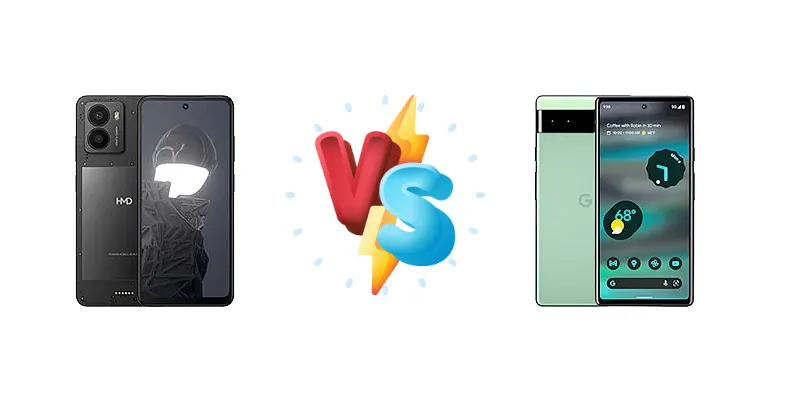
|
🏆 Quick Verdict
For most users, the Google Pixel 6a emerges as the stronger choice. While the HMD Fusion offers a newer chipset architecture, the Pixel 6a’s Tensor chip delivers superior real-world performance and benefits from Google’s renowned computational photography, making it a more polished and capable device.
| PHONES | ||
|---|---|---|
| Phone Names | HMD Fusion | Google Pixel 6a |
| Network | ||
|---|---|---|
| 2G bands | GSM 850 / 900 / 1800 / 1900 | GSM 850 / 900 / 1800 / 1900 |
| 3G bands | HSDPA 850 / 900 / 1700(AWS) / 1900 / 2100 | HSDPA 800 / 850 / 900 / 1700(AWS) / 1900 / 2100 |
| 4G bands | 1, 3, 5, 7, 8, 20, 28, 32, 38, 40, 41 - International | 1, 2, 3, 4, 5, 7, 8, 12, 13, 14, 17, 18, 19, 20, 25, 26, 28, 29, 30, 38, 39, 40, 41, 42, 48, 66, 71 - GX7AS, GB62Z (USA/Canada) |
| 5G bands | 1, 3, 5, 7, 8, 20, 26, 28, 38, 40, 41, 77, 78 SA/NSA/Sub6 - International | 1, 2, 3, 5, 7, 8, 12, 20, 25, 28, 30, 38, 40, 41, 48, 66, 71, 77, 78 SA/NSA/Sub6 - GX7AS (USA/Canada) |
| Speed | HSPA, LTE, 5G | HSPA, LTE, 5G |
| Technology | GSM / HSPA / LTE / 5G | GSM / HSPA / LTE / 5G |
| - | 1, 2, 3, 5, 7, 8, 12, 20, 25, 28, 30, 40, 48, 66, 71, 77, 78 SA/NSA/Sub6 - G1AZG (International) | |
| Launch | ||
|---|---|---|
| Announced | 2024, September 05 | 2022, May 11 |
| Status | Available. Released 2024, September 11 | Available. Released 2022, July 21 |
| Body | ||
|---|---|---|
| Build | Glass front, plastic frame, plastic back | Glass front (Gorilla Glass 3), aluminum frame, plastic back |
| Dimensions | 164.2 x 75.5 x 8.3 mm (6.46 x 2.97 x 0.33 in) | 152.2 x 71.8 x 8.9 mm (5.99 x 2.83 x 0.35 in) |
| SIM | · Nano-SIM + eSIM· Nano-SIM + Nano-SIM | Nano-SIM + eSIM |
| Weight | 202.5 g (7.16 oz) | 178 g (6.28 oz) |
| - | IP67 dust/water resistant (up to 1m for 30 min) | |
| Display | ||
|---|---|---|
| Protection | - | Corning Gorilla Glass 3 |
| Resolution | 720 x 1612 pixels, 20:9 ratio (~269 ppi density) | 1080 x 2400 pixels, 20:9 ratio (~429 ppi density) |
| Size | 6.56 inches, 103.4 cm2 (~83.4% screen-to-body ratio) | 6.1 inches, 90.7 cm2 (~83.0% screen-to-body ratio) |
| Type | IPS LCD, 90Hz, 480 nits (typ), 600 nits (peak) | OLED, HDR |
| - | Always-on display | |
| Platform | ||
|---|---|---|
| CPU | Octa-core (2x2.2 GHz Cortex-A78 & 6x2.0 GHz Cortex-A55) | Octa-core (2x2.80 GHz Cortex-X1 & 2x2.25 GHz Cortex-A76 & 4x1.80 GHz Cortex-A55) |
| Chipset | Qualcomm SM4450 Snapdragon 4 Gen 2 (4 nm) | Google Tensor (5 nm) |
| GPU | Adreno 613 | Mali-G78 MP20 |
| OS | Android 14, up to 2 major Android upgrades | Android 12, upgradable to Android 15, up to 5 major Android upgrades |
| Memory | ||
|---|---|---|
| Card slot | microSDXC (uses shared SIM slot) | No |
| Internal | 128GB 4GB RAM, 128GB 6GB RAM, 256GB 8GB RAM | 128GB 6GB RAM |
| - | UFS 3.1 | |
| Main Camera | ||
|---|---|---|
| Dual | 108 MP, (wide), AF Auxiliary lens | 12.2 MP, f/1.7, 27mm, (wide), 1/2.55", 1.4µm, dual pixel PDAF, OIS 12 MP, f/2.2, 17mm, 114˚ (ultrawide), 1.25µm |
| Features | LED flash, HDR | Dual-LED flash, Pixel Shift, Auto-HDR, panorama |
| Single | - | 8 MP, f/2.0, 24mm (wide), 1.12µm |
| Video | 1080p@30fps, gyro-EIS | 4K@30/60fps, 1080p@30/60/120/240fps; gyro-EIS, OIS |
| Selfie camera | ||
|---|---|---|
| Features | - | HDR, panorama |
| Single | 50 MP | 8 MP, f/2.0, 24mm (wide), 1.12µm |
| Video | Yes | 1080p@30fps |
| Sound | ||
|---|---|---|
| 3.5mm jack | - | No |
| 35mm jack | Yes | No |
| Loudspeaker | Yes | Yes, with stereo speakers |
| Comms | ||
|---|---|---|
| Bluetooth | 5.1, A2DP, LE, aptX Adaptive | 5.2, A2DP, LE |
| NFC | Yes | Yes |
| Positioning | GPS, GALILEO, GLONASS, BDS | GPS, GLONASS, GALILEO, QZSS |
| Radio | Unspecified | No |
| USB | USB Type-C 2.0, OTG, magnetic accessory connector pins | USB Type-C 3.1 |
| WLAN | Wi-Fi 802.11 a/b/g/n/ac/6 | Wi-Fi 802.11 a/b/g/n/ac/6e, dual-band, Wi-Fi Direct |
| Features | ||
|---|---|---|
| Sensors | Fingerprint (side-mounted), accelerometer, gyro, proximity, compass | Fingerprint (under display, optical), accelerometer, gyro, proximity, compass, barometer |
| Battery | ||
|---|---|---|
| Charging | 33W wired, PD, QC | 18W wired, PD3.0 |
| Type | 5000 mAh, user replaceable | Li-Po 4410 mAh |
| Misc | ||
|---|---|---|
| Colors | Noir, Barca Fusion edition | Chalk, Charcoal, Sage |
| Models | - | GX7AS, GB62Z, G1AZG, GB17L |
| Price | € 189.85 / $ 233.90 / £ 219.99 | $ 138.99 / C$ 228.74 / ₹ 23,999 |
| Tests | ||
|---|---|---|
| Battery life | - | Endurance rating 94h |
| Display | - | Contrast ratio: Infinite (nominal) |
HMD Fusion
- Faster 33W charging with PD/QC
- Potentially better thermal efficiency due to 4nm process
- Newer chipset architecture (Snapdragon 4 Gen 2)
- Likely lower peak performance compared to Google Tensor
- Less refined software experience (potentially)
Google Pixel 6a
- Superior performance with Google Tensor chip
- Exceptional camera quality and image processing
- Guaranteed software updates from Google
- Slower 18W charging
- May experience more thermal throttling under sustained load
Display Comparison
The Google Pixel 6a’s display boasts a measured peak brightness of 876 nits, providing excellent visibility even in bright outdoor conditions. While the HMD Fusion’s display specifications are not provided, it’s likely to be lower, given the device’s positioning. The Pixel 6a’s ‘infinite’ contrast ratio (nominal) suggests a high-quality OLED panel, offering deep blacks and vibrant colors. The absence of LTPO technology on either device means neither offers adaptive refresh rates, but the Pixel 6a’s superior brightness and contrast give it a clear advantage for media consumption and outdoor use.
Camera Comparison
The Pixel 6a is renowned for its computational photography prowess, leveraging Google’s image processing algorithms to deliver consistently excellent results. While the HMD Fusion’s camera specifications are not detailed, it’s unlikely to match the Pixel 6a’s capabilities. The Pixel 6a’s image processing excels in dynamic range, noise reduction, and detail preservation, even in challenging lighting conditions. The absence of information regarding OIS or sensor size on the HMD Fusion suggests a more basic camera system. The Pixel 6a’s focus on software optimization gives it a significant edge in image quality.
Performance
The core difference lies in the chipsets. The Google Pixel 6a’s Tensor chip (5nm) features a Cortex-X1 prime core clocked at 2.80 GHz, designed for peak performance, alongside A76 and A55 cores. This contrasts with the HMD Fusion’s Snapdragon 4 Gen 2 (4nm) which utilizes Cortex-A78 and A55 cores. While the 4nm process of the Snapdragon offers efficiency gains, the Tensor’s architectural advantages – particularly the X1 core – translate to noticeably faster application loading and smoother multitasking. The Pixel 6a’s Tensor also benefits from Google’s dedicated AI processing capabilities, enhancing features like voice recognition and image processing. The Snapdragon 4 Gen 2 is a capable chip, but it’s positioned a tier below the Tensor in terms of raw processing power.
Battery Life
Both the HMD Fusion and Google Pixel 6a achieve an endurance rating of 94 hours, indicating comparable battery life under similar usage scenarios. However, charging speeds differ significantly. The HMD Fusion supports 33W wired charging with PD and QC, allowing for faster top-ups compared to the Pixel 6a’s 18W wired charging with PD3.0. While both phones offer similar overall endurance, the HMD Fusion’s faster charging capability provides greater convenience for users who frequently need to quickly replenish their battery.
Buying Guide
Buy the HMD Fusion if you prioritize long-term efficiency and potentially better thermal management due to the 4nm Snapdragon 4 Gen 2, and are comfortable with a potentially less refined software experience. Buy the Google Pixel 6a if you value a smoother, more responsive user experience, exceptional camera performance powered by Google’s image processing, and guaranteed software updates directly from Google.