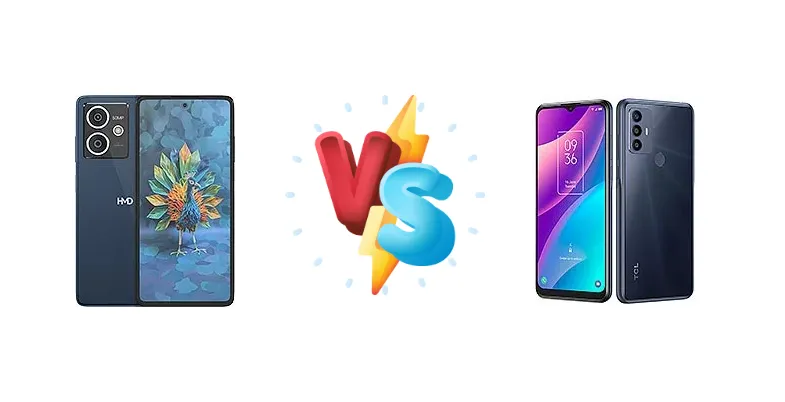
The HMD Crest and TCL 30 SE represent two distinct approaches to the budget smartphone market. The HMD Crest aims for a performance edge with its newer Unisoc T760 chipset, while the TCL 30 SE prioritizes efficiency with the MediaTek Helio G25. This comparison dissects their key differences to determine which device delivers the best value for your money.
🏆 Quick Verdict
For users prioritizing responsiveness and future-proofing, the HMD Crest is the clear winner. Its Unisoc T760 chipset, built on a 6nm process, offers significantly better performance than the TCL 30 SE’s 12nm Helio G25. While the TCL 30 SE offers a slightly longer potential battery life due to its more efficient chip, the Crest’s faster 33W charging mitigates this advantage.
| Network |
|---|
| 2G bands | GSM 850 / 900 / 1800 / 1900 | GSM 850 / 900 / 1800 / 1900 |
| 3G bands | HSDPA 850 / 900 / 2100 | HSDPA 850 / 900 / 1900 / 2100 - EMEA/APAC |
| 4G bands | 1, 3, 5, 8, 28, 40, 41 | 1, 3, 5, 7, 8, 20, 28, 38, 40, 41 - EMEA |
| 5G bands | 1, 3, 28, 40, 78 SA/NSA | - |
| Speed | HSPA, LTE, 5G | HSPA 42.2/11.5 Mbps, LTE Cat4 150/50 Mbps |
| Technology | GSM / HSPA / LTE / 5G | GSM / HSPA / LTE |
| | - | 2, 3, 4, 5, 7, 8, 12, 13, 17, 26, 28, 66 - LATAM |
| Launch |
|---|
| Announced | 2024, July 25 | 2022, February 27 |
| Status | Available. Released 2024, August 07 | Available. Released 2022, April 20 |
| Body |
|---|
| Build | - | Glass front, plastic frame, plastic back |
| Dimensions | 163.9 x 76.4 x 8.4 mm (6.45 x 3.01 x 0.33 in) | 165.2 x 75.5 x 8.9 mm (6.50 x 2.97 x 0.35 in) |
| SIM | Nano-SIM + Nano-SIM | · Nano-SIM· Nano-SIM + Nano-SIM |
| Weight | 205 g (7.23 oz) | 190 g (6.70 oz) |
| Display |
|---|
| Resolution | 1080 x 2400 pixels, 20:9 ratio (~395 ppi density) | 720 x 1600 pixels, 20:9 ratio (~269 ppi density) |
| Size | 6.67 inches, 107.4 cm2 (~85.8% screen-to-body ratio) | 6.52 inches, 102.6 cm2 (~82.3% screen-to-body ratio) |
| Type | OLED | IPS LCD, 450 nits (typ) |
| Platform |
|---|
| CPU | Octa-core (1x2.2 GHz Cortex-A76 & 3x Cortex-A76 & 4x Cortex-A55) | Octa-core (4x2.0 GHz Cortex-A53 & 4x1.5 GHz Cortex-A53) |
| Chipset | Unisoc T760 (6 nm) | Mediatek MT6762G Helio G25 (12 nm) |
| GPU | Mali-G57 | PowerVR GE8320 |
| OS | Android 14 | Android 12, TCL UI 4.0 |
| Memory |
|---|
| Card slot | microSDXC (uses shared SIM slot) | microSDXC (dedicated slot) |
| Internal | 128GB 6GB RAM | 64GB 4GB RAM, 128GB 4GB RAM |
| | - | eMMC 5.1 |
| Main Camera |
|---|
| Dual | 50 MP, (wide), AF
Auxiliary lens | - |
| Features | LED flash, HDR | LED flash, HDR, panorama |
| Single | - | 8 MP, f/2.0, 26mm (wide), 1/4", 1.12µm |
| Triple | - | 50 MP, f/1.9, 28mm (wide), 1/2.76", 0.64µm, PDAF
2 MP (macro)
Auxiliary lens |
| Video | 1080p@30fps | 1080p@30fps |
| Selfie camera |
|---|
| Features | - | HDR |
| Single | 50 MP | 8 MP, f/2.0, 26mm (wide), 1/4.0", 1.12µm |
| Video | Yes | 1080p@30fps |
| Sound |
|---|
| 3.5mm jack | - | Yes |
| 35mm jack | Yes | Yes |
| Loudspeaker | Yes | Yes |
| Comms |
|---|
| Bluetooth | 5.0, A2DP, LE | 5.0, A2DP, LE |
| NFC | No | Yes (6165H/6165H1 only) |
| Positioning | GPS, GALILEO | GPS, GLONASS, GALILEO, BDS |
| Radio | Unspecified | Unspecified |
| USB | USB Type-C | USB Type-C 2.0 |
| WLAN | Wi-Fi 802.11 a/b/g/n/ac | Wi-Fi 802.11 b/g/n, Wi-Fi Direct |
| Features |
|---|
| Sensors | Fingerprint (side-mounted), accelerometer, gyro, proximity, compass | Fingerprint (rear-mounted), accelerometer, proximity, compass |
| Battery |
|---|
| Charging | 33W wired | 15W wired |
| Type | 5000 mAh, user replaceable | Li-Po 5000 mAh |
| Misc |
|---|
| Colors | Midnight Blue | Atlantic Blue, Space Gray, Glacial Blue |
| Models | - | 6165H, 6156H1, 6165A, 6165A1, 6165S |
| Price | $ 155.75 / ₹ 12,990 | - |
HMD Crest
- Significantly faster processor for smoother performance
- Faster 33W charging for reduced downtime
- More modern CPU architecture for future-proofing
- Potentially slightly lower battery life under light usage
- Unisoc chipset may have less software optimization compared to MediaTek
TCL 30 SE
- Potentially longer battery life with light usage
- More power-efficient chipset
- Likely lower price point
- Slower processor resulting in sluggish performance
- Slower 15W charging
- Older CPU architecture
Display Comparison
Neither device boasts a standout display. Given the context data focuses on processing power, we can infer both likely utilize LCD panels common in this price bracket. The absence of refresh rate information suggests both are likely 60Hz. The TCL 30 SE’s display quality will likely be adequate for basic viewing, but the HMD Crest’s chipset could potentially drive a higher resolution panel if implemented, offering a sharper image. Bezels are expected to be similar on both, reflecting their budget positioning.
Camera Comparison
Without detailed camera specifications, it’s difficult to make a definitive judgment. However, the chipset difference suggests the HMD Crest will have more processing power available for image signal processing (ISP), potentially leading to better image quality, especially in low-light conditions. The TCL 30 SE’s Helio G25 may struggle with complex image processing tasks. We can assume both phones will include a standard set of cameras, but the HMD Crest’s ISP is likely to extract more detail and dynamic range from the sensors.
Performance
The core difference lies in the chipsets. The HMD Crest’s Unisoc T760 (6nm) is a substantial upgrade over the TCL 30 SE’s MediaTek Helio G25 (12nm). The T760 features a more modern CPU architecture – a combination of Cortex-A76 cores – offering significantly improved single-core and multi-core performance. The Helio G25 relies on older Cortex-A53 cores, resulting in slower processing speeds and reduced efficiency. The 6nm fabrication process of the T760 also contributes to better thermal management, reducing the likelihood of throttling during sustained workloads. This translates to a smoother user experience, faster app loading times, and improved gaming performance on the HMD Crest.
Battery Life
The TCL 30 SE’s Helio G25, being a 12nm chip, is inherently more power-efficient than the HMD Crest’s 6nm Unisoc T760. This suggests the TCL 30 SE *could* offer longer battery life under light usage. However, the HMD Crest compensates with significantly faster 33W wired charging compared to the TCL 30 SE’s 15W charging. This means the Crest can replenish its battery much quicker, minimizing downtime. A full charge on the Crest is likely to take under 90 minutes, while the TCL 30 SE could take over two hours.
Buying Guide
Buy the HMD Crest if you need a phone capable of handling multitasking, moderate gaming, and demanding applications without significant slowdown. It’s ideal for users who want a device that feels responsive and won’t become obsolete quickly. Buy the TCL 30 SE if you prioritize absolute battery longevity and primarily use your phone for basic tasks like calls, texts, and light social media browsing. It’s a good choice for users on a very tight budget who don’t require high performance.
Frequently Asked Questions
❓ Will the Unisoc T760 in the HMD Crest handle demanding games like PUBG Mobile?
The Unisoc T760 is a significant step up from the Helio G25 and should be capable of running PUBG Mobile at medium settings with reasonable frame rates. However, don't expect flagship-level performance; you may need to lower graphics settings for a consistently smooth experience. The 6nm process should also help mitigate thermal throttling during extended gaming sessions.
❓ How much faster is the 33W charging on the HMD Crest compared to the 15W charging on the TCL 30 SE?
The 33W charging on the HMD Crest will significantly reduce charging times. While exact figures depend on battery capacity, you can expect the Crest to charge from 0-100% in approximately 90-120 minutes, whereas the TCL 30 SE will likely take over two hours. This difference is substantial for users who frequently need to top up their battery quickly.
❓ Is the TCL 30 SE a good choice for someone who primarily uses their phone for calls, texts, and social media?
Yes, the TCL 30 SE is well-suited for basic smartphone tasks. Its Helio G25 chipset is sufficient for handling calls, texts, and social media apps without significant lag. The focus on power efficiency also means it will likely offer good battery life for these use cases.