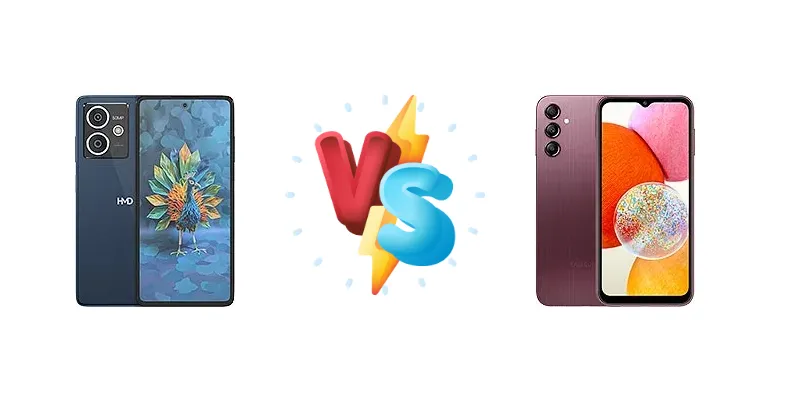
The HMD Crest and Samsung Galaxy A14 represent compelling options in the sub-$200 smartphone market. The Crest arrives with a newer Unisoc T760 chipset, while the A14 offers a choice between the Mediatek Helio G80 and the Exynos 850, creating a fascinating battle of architectures and efficiency. This comparison will dissect the key differences to help you choose the right device.
🏆 Quick Verdict
For most users, the HMD Crest emerges as the better value. Its more modern 6nm Unisoc T760 chipset offers a performance edge over the 12nm Helio G80 version of the A14, and even competes favorably with the 8nm Exynos 850, coupled with faster 33W charging. While Samsung's brand recognition is strong, the Crest delivers more for the money.
| Network |
|---|
| 2G bands | GSM 850 / 900 / 1800 / 1900 | GSM 850 / 900 / 1800 / 1900 |
| 3G bands | HSDPA 850 / 900 / 2100 | HSDPA 850 / 900 / 2100 |
| 4G bands | 1, 3, 5, 8, 28, 40, 41 | 1, 3, 5, 7, 8, 20, 28, 38, 40, 41 |
| 5G bands | 1, 3, 28, 40, 78 SA/NSA | - |
| Speed | HSPA, LTE, 5G | HSPA, LTE |
| Technology | GSM / HSPA / LTE / 5G | GSM / HSPA / LTE |
| Launch |
|---|
| Announced | 2024, July 25 | 2023, February 28 |
| Status | Available. Released 2024, August 07 | Available. Released 2023, March 27 |
| Body |
|---|
| Build | - | Glass front, plastic back, plastic frame |
| Dimensions | 163.9 x 76.4 x 8.4 mm (6.45 x 3.01 x 0.33 in) | 167.7 x 78 x 9.1 mm (6.60 x 3.07 x 0.36 in) |
| SIM | Nano-SIM + Nano-SIM | · Nano-SIM· Nano-SIM + Nano-SIM |
| Weight | 205 g (7.23 oz) | 201 g (7.09 oz) |
| Display |
|---|
| Resolution | 1080 x 2400 pixels, 20:9 ratio (~395 ppi density) | 1080 x 2408 pixels, 20:9 ratio (~400 ppi density) |
| Size | 6.67 inches, 107.4 cm2 (~85.8% screen-to-body ratio) | 6.6 inches, 104.9 cm2 (~80.2% screen-to-body ratio) |
| Type | OLED | PLS LCD |
| Platform |
|---|
| CPU | Octa-core (1x2.2 GHz Cortex-A76 & 3x Cortex-A76 & 4x Cortex-A55) | Octa-core (2x2.0 GHz Cortex-A75 & 6x1.8 GHz Cortex-A55) - Version AOcta-core (4x2.0 GHz Cortex-A55 & 4x2.0 GHz Cortex-A55) - Version B |
| Chipset | Unisoc T760 (6 nm) | Mediatek MT6769 Helio G80 (12 nm) - Version AExynos 850 (8 nm) - Version B |
| GPU | Mali-G57 | Mali-G52 MC2 |
| OS | Android 14 | Android 13, upgradable to Android 15, One UI 7 |
| Memory |
|---|
| Card slot | microSDXC (uses shared SIM slot) | microSDXC (dedicated slot) |
| Internal | 128GB 6GB RAM | 64GB 4GB RAM, 128GB 4GB RAM, 128GB 6GB RAM |
| Main Camera |
|---|
| Dual | 50 MP, (wide), AF
Auxiliary lens | - |
| Features | LED flash, HDR | LED flash, panorama, HDR |
| Single | - | 13 MP, f/2.0, (wide) |
| Triple | - | 50 MP, f/1.8, 26mm (wide), 1/2.75", 0.64µm, PDAF
5 MP, f/2.2, 17mm (ultrawide), 1/5.0", 1.12µm
2 MP (macro) |
| Video | 1080p@30fps | 1080p@30fps |
| Selfie camera |
|---|
| Single | 50 MP | 13 MP, f/2.0, 26mm (wide), 1/3.1", 1.12µm |
| Video | Yes | 1080p@30fps |
| Sound |
|---|
| 3.5mm jack | - | Yes |
| 35mm jack | Yes | Yes |
| Loudspeaker | Yes | Yes |
| Comms |
|---|
| Bluetooth | 5.0, A2DP, LE | 5.1 or 5.3, A2DP, LE |
| NFC | No | Yes (market/region dependent) |
| Positioning | GPS, GALILEO | GPS, GALILEO, GLONASS, BDS, QZSS |
| Radio | Unspecified | Unspecified |
| USB | USB Type-C | USB Type-C 2.0 |
| WLAN | Wi-Fi 802.11 a/b/g/n/ac | Wi-Fi 802.11 a/b/g/n/ac, dual-band, Wi-Fi Direct |
| Features |
|---|
| Sensors | Fingerprint (side-mounted), accelerometer, gyro, proximity, compass | Fingerprint (side-mounted), accelerometer, proximity, compass |
| Battery |
|---|
| Charging | 33W wired | 15W wired |
| Type | 5000 mAh, user replaceable | Li-Po 5000 mAh |
| Misc |
|---|
| Colors | Midnight Blue | Black, Dark Red, Silver, Green |
| Models | - | SM-A145F, SM-A145F/DSN, SM-A145M, SM-A145M/DS, SM-A145P, SM-A145R |
| Price | $ 155.75 / ₹ 12,990 | € 85.76 / $ 147.60 / £ 79.95 |
| SAR EU | - | 0.46 W/kg (head) 1.37 W/kg (body) |
HMD Crest
- Faster 33W charging
- More efficient Unisoc T760 chipset
- Potentially better sustained performance
- Less established brand recognition
- Software updates may be less frequent
Samsung Galaxy A14
- Samsung’s established software ecosystem
- Potentially wider carrier compatibility
- Generally good image processing
- Slower 15W charging
- Less efficient Mediatek Helio G80 (in some versions)
- Exynos 850 version may still be outperformed by the Crest
Display Comparison
Neither device is expected to deliver a flagship-level display experience. Details on panel type and resolution are missing, but the focus here is on processing power. The absence of high refresh rates on both devices suggests a focus on battery life. The A14's potential for slightly better color calibration, typical of Samsung displays, is offset by the Crest's more efficient chipset, potentially allowing for longer screen-on time.
Camera Comparison
Camera performance is difficult to assess without detailed sensor information. Both phones likely feature a primary camera accompanied by auxiliary lenses of limited utility (like the common 2MP macro). The focus should be on the main sensor's capabilities. Assuming similar sensor sizes, the Unisoc T760’s image signal processor (ISP) will play a crucial role. Unisoc has been steadily improving its ISP capabilities, and the T760 should offer competitive image processing. Samsung’s image processing is generally well-regarded, but the A14’s chipset limitations may hinder its ability to fully leverage the sensor’s potential.
Performance
The HMD Crest’s Unisoc T760 (6nm) is the key differentiator. While the Mediatek Helio G80 (12nm) in the A14 is a capable chip, the larger node size inherently leads to lower efficiency and more heat generation. The Exynos 850 (8nm) version of the A14 closes the gap, but the T760’s Cortex-A76 core configuration (1x2.2 GHz + 3x Cortex-A76) provides a potential advantage in sustained performance compared to the A14’s 2x2.0 GHz Cortex-A75 setup. The A14’s 4x2.0 GHz Cortex-A55 cores in the Exynos version are similar to the Crest's 4x Cortex-A55, but the overall architecture favors the Crest for demanding tasks. The 6nm process also implies better thermal management, reducing the likelihood of throttling during extended gaming sessions.
Battery Life
The HMD Crest’s 33W wired charging is a significant advantage over the Galaxy A14’s 15W charging. This translates to substantially faster charging times, reducing downtime. While battery capacity isn’t specified, the more efficient Unisoc T760 chipset will likely deliver comparable or better battery life despite potentially having a smaller battery capacity than the A14. The 6nm process node contributes directly to lower power consumption.
Buying Guide
Buy the HMD Crest if you prioritize raw performance for the price, faster charging speeds, and a more modern chipset architecture. This phone is ideal for users who frequently multitask, enjoy mobile gaming, or simply want a responsive experience. Buy the Samsung Galaxy A14 if you value Samsung's established software ecosystem, potentially wider carrier compatibility, and a slightly more refined user experience, understanding you may sacrifice some processing power and charging speed, depending on the version.
Frequently Asked Questions
❓ Does the Exynos 850 version of the Galaxy A14 significantly outperform the Helio G80 version?
Yes, the Exynos 850 (8nm) is a noticeable upgrade over the Helio G80 (12nm). It offers improved CPU and GPU performance, as well as better power efficiency. However, even the Exynos version is likely to be matched or surpassed by the HMD Crest’s Unisoc T760 in demanding tasks due to the T760’s core configuration and the 6nm process.
❓ Is the Unisoc T760 chipset known for overheating?
The Unisoc T760 benefits from being manufactured on a 6nm process, which inherently generates less heat compared to the 12nm process used in the Helio G80. While not as widely tested as Qualcomm or Mediatek chips, early reports suggest the T760 manages thermals well, reducing the risk of significant throttling during prolonged use.
❓ How much faster is the 33W charging on the HMD Crest compared to the 15W charging on the Galaxy A14?
The 33W charging on the HMD Crest will significantly reduce charging times. Expect a full charge in approximately 90-120 minutes, while the Galaxy A14 with 15W charging will likely take over 2.5-3 hours to reach 100% from a depleted battery.