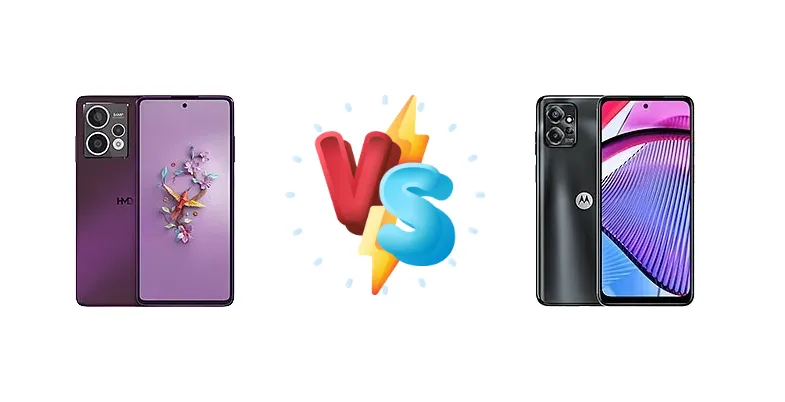
The HMD Crest Max and Motorola Moto G Power 5G represent compelling options in the increasingly competitive sub-$300 5G smartphone market. While both aim to deliver affordable connectivity, they take different approaches to achieving that goal, primarily diverging in their chipset choices and charging capabilities. This comparison dissects those differences to determine which device offers the best value for your money.
🏆 Quick Verdict
For the average user prioritizing overall performance and future-proofing, the Motorola Moto G Power 5G is the better choice. Its Mediatek Dimensity 930 chipset provides a noticeable performance advantage over the HMD Crest Max’s Unisoc T760, despite the Crest Max’s faster 33W charging. The G Power 5G’s superior processing power translates to a smoother user experience and better gaming capabilities.
| Network |
|---|
| 2G bands | GSM 850 / 900 / 1800 / 1900 | GSM 850 / 900 / 1800 / 1900 |
| 3G bands | HSDPA 850 / 900 / 2100 | HSDPA 850 / 900 / 1700(AWS) / 1900 / 2100 |
| 4G bands | 1, 3, 5, 8, 28, 40, 41 | 1, 2, 3, 4, 5, 7, 8, 12, 13, 14, 17, 20, 25, 26, 29, 30, 38, 39, 40, 41, 48, 66, 71 |
| 5G bands | 1, 3, 28, 40, 78 SA/NSA | 2, 5, 7, 12, 25, 30, 41, 66, 71, 77, 78 SA/NSA/Sub6 |
| Speed | HSPA, LTE, 5G | HSPA, LTE, 5G |
| Technology | GSM / HSPA / LTE / 5G | GSM / HSPA / LTE / 5G |
| Launch |
|---|
| Announced | 2024, July 25 | 2023, April 06 |
| Status | Available. Released 2024, August 07 | Available. Released 2023, April 13 |
| Body |
|---|
| Build | - | Glass front, plastic back, plastic frame |
| Dimensions | 163.9 x 76.4 x 8.4 mm (6.45 x 3.01 x 0.33 in) | 163.1 x 74.8 x 8.5 mm (6.42 x 2.94 x 0.33 in) |
| SIM | Nano-SIM + Nano-SIM | Nano-SIM |
| Weight | 205 g (7.23 oz) | 185 g (6.53 oz) |
| | - | Water-repellent design |
| Display |
|---|
| Resolution | 1080 x 2400 pixels, 20:9 ratio (~395 ppi density) | 1080 x 2400 pixels, 20:9 ratio (~405 ppi density) |
| Size | 6.67 inches, 107.4 cm2 (~85.8% screen-to-body ratio) | 6.5 inches, 102.0 cm2 (~83.6% screen-to-body ratio) |
| Type | OLED | IPS LCD, 120Hz |
| Platform |
|---|
| CPU | Octa-core (1x2.2 GHz Cortex-A76 & 3x Cortex-A76 & 4x Cortex-A55) | Octa-core (2x2.2 GHz Cortex-A78 & 6x2.0 GHz Cortex-A55) |
| Chipset | Unisoc T760 (6 nm) | Mediatek Dimensity 930 (6 nm) |
| GPU | Mali-G57 | IMG BXM-8-256 |
| OS | Android 14 | Android 13, upgradable to Android 14 |
| Memory |
|---|
| Card slot | microSDXC (uses shared SIM slot) | microSDXC (dedicated slot) |
| Internal | 256GB 8GB RAM | 128GB 4GB RAM, 256GB 6GB RAM |
| Main Camera |
|---|
| Features | LED flash, HDR | LED flash, HDR, panorama |
| Triple | 64 MP, (wide), AF
5 MP, (ultrawide)
2 MP (macro) | 50 MP, f/1.8, (wide), 0.64µm, PDAF
2 MP (macro)
Auxiliary lens |
| Video | 1080p@30fps | 1080p@30fps, gyro-EIS |
| Selfie camera |
|---|
| Single | 50 MP | 16 MP, f/2.4, (wide), 1.0µm |
| Video | Yes | 1080p@30fps |
| Sound |
|---|
| 3.5mm jack | - | Yes |
| 35mm jack | Yes | Yes |
| Loudspeaker | Yes | Yes, with stereo speakers |
| Comms |
|---|
| Bluetooth | 5.0, A2DP, LE | 5.3, A2DP, LE |
| NFC | No | No |
| Positioning | GPS, GALILEO | GPS, GLONASS, GALILEO |
| Radio | Unspecified | No |
| USB | USB Type-C | USB Type-C 2.0 |
| WLAN | Wi-Fi 802.11 a/b/g/n/ac | Wi-Fi 802.11 a/b/g/n/ac, dual-band |
| Features |
|---|
| Sensors | Fingerprint (side-mounted), accelerometer, gyro, proximity, compass | Fingerprint (side-mounted), accelerometer, gyro, proximity, compass |
| Battery |
|---|
| Charging | 33W wired | 15W wired |
| Type | 5000 mAh, user replaceable | Li-Po 5000 mAh |
| Misc |
|---|
| Colors | Aqua Green, Royal Pink, Deep Purple | Dark Blue |
| Price | About 180 EUR | $ 97.90 / £ 199.00 |
HMD Crest Max
- Faster 33W wired charging
- Potentially more durable build quality (HMD reputation)
- Unisoc chipset offers good efficiency for basic tasks
- Less powerful Unisoc T760 chipset
- Likely limited gaming performance
- Unknown camera sensor quality
Motorola Moto G Power 5G
- More powerful Mediatek Dimensity 930 chipset
- Superior CPU architecture for smoother performance
- Better suited for gaming and demanding apps
- Slower 15W wired charging
- Potentially shorter battery life (depending on capacity)
- Motorola’s software update track record is inconsistent
Display Comparison
Neither device’s display specifications are provided, so a direct comparison is limited. However, given the price point, both likely utilize LCD panels. The real differentiator will be color accuracy and peak brightness, which are unknown. Motorola historically focuses on maximizing screen real estate, while HMD often prioritizes durability. Without specific data, it’s reasonable to assume both offer adequate, but not exceptional, viewing experiences.
Camera Comparison
Without sensor details, a detailed camera comparison is impossible. However, the market segment suggests both phones will feature a primary camera supplemented by macro and depth sensors. The quality will largely depend on image processing algorithms. Motorola’s image processing tends to lean towards more saturated colors, while HMD often aims for a more natural look. The absence of Optical Image Stabilization (OIS) on either device suggests low-light performance will be a weakness. The usefulness of any included 2MP macro lens is questionable on both devices.
Performance
The core difference lies in the chipsets. The Motorola Moto G Power 5G’s Mediatek Dimensity 930 (6nm) features a more modern CPU architecture with 2x Cortex-A78 cores clocked at 2.2 GHz, alongside 6x Cortex-A55 cores. This contrasts with the HMD Crest Max’s Unisoc T760 (6nm) which uses 1x Cortex-A76, 3x Cortex-A76, and 4x Cortex-A55 cores. The A78 cores in the Dimensity 930 offer a significant performance uplift over the A76 cores in the Unisoc chip, particularly in single-core tasks and sustained workloads. This translates to snappier app launches, smoother multitasking, and better gaming performance. While both are 6nm chips, the architectural advantage favors the Dimensity 930.
Battery Life
The HMD Crest Max’s 33W wired charging is a clear advantage over the Motorola Moto G Power 5G’s 15W charging. This means significantly faster top-ups, reducing downtime. However, battery capacity isn’t specified for either device. The Moto G Power series historically prioritizes large battery capacities, potentially offsetting the slower charging speed. Even with a smaller battery, the 33W charging on the Crest Max will likely result in a quicker 0-100% charge time, appealing to users who frequently need to recharge quickly.
Buying Guide
Buy the HMD Crest Max if you prioritize faster charging speeds and are primarily focused on everyday tasks like browsing, social media, and light communication. Its 33W charging will minimize downtime. Buy the Motorola Moto G Power 5G if you need a phone capable of handling more demanding applications, enjoy mobile gaming, or anticipate keeping the device for several years – the Dimensity 930 offers a more robust and future-proof platform.
Frequently Asked Questions
❓ Will the Unisoc T760 in the HMD Crest Max struggle with graphically intensive games like Genshin Impact?
Yes, the Unisoc T760 is likely to struggle with demanding games like Genshin Impact. While it can handle less intensive titles, the Dimensity 930 in the Moto G Power 5G offers a significantly better gaming experience due to its more powerful CPU and GPU architecture. Expect lower frame rates and potentially noticeable lag on the Crest Max.
❓ How long will it take to fully charge the Motorola Moto G Power 5G with its 15W charging?
Without knowing the battery capacity, it's difficult to give an exact time. However, with 15W charging, a full charge from 0% will likely take between 2.5 to 3.5 hours. The HMD Crest Max, with its 33W charging, will be considerably faster, potentially completing a full charge in around 1.5 to 2 hours.
❓ Does the Mediatek Dimensity 930 in the Moto G Power 5G tend to overheat during prolonged use?
The Dimensity 930 is generally well-regarded for its thermal efficiency. While it can get warm during extended gaming sessions, it's unlikely to experience significant throttling under normal usage conditions. Motorola’s thermal management implementation will play a role, but the chipset itself is not prone to overheating.