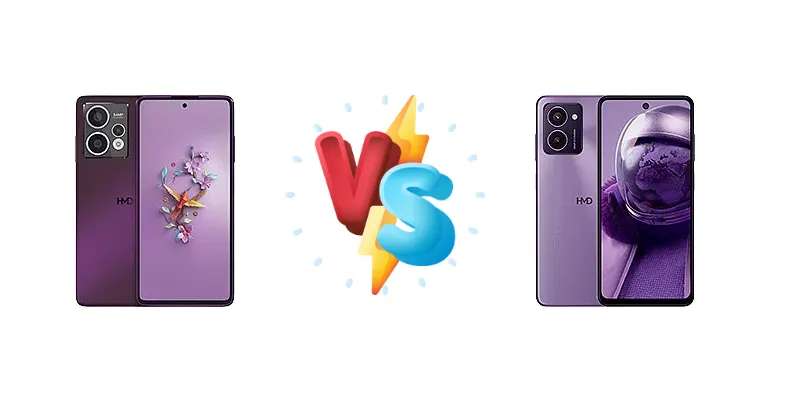
HMD is aggressively targeting the budget and mid-range smartphone markets with the Crest Max and Pulse Pro. Both devices offer compelling features for their price points, but significant differences in their core hardware – specifically the chipsets and charging capabilities – dictate which phone is best suited for different users. This comparison will dissect those differences to provide a clear recommendation.
🏆 Quick Verdict
For users prioritizing performance and faster charging, the HMD Crest Max is the clear winner. Its Unisoc T760 chipset, built on a more efficient 6nm process, delivers a noticeable performance uplift over the Pulse Pro’s T606. While the Pulse Pro offers a respectable experience, the Crest Max provides a smoother, more responsive user experience for demanding tasks.
| Network |
|---|
| 2G bands | GSM 850 / 900 / 1800 / 1900 | GSM 850 / 900 / 1800 / 1900 |
| 3G bands | HSDPA 850 / 900 / 2100 | HSDPA 850 / 900 / 2100 |
| 4G bands | 1, 3, 5, 8, 28, 40, 41 | 1, 3, 5, 7, 8, 20, 28, 38, 40 |
| 5G bands | 1, 3, 28, 40, 78 SA/NSA | - |
| Speed | HSPA, LTE, 5G | HSPA, LTE |
| Technology | GSM / HSPA / LTE / 5G | GSM / HSPA / LTE |
| Launch |
|---|
| Announced | 2024, July 25 | 2024, April 24 |
| Status | Available. Released 2024, August 07 | Available. Released 2024, April 26 |
| Body |
|---|
| Dimensions | 163.9 x 76.4 x 8.4 mm (6.45 x 3.01 x 0.33 in) | 163.2 x 75 x 8.6 mm (6.43 x 2.95 x 0.34 in) |
| SIM | Nano-SIM + Nano-SIM | Nano-SIM |
| Weight | 205 g (7.23 oz) | 196 g (6.91 oz) |
| Display |
|---|
| Resolution | 1080 x 2400 pixels, 20:9 ratio (~395 ppi density) | 720 x 1612 pixels, 20:9 ratio (~265 ppi density) |
| Size | 6.67 inches, 107.4 cm2 (~85.8% screen-to-body ratio) | 6.65 inches, 106.2 cm2 (~86.8% screen-to-body ratio) |
| Type | OLED | IPS LCD, 90Hz, 480 nits (typ), 600 nits (HBM) |
| Platform |
|---|
| CPU | Octa-core (1x2.2 GHz Cortex-A76 & 3x Cortex-A76 & 4x Cortex-A55) | Octa-core (2x1.6 GHz Cortex-A75 & 6x1.6 GHz Cortex-A55) |
| Chipset | Unisoc T760 (6 nm) | Unisoc T606 (12 nm) |
| GPU | Mali-G57 | Mali-G57 MP1 |
| OS | Android 14 | Android 14 |
| Memory |
|---|
| Card slot | microSDXC (uses shared SIM slot) | microSDXC |
| Internal | 256GB 8GB RAM | 128GB 4GB RAM, 128GB 6GB RAM, 128GB 8GB RAM |
| Main Camera |
|---|
| Dual | - | 50 MP, (wide), AF
Auxiliary lens |
| Features | LED flash, HDR | LED flash, HDR |
| Triple | 64 MP, (wide), AF
5 MP, (ultrawide)
2 MP (macro) | - |
| Video | 1080p@30fps | 1080p@30fps |
| Selfie camera |
|---|
| Single | 50 MP | 50 MP |
| Video | Yes | Yes |
| Sound |
|---|
| 35mm jack | Yes | Yes |
| Loudspeaker | Yes | Yes |
| Comms |
|---|
| Bluetooth | 5.0, A2DP, LE | 5.0, A2DP, LE |
| NFC | No | Yes |
| Positioning | GPS, GALILEO | GPS, GALILEO |
| Radio | Unspecified | Unspecified |
| USB | USB Type-C | USB Type-C 2.0, OTG |
| WLAN | Wi-Fi 802.11 a/b/g/n/ac | Wi-Fi 802.11 a/b/g/n/ac |
| Features |
|---|
| Sensors | Fingerprint (side-mounted), accelerometer, gyro, proximity, compass | Fingerprint (side-mounted), accelerometer, proximity, compass |
| Battery |
|---|
| Charging | 33W wired | 20W wired |
| Type | 5000 mAh, user replaceable | 5000 mAh, user replaceable |
| Misc |
|---|
| Colors | Aqua Green, Royal Pink, Deep Purple | Black Ocean, Clacier Creen, Twilight Purple |
| Price | About 180 EUR | € 106.37 / £ 149.00 |
HMD Crest Max
- Faster charging with 33W support
- More powerful Unisoc T760 chipset
- More efficient 6nm fabrication process
- Potentially higher price point
- May not have significantly better camera performance
HMD Pulse Pro
- More affordable price
- Decent performance for basic tasks
- Reliable for everyday use
- Slower 20W charging
- Less powerful Unisoc T606 chipset
- Less efficient 12nm fabrication process
Display Comparison
Display specifications are not provided, so a direct comparison is limited. However, given the positioning of these devices, we can infer both likely utilize LCD panels. The Crest Max, being the slightly higher-tier model, *may* feature a higher resolution or slightly improved color accuracy. Bezels are likely comparable, focusing on cost optimization. Without specific data, it's reasonable to assume both displays prioritize functionality over premium features like high refresh rates or OLED technology.
Camera Comparison
Camera details are absent, making a detailed comparison impossible. However, it’s common for budget phones to prioritize the main sensor. We can assume both phones will have a primary camera, but the Crest Max likely benefits from a slightly larger sensor or more advanced image processing capabilities due to its higher tier positioning. Any secondary cameras (ultrawide, macro, depth) are likely to be of similar, basic quality on both devices. Image processing algorithms will play a key role in differentiating the final image quality, but without sample images, it’s difficult to assess.
Performance
The core difference lies in the chipsets. The HMD Crest Max’s Unisoc T760 (6nm) boasts a more modern architecture with a single 2.2 GHz Cortex-A76 core, alongside three additional Cortex-A76 cores, and four Cortex-A55 cores. This contrasts with the Pulse Pro’s Unisoc T606 (12nm), which features two 1.6 GHz Cortex-A75 cores and six Cortex-A55 cores. The 6nm fabrication process of the T760 is significantly more efficient than the 12nm process of the T606, resulting in better thermal management and sustained performance. The Cortex-A76 cores in the Crest Max also offer a performance advantage over the A75 cores in the Pulse Pro, particularly in CPU-intensive tasks. While both phones likely feature similar RAM configurations, the superior chipset in the Crest Max will translate to faster app loading times and smoother multitasking.
Battery Life
Battery capacity is not specified. However, the Crest Max’s 33W wired charging is a significant advantage over the Pulse Pro’s 20W charging. This means the Crest Max will charge considerably faster, reducing downtime. Even if the Pulse Pro has a slightly larger battery capacity, the faster charging of the Crest Max will likely result in a more convenient user experience. The 6nm process of the T760 also contributes to better power efficiency, potentially offsetting any battery capacity difference.
Buying Guide
Buy the HMD Crest Max if you need a phone capable of handling multitasking, moderate gaming, and benefit from quicker charging times. This phone is ideal for users who frequently switch between apps or enjoy mobile games. Buy the HMD Pulse Pro if you prioritize affordability and a simple, reliable smartphone experience for basic tasks like calling, texting, and light social media use. It’s a solid choice for first-time smartphone owners or those on a very tight budget.
Frequently Asked Questions
❓ Will the Unisoc T760 in the Crest Max handle demanding games like PUBG or Call of Duty?
The Unisoc T760 is capable of running PUBG and Call of Duty, but you’ll likely need to lower the graphics settings to achieve a smooth frame rate. The Cortex-A76 cores provide a performance boost over the T606, but it’s still a mid-range chipset. Expect playable performance at medium settings.
❓ How long will it take to fully charge the HMD Crest Max with the 33W charger?
While a precise 0-100% charge time isn't available, the 33W charging should fully charge the HMD Crest Max in approximately 1 hour and 30 minutes to 2 hours, depending on battery capacity. This is significantly faster than the Pulse Pro’s 20W charging.
❓ Is the difference in chipset performance between the T760 and T606 noticeable in everyday use?
Yes, the difference is noticeable, especially when multitasking or opening multiple apps. The Crest Max will feel snappier and more responsive due to the more powerful CPU cores and efficient fabrication process of the T760. The Pulse Pro will handle basic tasks adequately, but may exhibit slight lag when pushed.