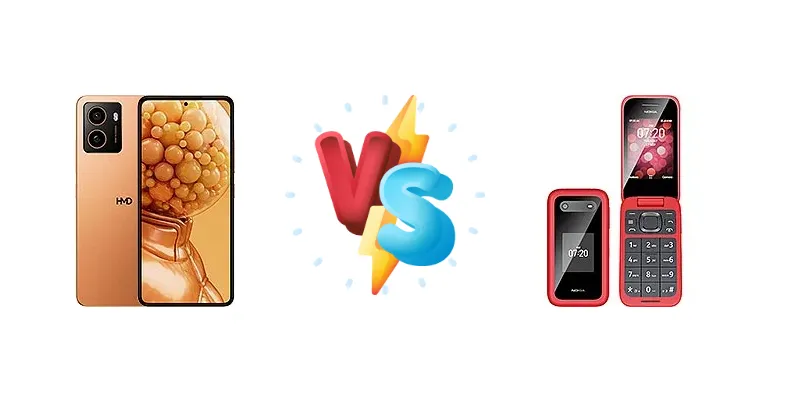
The HMD Bold and Nokia 2780 Flip represent divergent paths in the mobile phone landscape. The Bold attempts to bridge the gap between classic usability and smartphone functionality, while the 2780 Flip doubles down on the simplicity and nostalgia of a traditional flip phone. This comparison dissects their core differences, focusing on performance, battery, and the user experience each delivers.
🏆 Quick Verdict
For users seeking a modern feature phone with app capabilities and a responsive experience, the HMD Bold is the clear winner. Its Unisoc T7200 chipset provides significantly more processing power than the Nokia 2780 Flip’s Snapdragon 215. However, the Nokia 2780 Flip excels for those prioritizing extreme simplicity and extended battery life.
| Network |
|---|
| 2G bands | GSM 850 / 900 / 1800 / 1900 | GSM 850 / 900 / 1800 / 1900 |
| 3G bands | HSDPA 850 / 900 / 2100 | HSDPA 850 / 1700(AWS) / 1900 |
| 4G bands | LTE | 2, 4, 5, 7, 12, 13, 17, 25, 26, 41, 66, 71 |
| Speed | HSPA, LTE | HSPA, LTE Cat4 150/50 Mbps |
| Technology | GSM / HSPA / LTE | GSM / HSPA / LTE |
| Launch |
|---|
| Announced | Not announced yet | 2022, November 03 |
| Status | Cancelled | Available. Released 2022, November 15 |
| Body |
|---|
| Dimensions | - | 202.1 x 58 x 11.5 mm (7.96 x 2.28 x 0.45 in) |
| SIM | Nano-SIM | Nano-SIM |
| Weight | - | 131.2 g (4.62 oz) |
| Display |
|---|
| Resolution | 720 x 1612 pixels, 20:9 ratio (~262 ppi density) | 240 x 320 pixels, 4:3 ratio (~148 ppi density) |
| Size | 6.74 inches, 109.1 cm2 | 2.7 inches, 22.6 cm2 (~19.3% screen-to-body ratio) |
| Type | IPS LCD, 90Hz | TFT LCD |
| | - | Secondary external 1.77" display |
| Platform |
|---|
| CPU | Octa-core (2x1.6 GHz Cortex-A75 & 6x1.6 GHz Cortex-A55) | Quad-core 1.3 GHz Cortex-A53 |
| Chipset | Unisoc T7200 (12 nm) | Qualcomm QM215 Snapdragon 215 (28 nm) |
| GPU | Mali-G57 MP1 | Adreno 308 |
| OS | Android 15 | KaiOS 3.1 |
| Memory |
|---|
| Card slot | microSDXC | microSDHC (dedicated slot) |
| Internal | 128GB 4GB RAM, 256GB 6GB RAM | 4GB 512MB RAM |
| Main Camera |
|---|
| Features | LED flash, HDR | LED flash |
| Single | 50 MP, (wide), AF
Auxiliary lens | 5 MP |
| Video | 1080p@30fps | Unspecified |
| Selfie camera |
|---|
| Single | 8 MP | - |
| Video | Yes | - |
| | - | No |
| Sound |
|---|
| 3.5mm jack | - | Yes |
| 35mm jack | Yes | Yes |
| Loudspeaker | Yes | Yes |
| Comms |
|---|
| Bluetooth | 5.0, A2DP, LE | 4.2, A2DP |
| NFC | No | No |
| Positioning | GPS | GPS |
| Radio | Unspecified | FM radio |
| USB | USB Type-C 2.0, OTG | USB Type-C 2.0 |
| WLAN | Wi-Fi 802.11 a/b/g/n/ac | Wi-Fi 802.11 b/g/n |
| Features |
|---|
| Sensors | Fingerprint (side-mounted), accelerometer, proximity, compass | - |
| Battery |
|---|
| Charging | 20W wired | - |
| Type | 5000 mAh, user replaceable | Li-Ion 1450 mAh, removable |
| Misc |
|---|
| Colors | Black; other colors | Red, Blue |
| Price | About 80 EUR | $ 97.05 |
HMD Bold
- Faster processor for smoother app usage
- 20W fast charging for quicker top-ups
- App support expands functionality beyond basic calls and texts
- Shorter battery life compared to the Nokia 2780 Flip
- Potentially more complex user interface
Nokia 2780 Flip
- Exceptional battery life – days on a single charge
- Classic flip phone design for nostalgia and portability
- Extremely simple and easy to use
- Slow processor limits functionality
- Limited app support
Display Comparison
While specific display details (resolution, panel type) are absent for both devices, the HMD Bold’s focus on app support suggests a higher-resolution screen is necessary for usability. The Nokia 2780 Flip likely utilizes a basic LCD panel optimized for readability, not visual fidelity. Bezels are expected to be substantial on both, inherent to the flip phone design, but the Bold’s screen is likely larger, offering more space for app content. Color accuracy is unlikely to be a priority on either device.
Camera Comparison
Camera details are limited, but both phones are unlikely to excel in photography. The HMD Bold, given its app support, may include basic camera software features. However, the Nokia 2780 Flip’s camera is likely intended for simple snapshots. Without sensor size or aperture information, it’s difficult to make a direct comparison, but the Bold’s processing power suggests a better ability to handle image processing, even with a similar sensor.
Performance
The performance disparity is stark. The HMD Bold’s Unisoc T7200, built on a 12nm process and featuring an octa-core configuration (2x1.6 GHz Cortex-A75 & 6x1.6 GHz Cortex-A55), offers a substantial advantage over the Nokia 2780 Flip’s Qualcomm QM215 Snapdragon 215 (28nm, quad-core 1.3 GHz Cortex-A53). The T7200’s Cortex-A75 cores provide significantly higher single-core performance, crucial for app responsiveness. The 28nm process of the Snapdragon 215 is considerably less efficient, leading to higher power consumption for similar tasks. This translates to a noticeably snappier experience on the Bold when running apps or navigating menus.
Battery Life
The Nokia 2780 Flip’s strength lies in its battery life, stemming from the power-efficient Snapdragon 215 and the inherent efficiency of a feature phone OS. While specific mAh ratings are unavailable, the 2780 Flip is expected to last for days on a single charge. The HMD Bold, with its more powerful Unisoc T7200 and app support, will have a shorter battery life, likely requiring daily charging. The Bold’s 20W wired charging offers a faster recharge time, mitigating this disadvantage, but the 2780 Flip’s longevity is a significant advantage for users prioritizing minimal charging.
Buying Guide
Buy the HMD Bold if you need access to apps like WhatsApp and Google Maps on a durable, compact device, and value a smoother user experience. It’s ideal for those wanting a step up from a basic phone without the complexity of a full smartphone. Buy the Nokia 2780 Flip if you prioritize ultimate simplicity, long battery life, and a classic flip phone form factor – perfect for minimalists or those seeking a dedicated emergency phone.
Frequently Asked Questions
❓ Will the HMD Bold be able to run popular social media apps like Facebook and WhatsApp smoothly?
The Unisoc T7200 chipset in the HMD Bold is capable of running lightweight apps like WhatsApp and Facebook, but performance may not be as fluid as on a modern smartphone. Expect some loading times and occasional lag, especially with multiple apps open. It's a trade-off for the simplicity and battery life benefits.
❓ How easy is it to transfer contacts from an old phone to the Nokia 2780 Flip?
The Nokia 2780 Flip supports contact transfer via Bluetooth. You can pair it with an old phone and send contacts wirelessly. Alternatively, you can use a micro-USB cable to connect it to a computer and transfer contacts using compatible software. The process is relatively straightforward, but may require some basic technical knowledge.
❓ Is the HMD Bold a good option for someone who wants a phone primarily for calls and texts, but occasionally needs to check email or use a map?
Yes, the HMD Bold is an excellent choice for this scenario. Its app support allows for email access and basic map functionality, while still offering a durable and relatively simple user experience. The Unisoc T7200 provides enough power for these tasks without the complexity of a full smartphone.
❓ Does the Nokia 2780 Flip have a headphone jack?
Yes, the Nokia 2780 Flip includes a 3.5mm headphone jack, allowing you to connect wired headphones or earbuds. This is a significant advantage for users who prefer not to use Bluetooth headphones or don't have a compatible smartphone charger for wireless earbuds.