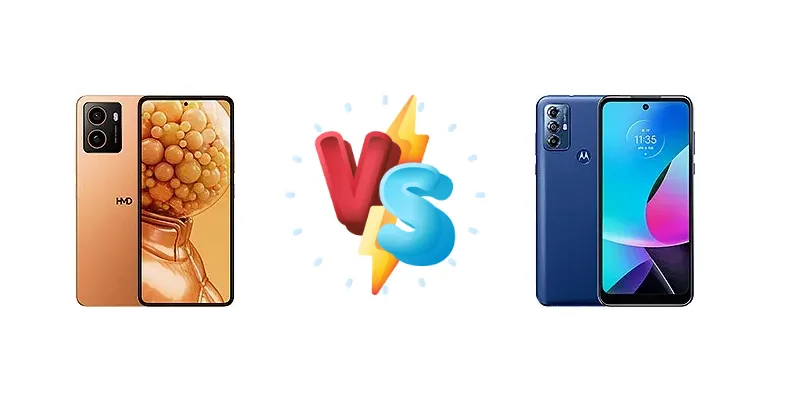
The sub-$200 smartphone market is fiercely competitive. The HMD Bold and Motorola Moto G Play (2023) both aim to deliver essential smartphone functionality at an accessible price. However, they take different approaches to achieving this, primarily through their chipset choices. This comparison dissects the key differences between the Unisoc T7200-powered HMD Bold and the MediaTek Helio G37-equipped Moto G Play (2023), focusing on performance, charging, and overall user experience.
🏆 Quick Verdict
For the average user prioritizing responsiveness and future-proofing, the HMD Bold emerges as the better choice. While the Moto G Play (2023) offers a slightly higher clocked CPU, the HMD Bold’s Unisoc T7200’s Cortex-A75 cores provide a significant architectural advantage, translating to smoother multitasking and a more fluid user experience. The faster 20W charging is also a notable benefit.
| Network |
|---|
| 2G bands | GSM 850 / 900 / 1800 / 1900 | GSM 850 / 900 / 1800 / 1900 |
| 3G bands | HSDPA 850 / 900 / 2100 | HSDPA 850 / 900 / 1700(AWS) / 1900 / 2100 |
| 4G bands | LTE | 1, 2, 3, 4, 5, 7, 8, 12, 13, 14, 17, 18, 19, 20, 25, 26, 29, 30, 38, 39, 40, 41, 66, 71 |
| Speed | HSPA, LTE | HSPA, LTE |
| Technology | GSM / HSPA / LTE | GSM / CDMA / HSPA / LTE |
| | - | CDMA 800 / 1900 |
| Launch |
|---|
| Announced | Not announced yet | 2022, December 08 |
| Status | Cancelled | Available. Released 2022, December 12 |
| Body |
|---|
| Build | - | Plastic frame, plastic back |
| Dimensions | - | 167.2 x 76.5 x 9.4 mm (6.58 x 3.01 x 0.37 in) |
| SIM | Nano-SIM | Nano-SIM |
| Weight | - | 203 g (7.20 oz) |
| | - | Water-repellent coating |
| Display |
|---|
| Resolution | 720 x 1612 pixels, 20:9 ratio (~262 ppi density) | 720 x 1600 pixels, 20:9 ratio (~270 ppi density) |
| Size | 6.74 inches, 109.1 cm2 | 6.5 inches, 102.0 cm2 (~79.7% screen-to-body ratio) |
| Type | IPS LCD, 90Hz | IPS LCD, 90Hz |
| Platform |
|---|
| CPU | Octa-core (2x1.6 GHz Cortex-A75 & 6x1.6 GHz Cortex-A55) | Octa-core (4x2.3 GHz Cortex-A53 & 4x1.8 GHz Cortex-A53) |
| Chipset | Unisoc T7200 (12 nm) | Mediatek MT6765 Helio G37 (12 nm) |
| GPU | Mali-G57 MP1 | PowerVR GE8320 |
| OS | Android 15 | Android 12 |
| Memory |
|---|
| Card slot | microSDXC | microSDXC (dedicated slot) |
| Internal | 128GB 4GB RAM, 256GB 6GB RAM | 32GB 3GB RAM |
| | - | eMMC 5.1 |
| Main Camera |
|---|
| Features | LED flash, HDR | LED flash, HDR, panorama |
| Single | 50 MP, (wide), AF
Auxiliary lens | - |
| Triple | - | 16 MP, f/2.2, (wide), 1.12µm, PDAF
2 MP (macro)
Auxiliary lens |
| Video | 1080p@30fps | 1080p@30/60fps |
| Selfie camera |
|---|
| Features | - | HDR |
| Single | 8 MP | 5 MP, f/2.4, (wide), 1.12µm |
| Video | Yes | 1080p@30fps |
| Sound |
|---|
| 3.5mm jack | - | Yes |
| 35mm jack | Yes | Yes |
| Loudspeaker | Yes | Yes |
| Comms |
|---|
| Bluetooth | 5.0, A2DP, LE | 5.0, A2DP, LE |
| NFC | No | No |
| Positioning | GPS | GPS, GLONASS |
| Radio | Unspecified | No |
| USB | USB Type-C 2.0, OTG | USB Type-C 2.0 |
| WLAN | Wi-Fi 802.11 a/b/g/n/ac | Wi-Fi 802.11 a/b/g/n/ac, dual-band |
| Features |
|---|
| Sensors | Fingerprint (side-mounted), accelerometer, proximity, compass | Fingerprint (rear-mounted), accelerometer, proximity, barometer |
| Battery |
|---|
| Charging | 20W wired | 10W wired |
| Type | 5000 mAh, user replaceable | Li-Po 5000 mAh |
| Misc |
|---|
| Colors | Black; other colors | Deep Indigo |
| Models | - | XT2271-1, XT2271-3, XT2271-5, XT2271-4 |
| Price | About 80 EUR | $ 54.00 / C$ 129.00 |
HMD Bold
- More powerful processor architecture (Cortex-A75 cores)
- Faster 20W charging
- Potentially better sustained performance
- May be slightly more expensive
- Unisoc brand recognition is lower than MediaTek
Motorola Moto G Play (2023)
- Potentially lower price
- Higher CPU clock speed (on paper)
- Motorola’s clean Android software experience
- Less powerful processor architecture (Cortex-A53 cores)
- Slower 10W charging
- Likely lower sustained performance
Display Comparison
Neither device boasts a standout display. Given the price point, both likely utilize LCD panels. Without specific display specs, it's reasonable to assume similar resolutions (likely 720p+). The focus here is on processing power, not visual fidelity. Bezels are expected to be substantial on both devices, and color accuracy will likely be standard for this segment.
Camera Comparison
Without detailed camera specifications, a direct comparison is difficult. Both phones likely feature a primary camera and potentially a depth or macro sensor. However, given the price bracket, image quality will be heavily reliant on software processing. The HMD Bold’s processor may offer slightly better image signal processing (ISP) capabilities, potentially leading to marginally better photos, but this is speculative. The presence of a 2MP macro camera on either device is largely a marketing feature with limited practical benefit.
Performance
This is where the core difference lies. The HMD Bold’s Unisoc T7200 features a dual-cluster configuration with 2x 1.6 GHz Cortex-A75 cores and 6x 1.6 GHz Cortex-A55 cores. The Moto G Play (2023) uses the MediaTek Helio G37 with 4x 2.3 GHz Cortex-A53 cores and 4x 1.8 GHz Cortex-A53 cores. While the G37 has a higher peak clock speed, the A75 cores in the T7200 are significantly more powerful *per clock cycle* than the A53 cores. This architectural advantage means the HMD Bold will handle demanding tasks and multitasking more efficiently. The Unisoc T7200’s more modern architecture will also likely result in better sustained performance due to improved thermal management, despite both being fabricated on a 12nm process.
Battery Life
Battery capacity is not specified, but both devices likely fall in the 4000-5000 mAh range. The key differentiator is charging speed. The HMD Bold supports 20W wired charging, while the Moto G Play (2023) is limited to 10W. This means the HMD Bold will significantly reduce charging times, offering a more convenient user experience. A full charge on the Moto G Play (2023) could easily take over 3 hours, while the HMD Bold could potentially reach 100% in under 2 hours.
Buying Guide
Buy the HMD Bold if you need a phone that feels responsive for everyday tasks like browsing, social media, and light gaming, and value faster charging. Buy the Motorola Moto G Play (2023) if you prioritize a potentially lower initial cost and are willing to accept a trade-off in processing power and charging speed. The Moto G Play is best suited for users with very basic smartphone needs.
Frequently Asked Questions
❓ Will the HMD Bold handle popular apps like Facebook and WhatsApp smoothly?
Yes, the Unisoc T7200’s Cortex-A75 cores are more than capable of handling everyday apps like Facebook, WhatsApp, and web browsing without noticeable lag. The improved architecture provides a smoother experience compared to the Moto G Play (2023)'s Helio G37.
❓ Is the 10W charging on the Moto G Play (2023) a dealbreaker if I often forget to charge overnight?
Yes, the 10W charging is a significant drawback if you frequently need to top up your phone quickly. It will take considerably longer to charge compared to the HMD Bold’s 20W charging, potentially leaving you with a low battery during the day.
❓ Can either of these phones handle basic mobile games like Candy Crush or Subway Surfers?
Both phones can handle casual games like Candy Crush and Subway Surfers. However, the HMD Bold will likely provide a more consistent frame rate and smoother gameplay experience due to its more powerful processor.
❓ Does the Unisoc T7200 in the HMD Bold support software updates for a long period?
HMD Global has generally committed to providing software updates for their devices. While the long-term update support for the HMD Bold specifically is not guaranteed, HMD’s track record suggests a reasonable level of support, potentially exceeding that of the Moto G Play (2023).