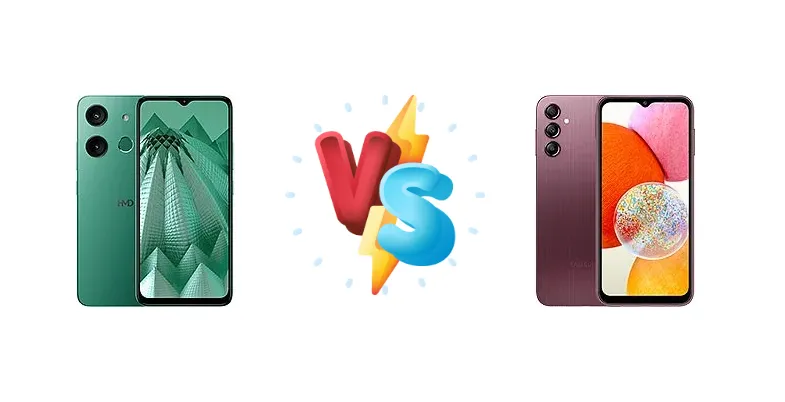
The HMD Aura and Samsung Galaxy A14 represent two distinct approaches to the ultra-budget smartphone market. The Aura aims for simplicity and affordability, while the A14 offers a choice of chipsets and a more established brand presence. This comparison dissects their key specifications to determine which device delivers the best value for your money.
🏆 Quick Verdict
For most users, the Samsung Galaxy A14 (specifically the Helio G80 version) offers a more compelling experience. Its more powerful chipset, faster charging, and broader software support outweigh the Aura’s lower price point. However, the Aura remains a viable option for those prioritizing extreme affordability.
| Network |
|---|
| 2G bands | GSM 850 / 900 / 1800 / 1900 | GSM 850 / 900 / 1800 / 1900 |
| 3G bands | HSDPA 850 / 900 / 2100 | HSDPA 850 / 900 / 2100 |
| 4G bands | 1, 3, 5, 8, 20, 28, 38, 41 | 1, 3, 5, 7, 8, 20, 28, 38, 40, 41 |
| Speed | HSPA, LTE | HSPA, LTE |
| Technology | GSM / HSPA / LTE | GSM / HSPA / LTE |
| Launch |
|---|
| Announced | 2024, May 23 | 2023, February 28 |
| Status | Available. Released 2024, May 23 | Available. Released 2023, March 27 |
| Body |
|---|
| Build | - | Glass front, plastic back, plastic frame |
| Dimensions | 163.9 x 75.5 x 8.9 mm (6.45 x 2.97 x 0.35 in) | 167.7 x 78 x 9.1 mm (6.60 x 3.07 x 0.36 in) |
| SIM | Nano-SIM + Nano-SIM | · Nano-SIM· Nano-SIM + Nano-SIM |
| Weight | 175 g (6.17 oz) | 201 g (7.09 oz) |
| Display |
|---|
| Resolution | 720 x 1612 pixels (~268 ppi density) | 1080 x 2408 pixels, 20:9 ratio (~400 ppi density) |
| Size | 6.56 inches, 101.4 cm2 (~82.0% screen-to-body ratio) | 6.6 inches, 104.9 cm2 (~80.2% screen-to-body ratio) |
| Type | IPS LCD, 480 nits (typ) | PLS LCD |
| Platform |
|---|
| CPU | Octa-core (4x1.6 GHz Cortex-A55 & 4x1.2 GHz Cortex-A55) | Octa-core (2x2.0 GHz Cortex-A75 & 6x1.8 GHz Cortex-A55) - Version AOcta-core (4x2.0 GHz Cortex-A55 & 4x2.0 GHz Cortex-A55) - Version B |
| Chipset | Unisoc SC9863A1 (22 nm) | Mediatek MT6769 Helio G80 (12 nm) - Version AExynos 850 (8 nm) - Version B |
| GPU | IMG8322 | Mali-G52 MC2 |
| OS | Android 13 | Android 13, upgradable to Android 15, One UI 7 |
| Memory |
|---|
| Card slot | microSDXC (uses shared SIM slot) | microSDXC (dedicated slot) |
| Internal | 64GB 4GB RAM, 128GB 4GB RAM | 64GB 4GB RAM, 128GB 4GB RAM, 128GB 6GB RAM |
| Main Camera |
|---|
| Features | LED flash, HDR | LED flash, panorama, HDR |
| Single | 13 MP, (wide), AF
Auxiliary lens | 13 MP, f/2.0, (wide) |
| Triple | - | 50 MP, f/1.8, 26mm (wide), 1/2.75", 0.64µm, PDAF
5 MP, f/2.2, 17mm (ultrawide), 1/5.0", 1.12µm
2 MP (macro) |
| Video | 1080p@30fps | 1080p@30fps |
| Selfie camera |
|---|
| Single | 5 MP | 13 MP, f/2.0, 26mm (wide), 1/3.1", 1.12µm |
| Video | Yes | 1080p@30fps |
| Sound |
|---|
| 3.5mm jack | - | Yes |
| 35mm jack | Yes | Yes |
| Loudspeaker | Yes | Yes |
| Comms |
|---|
| Bluetooth | 4.2, A2DP | 5.1 or 5.3, A2DP, LE |
| NFC | No | Yes (market/region dependent) |
| Positioning | GPS | GPS, GALILEO, GLONASS, BDS, QZSS |
| Radio | Unspecified | Unspecified |
| USB | USB Type-C 2.0, OTG | USB Type-C 2.0 |
| WLAN | Wi-Fi 802.11 b/g/n | Wi-Fi 802.11 a/b/g/n/ac, dual-band, Wi-Fi Direct |
| Features |
|---|
| Sensors | Fingerprint (rear-mounted), accelerometer, proximity | Fingerprint (side-mounted), accelerometer, proximity, compass |
| Battery |
|---|
| Charging | 10W wired | 15W wired |
| Type | 5000 mAh | Li-Po 5000 mAh |
| Misc |
|---|
| Colors | Glacier Green, Indigo Black | Black, Dark Red, Silver, Green |
| Models | - | SM-A145F, SM-A145F/DSN, SM-A145M, SM-A145M/DS, SM-A145P, SM-A145R |
| Price | About 110 EUR | € 85.76 / $ 147.60 / £ 79.95 |
| SAR EU | - | 0.46 W/kg (head) 1.37 W/kg (body) |
HMD Aura
- Extremely affordable price point
- Simple and straightforward user experience
- Functional for basic communication
- Weak processor performance
- Slow charging speed (10W)
- Limited software support
Samsung Galaxy A14
- More powerful processor options (Helio G80/Exynos 850)
- Faster charging (15W)
- Better software support from Samsung
- Slightly higher price than the HMD Aura
- Potential for bloatware
- Camera quality is still limited by the budget segment
Display Comparison
Neither device boasts a standout display. Both likely utilize LCD panels, common in this price bracket. The A14’s larger screen size is a benefit for media consumption, but without knowing the specific panel characteristics (brightness, color gamut), it’s difficult to declare a clear winner. The HMD Aura’s display resolution is likely 720p, while the A14 is also likely 720p or 1080p depending on the region. The lack of high refresh rates on either device means scrolling won’t be exceptionally smooth.
Camera Comparison
Camera performance is likely to be similar in real-world usage, as both phones target the budget segment. However, the A14 likely benefits from Samsung’s more refined image processing algorithms. While both phones likely feature a primary camera, the A14’s sensor size and aperture are likely larger, resulting in better low-light performance. The Aura’s camera system is likely more basic, with limited features and image quality. The inclusion of a 2MP macro camera on the A14 is largely a marketing gimmick and offers minimal practical benefit.
Performance
The Samsung Galaxy A14’s chipset options provide a significant advantage. The Mediatek Helio G80 (12nm) is demonstrably more powerful than the HMD Aura’s Unisoc SC9863A1 (22nm). The Helio G80’s Cortex-A75 cores offer a substantial performance uplift in CPU-intensive tasks and gaming. The Exynos 850 version of the A14 (8nm) further improves efficiency and sustained performance. The Aura’s Cortex-A55 cores, while efficient, are less capable. This translates to slower app loading times, more noticeable lag, and a less enjoyable gaming experience on the Aura. The A14’s potential for LPDDR4X RAM (versus likely LPDDR3 on the Aura) also contributes to faster multitasking.
Battery Life
Both devices offer adequate battery life for typical daily use. The A14’s 15W charging is a clear advantage over the Aura’s 10W charging. While neither phone will charge exceptionally quickly, the A14 will reach a full charge significantly faster. The actual battery capacity of both devices is unknown, but the faster charging speed of the A14 mitigates any potential capacity disadvantage.
Buying Guide
Buy the HMD Aura if you need a truly minimal smartphone for basic communication and are on the tightest of budgets. It’s a functional device for essential tasks. Buy the Samsung Galaxy A14 if you prioritize a smoother user experience, occasional gaming, and faster charging, even if it means spending a bit more. The A14’s chipset options provide a noticeable performance boost.
Frequently Asked Questions
❓ Does the Exynos 850 chip in some Galaxy A14 models overheat during prolonged gaming sessions?
The Exynos 850 is an 8nm chip, offering better thermal efficiency than the Unisoc SC9863A1. While it may experience some throttling during extended gaming, it’s unlikely to overheat to the point of causing performance issues or discomfort. The larger surface area of the A14 also aids in heat dissipation.
❓ Is the 2MP macro camera on the Samsung Galaxy A14 actually useful for taking detailed close-up photos?
Generally, 2MP macro cameras on budget phones offer limited practical benefit. The low resolution results in images lacking detail and sharpness. It’s more of a marketing feature than a genuinely useful camera component. Expect soft, grainy results.
❓ Can the Samsung Galaxy A14 run popular games like PUBG Mobile at 60fps?
The Helio G80 version of the Galaxy A14 can likely run PUBG Mobile at balanced graphics settings and 60fps. However, the Exynos 850 version will provide a smoother experience with higher graphics settings. The HMD Aura will struggle to maintain a stable 60fps, even at the lowest settings.
❓ How long will it take to fully charge the HMD Aura from 0% to 100%?
With only 10W charging, the HMD Aura will likely take over 3 hours to fully charge from 0% to 100%. This is significantly slower than the Samsung Galaxy A14’s 15W charging.