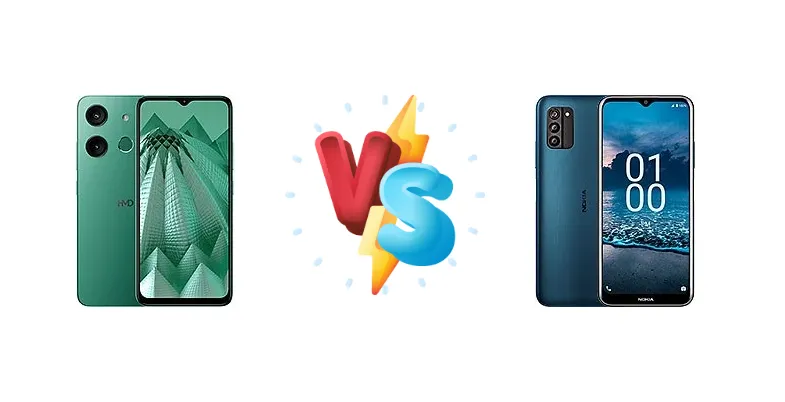
The HMD Aura and Nokia G100 represent two distinct approaches to the ultra-budget smartphone market. The Aura leverages the efficiency of a Unisoc chipset, while the G100 opts for Qualcomm's Snapdragon 662. This comparison dissects the core differences to determine which device delivers the best experience for the price-conscious consumer.
🏆 Quick Verdict
For most users, the Nokia G100 emerges as the better choice. Its Snapdragon 662, built on an 11nm process, provides a noticeable performance advantage over the HMD Aura’s Unisoc SC9863A1, translating to smoother multitasking and app loading. While the Aura may offer slightly better efficiency, the G100’s 15W charging partially mitigates any battery concerns.
| Network |
|---|
| 2G bands | GSM 850 / 900 / 1800 / 1900 | GSM 850 / 900 / 1800 / 1900 |
| 3G bands | HSDPA 850 / 900 / 2100 | HSDPA 850 / 1700(AWS) / 1900 |
| 4G bands | 1, 3, 5, 8, 20, 28, 38, 41 | 2, 4, 5, 7, 12, 13, 17, 44, 66, 71 |
| Speed | HSPA, LTE | HSPA, LTE |
| Technology | GSM / HSPA / LTE | GSM / HSPA / LTE |
| Launch |
|---|
| Announced | 2024, May 23 | 2022, September 22 |
| Status | Available. Released 2024, May 23 | Available. Released 2022, October |
| Body |
|---|
| Build | - | Glass front, plastic frame, plastic back |
| Dimensions | 163.9 x 75.5 x 8.9 mm (6.45 x 2.97 x 0.35 in) | 166.6 x 76.7 x 8.9 mm (6.56 x 3.02 x 0.35 in) |
| SIM | Nano-SIM + Nano-SIM | Nano-SIM |
| Weight | 175 g (6.17 oz) | 195.1 g (6.88 oz) |
| Display |
|---|
| Resolution | 720 x 1612 pixels (~268 ppi density) | 720 x 1600 pixels, 20:9 ratio (~269 ppi density) |
| Size | 6.56 inches, 101.4 cm2 (~82.0% screen-to-body ratio) | 6.52 inches, 102.6 cm2 (~80.3% screen-to-body ratio) |
| Type | IPS LCD, 480 nits (typ) | IPS LCD |
| Platform |
|---|
| CPU | Octa-core (4x1.6 GHz Cortex-A55 & 4x1.2 GHz Cortex-A55) | Octa-core (4x2.0 GHz Kryo 260 Gold & 4x1.8 GHz Kryo 260 Silver) |
| Chipset | Unisoc SC9863A1 (22 nm) | Qualcomm SM6115 Snapdragon 662 (11 nm) |
| GPU | IMG8322 | Adreno 610 |
| OS | Android 13 | Android 12 |
| Memory |
|---|
| Card slot | microSDXC (uses shared SIM slot) | microSDXC |
| Internal | 64GB 4GB RAM, 128GB 4GB RAM | 32GB 3GB RAM, 128GB 4GB RAM |
| Main Camera |
|---|
| Features | LED flash, HDR | LED flash, HDR, panorama |
| Single | 13 MP, (wide), AF
Auxiliary lens | - |
| Triple | - | 13 MP, f/1.8, (wide), AF
5 MP, f/2.2, 115˚ (ultrawide), 1/5.0"
Auxiliary lens |
| Video | 1080p@30fps | 1080p@30fps |
| Selfie camera |
|---|
| Single | 5 MP | 8 MP, f/2.0, (wide), 1/4.0", 1.12µm |
| Video | Yes | 1080p@30fps |
| Sound |
|---|
| 35mm jack | Yes | Yes |
| Loudspeaker | Yes | Yes |
| Comms |
|---|
| Bluetooth | 4.2, A2DP | 5.0, A2DP, LE |
| NFC | No | No |
| Positioning | GPS | GPS |
| Radio | Unspecified | FM radio |
| USB | USB Type-C 2.0, OTG | USB Type-C 2.0, OTG |
| WLAN | Wi-Fi 802.11 b/g/n | Wi-Fi 802.11 b/g/n/ac, dual-band |
| Features |
|---|
| Sensors | Fingerprint (rear-mounted), accelerometer, proximity | Fingerprint (side-mounted), accelerometer, gyro, proximity, barometer |
| Battery |
|---|
| Charging | 10W wired | 15W wired |
| Type | 5000 mAh | Li-Po 5000 mAh |
| Misc |
|---|
| Colors | Glacier Green, Indigo Black | Nordic Blue |
| Price | About 110 EUR | About 60 EUR |
HMD Aura
- Potentially better power efficiency with Unisoc chipset.
- Likely lower price point.
- Simple and straightforward user experience.
- Significantly slower performance compared to Snapdragon 662.
- Slower 10W charging.
- Limited multitasking capabilities.
Nokia G100
- Faster and more responsive performance with Snapdragon 662.
- Faster 15W charging.
- Better suited for gaming and multitasking.
- Potentially slightly lower battery life under heavy use.
- May be slightly more expensive.
- Qualcomm chipsets can sometimes generate more heat.
Display Comparison
Neither device boasts a standout display. Given the context data focuses on processing, we can infer both likely utilize LCD panels common in this price bracket. The absence of specifications like resolution or refresh rate suggests a focus on cost reduction. Bezels are likely substantial on both, and color accuracy will be standard for budget devices. The real difference will be in brightness, which is not specified, but the more powerful chipset in the G100 *could* allow for slightly better display driving capabilities.
Camera Comparison
Without detailed camera specifications, a direct comparison is limited. However, it’s reasonable to assume both devices feature basic camera setups geared towards casual photography. The absence of information regarding sensor size or optical image stabilization (OIS) suggests neither phone will excel in low-light conditions. The G100’s more powerful ISP (Image Signal Processor) within the Snapdragon 662 *may* offer slightly better image processing, resulting in more detailed and vibrant photos, but this is speculative. The inclusion of a 2MP macro lens on either device is likely a marketing gimmick with limited practical value.
Performance
The Nokia G100’s Qualcomm Snapdragon 662 (11nm) holds a significant advantage over the HMD Aura’s Unisoc SC9863A1 (22nm). The 11nm fabrication process inherently offers better transistor density and power efficiency. The Snapdragon 662’s CPU configuration – 4x2.0 GHz Kryo 260 Gold & 4x1.8 GHz Kryo 260 Silver – is architecturally superior to the Aura’s 4x1.6 GHz Cortex-A55 & 4x1.2 GHz Cortex-A55. This translates to faster app launches, smoother multitasking, and a more responsive overall experience. Users who play mobile games will find the G100’s GPU noticeably more capable. The Aura will struggle with graphically demanding titles.
Battery Life
Battery capacity isn’t specified for either device, making a direct mAh comparison impossible. However, the Nokia G100’s 15W wired charging is a clear advantage over the HMD Aura’s 10W charging. This means the G100 will reach a full charge significantly faster, reducing downtime. While the Unisoc chip in the Aura *might* offer slightly better power efficiency under light loads, the Snapdragon 662’s faster charging capability and overall performance benefits likely outweigh this advantage for most users. The G100’s ability to quickly top up its battery is crucial for users who rely on their phones throughout the day.
Buying Guide
Buy the HMD Aura if your primary need is a basic, reliable smartphone for essential tasks like calls, texts, and light social media, and you prioritize potential long-term efficiency. Buy the Nokia G100 if you value a more responsive user experience, enjoy occasional gaming, or frequently use multiple apps simultaneously, and are willing to trade a small amount of potential battery life for increased performance.
Frequently Asked Questions
❓ Will the Unisoc SC9863A1 in the HMD Aura struggle with popular apps like Facebook or Instagram?
While the HMD Aura can run these apps, users may experience noticeable lag and slower loading times, especially when multitasking. The Unisoc SC9863A1 is designed for basic tasks and isn't optimized for demanding applications.
❓ Is the Snapdragon 662 in the Nokia G100 powerful enough for casual gaming?
Yes, the Snapdragon 662 is capable of handling many popular casual games at medium settings. While it won't deliver a high-end gaming experience, it provides a significantly smoother and more enjoyable gaming experience than the HMD Aura.
❓ How long will it take to fully charge each phone from 0%?
With its 15W charging, the Nokia G100 will likely reach 100% in approximately 2.5 to 3 hours, assuming a standard charger. The HMD Aura’s 10W charging will take considerably longer, potentially 4 to 5 hours.
❓ Does the Nokia G100 get hot during extended use, like when watching videos or playing games?
The Snapdragon 662 can generate some heat under sustained load. However, it's unlikely to reach uncomfortable temperatures. The Nokia G100’s thermal management should be adequate for typical use cases, but prolonged gaming sessions may result in some throttling to prevent overheating.