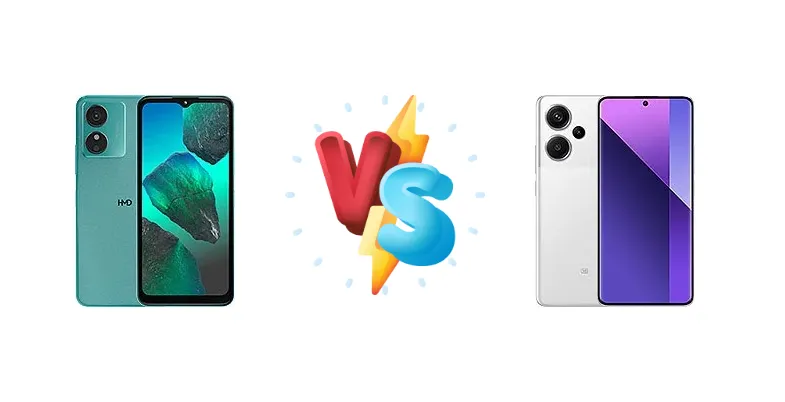
The smartphone landscape is increasingly segmented, with options ranging from ultra-premium flagships to aggressively priced budget devices. This comparison pits the Xiaomi Redmi Note 13 Pro+, a mid-range contender focused on rapid charging and solid performance, against the HMD Aura 2, a more affordable option prioritizing essential functionality. We’ll dissect their key differences to help you determine which device best suits your needs.
🏆 Quick Verdict
For the average user prioritizing speed and convenience, the Xiaomi Redmi Note 13 Pro+ is the clear winner. Its 120W charging, significantly more powerful processor, and brighter display justify the higher price. However, the HMD Aura 2 remains a viable option for those on a strict budget who prioritize basic smartphone functionality.
| Network |
|---|
| 2G bands | GSM 850 / 900 / 1800 / 1900 | GSM 850 / 900 / 1800 / 1900 |
| 3G bands | HSDPA 850 / 900 / 2100 | HSDPA 800 / 850 / 900 / 1700(AWS) / 1900 / 2100 - International |
| 4G bands | 1, 3, 5, 7, 8, 20, 28, 38, 40, 41 | 1, 2, 3, 4, 5, 7, 8, 12, 13, 17, 18, 19, 20, 26, 28, 32, 38, 40, 41, 66 - International |
| 5G bands | - | 1, 3, 5, 7, 8, 20, 28, 38, 40, 41, 66, 77, 78 SA/NSA- International |
| Speed | HSPA, LTE | HSPA, LTE, 5G |
| Technology | GSM / HSPA / LTE | GSM / CDMA / HSPA / EVDO / LTE / 5G |
| Launch |
|---|
| Announced | 2025, February 11 | 2023, September 21 |
| Status | Available. Released 2025, March 13 | Available. Released 2023, September 21 |
| Body |
|---|
| Build | - | Glass front (Gorilla Glass Victus), glass back or silicone polymer back (eco leather) |
| Dimensions | 166.4 x 76.9 x 9 mm (6.55 x 3.03 x 0.35 in) | 161.4 x 74.2 x 8.9 mm (6.35 x 2.92 x 0.35 in) |
| SIM | Nano-SIM | · Nano-SIM + eSIM· Nano-SIM + Nano-SIM |
| Weight | 185.4 g (6.53 oz) | 199 g or 204.5 g (7.02 oz) |
| Display |
|---|
| Protection | - | Corning Gorilla Glass Victus |
| Resolution | 576 x 1280 pixels, 20:9 ratio (~215 ppi density) | 1220 x 2712 pixels, 20:9 ratio (~446 ppi density) |
| Size | 6.52 inches, 102.6 cm2 (~80.2% screen-to-body ratio) | 6.67 inches, 107.4 cm2 (~89.7% screen-to-body ratio) |
| Type | IPS LCD, 460 nits (peak) | AMOLED, 68B colors, 120Hz, 1920Hz PWM, Dolby Vision, HDR10+, 1800 nits (peak) |
| Platform |
|---|
| CPU | Octa-core (4x1.6 GHz Cortex-A55 & 4x1.2 GHz Cortex-A55) | Octa-core (2x2.8 GHz Cortex-A715 & 6x2.0 GHz Cortex-A510) |
| Chipset | Unisoc SC9863A (28 nm) | Mediatek Dimensity 7200 Ultra (4 nm) |
| GPU | IMG8322 | Mali-G610 MC4 |
| OS | Android 14 (Go edition) | Android 13, up to 3 major Android upgrades, HyperOS |
| Memory |
|---|
| Card slot | microSDXC | No |
| Internal | 256GB 4GB RAM | 256GB 8GB RAM, 256GB 12GB RAM, 512GB 8GB RAM, 512GB 12GB RAM, 512GB 16GB RAM |
| Main Camera |
|---|
| Features | LED flash, panorama | Dual-LED dual-tone flash, HDR, panorama |
| Single | 13 MP, (wide), AF | - |
| Triple | - | 200 MP, f/1.7, 23mm (wide), 1/1.4", 0.56µm, multi-directional PDAF, OIS
8 MP, f/2.2, 16mm, 120˚ (ultrawide), 1/4.0", 1.12µm
2 MP (macro) |
| Video | Yes | 4K@24/30fps, 1080p@30/60/120fps, gyro-EIS |
| Selfie camera |
|---|
| Features | - | HDR, panorama |
| Single | 5 MP | 16 MP, f/2.4, (wide) |
| Video | Yes | 1080p@30/60fps |
| Sound |
|---|
| 35mm jack | Yes | No |
| Loudspeaker | Yes | Yes, with stereo speakers |
| Comms |
|---|
| Bluetooth | 5.2, A2DP, LE | 5.3, A2DP, LE |
| Infrared port | - | Yes |
| NFC | No | Yes (market/region dependent) |
| Positioning | GPS, GALILEO | GPS, GLONASS, BDS, GALILEO, QZSS |
| Radio | FM radio | No |
| USB | USB Type-C | USB Type-C 2.0, OTG |
| WLAN | Wi-Fi 802.11 b/g/n | Wi-Fi 802.11 a/b/g/n/ac/6, dual-band, Wi-Fi Direct |
| Features |
|---|
| Sensors | Fingerprint (side-mounted), accelerometer, proximity | Fingerprint (under display, optical), accelerometer, gyro, proximity, compass |
| Battery |
|---|
| Charging | 10W wired | 120W wired, PD3.0, 100% in 19 min |
| Type | 5000 mAh | Li-Po 5000 mAh |
| Misc |
|---|
| Colors | Midnight Black, Icy Blue, Electric Purple | Midnight Black (Fushion Black), Moonlight White (Fushion White), Aurora Purple, Fushion Purple, Camo Green |
| Models | - | 23090RA98C, 23090RA98G, 23090RA98I |
| Price | About 100 EUR | $ 299.98 / £ 299.00 / € 208.98 / ₹ 24,999 |
| SAR | - | 1.09 W/kg (head) 0.85 W/kg (body) |
| SAR EU | - | 0.98 W/kg (head) 1.00 W/kg (body) |
HMD Aura 2
- Extremely affordable price point.
- Functional for basic smartphone tasks.
- Acceptable battery life for light users.
- Slow processor struggles with demanding apps.
- Slow 10W charging.
- Likely a low-resolution display.
Xiaomi Redmi Note 13 Pro+
- Blazing-fast 120W charging.
- Powerful Mediatek Dimensity 7200 Ultra processor.
- Bright and vibrant display (1283 nits).
- Excellent battery life (10:38h active use).
- Higher price compared to the HMD Aura 2.
- May be overkill for users with basic needs.
- No mention of expandable storage.
Display Comparison
The Xiaomi Redmi Note 13 Pro+ boasts a significantly brighter display, reaching a measured peak of 1283 nits. This translates to superior visibility outdoors under direct sunlight, a common pain point for smartphone users. While the HMD Aura 2’s display specifications are not provided, it’s reasonable to assume it falls considerably short of this brightness level given its price point. The Redmi Note 13 Pro+'s panel likely offers better color accuracy and viewing angles as well, contributing to a more immersive visual experience. The absence of LTPO technology on either device suggests neither will dynamically adjust refresh rates for optimal power saving.
Camera Comparison
Without detailed camera specifications for the HMD Aura 2, a direct comparison is limited. However, the Redmi Note 13 Pro+ likely offers a more versatile and capable camera system. While the Redmi Note 13 Pro+’s sensor size and aperture are unknown, its image processing capabilities, driven by the Dimensity 7200 Ultra’s ISP, will likely produce sharper, more detailed images with better dynamic range. The HMD Aura 2 will likely rely on software processing to compensate for a less capable sensor, potentially resulting in softer images and reduced low-light performance. We can assume the Aura 2 will include lower resolution sensors and lack features like OIS.
Performance
The performance gap between these two devices is substantial. The Xiaomi Redmi Note 13 Pro+ is powered by the Mediatek Dimensity 7200 Ultra, a 4nm chipset featuring a powerful octa-core configuration with 2x2.8 GHz Cortex-A715 cores and 6x2.0 GHz Cortex-A510 cores. This architecture delivers significantly faster processing speeds and improved efficiency compared to the HMD Aura 2’s Unisoc SC9863A (28nm). The Unisoc chip, with its four Cortex-A55 cores clocked at 1.6 GHz and another four at 1.2 GHz, is geared towards basic tasks and will struggle with demanding applications or multitasking. The 4nm process node of the Dimensity 7200 Ultra also contributes to better thermal management, reducing the likelihood of performance throttling during extended use.
Battery Life
The Xiaomi Redmi Note 13 Pro+ excels in charging speed, offering 120W wired charging capable of reaching 100% in just 19 minutes. This is a game-changer for users who frequently find themselves needing a quick power boost. While the HMD Aura 2 offers wired charging, it’s limited to a slow 10W rate, requiring significantly longer to fully charge. The Redmi Note 13 Pro+ also boasts an active use battery score of 10:38h, indicating excellent battery life despite its faster charging capabilities. The HMD Aura 2’s battery capacity is unknown, but its slower charging and less efficient chipset suggest it will likely require more frequent charging.
Buying Guide
Buy the HMD Aura 2 if you need a functional smartphone for basic tasks like calls, messaging, and light web browsing, and are unwilling to spend more than $150. Buy the Xiaomi Redmi Note 13 Pro+ if you demand faster performance for gaming and multitasking, appreciate the convenience of incredibly fast charging, and value a brighter, more vibrant display – even if it means spending closer to $300.
Frequently Asked Questions
❓ Is the 120W charging on the Redmi Note 13 Pro+ safe for the battery's long-term health?
Xiaomi employs multiple layers of safety protocols, including temperature monitoring and optimized charging algorithms, to mitigate potential risks associated with fast charging. While all batteries degrade over time, the Redmi Note 13 Pro+'s charging system is designed to minimize this effect. The phone also supports PD3.0, allowing for slower, more conservative charging if desired.
❓ How will the Unisoc SC9863A in the HMD Aura 2 handle common apps like Facebook, WhatsApp, and YouTube?
The Unisoc SC9863A is capable of running these apps, but expect slower loading times and potential lag when switching between them. The processor is designed for basic tasks, and multitasking with these apps simultaneously may result in a noticeable performance decrease. Video playback on YouTube may be limited to lower resolutions.
❓ Does the Redmi Note 13 Pro+ support 5G connectivity?
Yes, the Mediatek Dimensity 7200 Ultra chipset integrated into the Redmi Note 13 Pro+ supports 5G connectivity, allowing for faster download and upload speeds where 5G networks are available. This is a significant advantage over the HMD Aura 2, which likely only supports 4G.