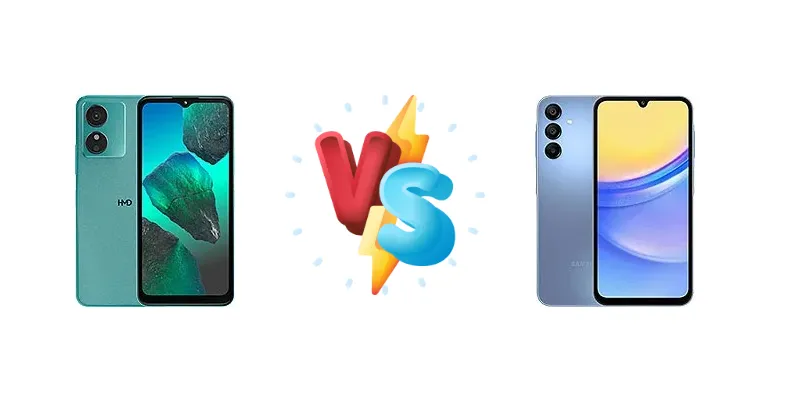
The sub-$200 5G smartphone market is heating up. The HMD Aura 2 aims to deliver essential connectivity at an incredibly low price point, while the Samsung Galaxy A15 5G offers a more polished experience with a stronger focus on display quality and performance. This comparison dissects the key differences to determine which device offers the best value.
🏆 Quick Verdict
For the average user, the Samsung Galaxy A15 5G is the superior choice. Its significantly more powerful Mediatek Dimensity 6100+ chipset, coupled with a brighter display and faster charging, outweighs the Aura 2’s lower price. While the Aura 2 offers basic functionality, the A15 5G provides a smoother, more enjoyable user experience.
| Network |
|---|
| 2G bands | GSM 850 / 900 / 1800 / 1900 | GSM 850 / 900 / 1800 / 1900 |
| 3G bands | HSDPA 850 / 900 / 2100 | HSDPA 850 / 900 / 1700(AWS) / 1900 / 2100 |
| 4G bands | 1, 3, 5, 7, 8, 20, 28, 38, 40, 41 | 1, 2, 3, 4, 5, 7, 8, 12, 17, 20, 26, 28, 38, 40, 41, 66 |
| 5G bands | - | 1, 3, 5, 7, 8, 26, 28, 40, 41, 66, 77, 78 SA/NSA/Sub6 |
| Speed | HSPA, LTE | HSPA, LTE, 5G |
| Technology | GSM / HSPA / LTE | GSM / HSPA / LTE / 5G |
| Launch |
|---|
| Announced | 2025, February 11 | 2023, December 11 |
| Status | Available. Released 2025, March 13 | Available. Released 2023, December 16 |
| Body |
|---|
| Build | - | Glass front, plastic back, plastic frame |
| Dimensions | 166.4 x 76.9 x 9 mm (6.55 x 3.03 x 0.35 in) | 160.1 x 76.8 x 8.4 mm (6.30 x 3.02 x 0.33 in) |
| SIM | Nano-SIM | · Nano-SIM· Nano-SIM + Nano-SIM |
| Weight | 185.4 g (6.53 oz) | 200 g (7.05 oz) |
| Display |
|---|
| Resolution | 576 x 1280 pixels, 20:9 ratio (~215 ppi density) | 1080 x 2340 pixels, 19.5:9 ratio (~396 ppi density) |
| Size | 6.52 inches, 102.6 cm2 (~80.2% screen-to-body ratio) | 6.5 inches, 103.7 cm2 (~84.3% screen-to-body ratio) |
| Type | IPS LCD, 460 nits (peak) | Super AMOLED, 90Hz, 800 nits (HBM) |
| Platform |
|---|
| CPU | Octa-core (4x1.6 GHz Cortex-A55 & 4x1.2 GHz Cortex-A55) | Octa-core (2x2.2 GHz Cortex-A76 & 6x2.0 GHz Cortex-A55) |
| Chipset | Unisoc SC9863A (28 nm) | Mediatek Dimensity 6100+ (6 nm) |
| GPU | IMG8322 | Mali-G57 MC2 |
| OS | Android 14 (Go edition) | Android 14, upgradable to Android 16, One UI 8, up to 4 major Android upgrades |
| Memory |
|---|
| Card slot | microSDXC | microSDXC (uses shared SIM slot) |
| Internal | 256GB 4GB RAM | 64GB 4GB RAM, 128GB 4GB RAM, 128GB 6GB RAM, 128GB 8GB RAM, 256GB 8GB RAM |
| Main Camera |
|---|
| Features | LED flash, panorama | LED flash, panorama, HDR |
| Single | 13 MP, (wide), AF | - |
| Triple | - | 50 MP, f/1.8, (wide), AF
5 MP, f/2.2, (ultrawide)
2 MP (macro) |
| Video | Yes | 1080p@30fps, gyro-EIS |
| Selfie camera |
|---|
| Single | 5 MP | 13 MP, f/2.0, (wide) |
| Video | Yes | 1080p@30fps |
| Sound |
|---|
| 35mm jack | Yes | Yes |
| Loudspeaker | Yes | Yes |
| Comms |
|---|
| Bluetooth | 5.2, A2DP, LE | 5.3, A2DP, LE |
| NFC | No | Yes (market/region dependent) |
| Positioning | GPS, GALILEO | GPS, GALILEO, GLONASS, BDS, QZSS |
| Radio | FM radio | No |
| USB | USB Type-C | USB Type-C 2.0 |
| WLAN | Wi-Fi 802.11 b/g/n | Wi-Fi 802.11 a/b/g/n/ac, dual-band, Wi-Fi Direct |
| Features |
|---|
| Sensors | Fingerprint (side-mounted), accelerometer, proximity | Fingerprint (side-mounted), accelerometer, gyro, compass |
| Battery |
|---|
| Charging | 10W wired | 25W wired |
| Type | 5000 mAh | 5000 mAh |
| Misc |
|---|
| Colors | Midnight Black, Icy Blue, Electric Purple | Brave Black, Personality Yellow, Magical Blue, Optimistic Blue |
| Models | - | SM-A156B, SM-A156B/DS, SM-A156P, SM-A156P/DS, SM-A156U, SM-A156U1, SM-A156U1/DS, SM-A156W, SM-A156P/N, SM-A156P/DSN, SM-S156VL, SM-A156M, SM-A156E, SM-A156E/DSN |
| Price | About 100 EUR | € 167.00 / $ 79.97 / ₹ 17,490 |
| SAR EU | - | 0.80 W/kg (head) 1.46 W/kg (body) |
HMD Aura 2
- Lowest possible price for 5G connectivity
- Simple and straightforward software experience
- Potentially longer software support from HMD
- Significantly weaker performance
- Lower display brightness and quality
- Slow 10W charging
Samsung Galaxy A15 5G
- Much faster and more efficient processor
- Brighter and more vibrant display
- Faster 25W charging
- Higher price than the HMD Aura 2
- Samsung’s One UI can be resource intensive
- May include bloatware
Display Comparison
The Samsung Galaxy A15 5G boasts a significantly brighter display, reaching a measured 786 nits. This is crucial for outdoor visibility, a clear advantage over the HMD Aura 2, whose brightness is not specified but is expected to be considerably lower given its price point. While both likely utilize LCD panels, the A15 5G’s higher peak brightness translates to a more enjoyable viewing experience in various lighting conditions. The Aura 2’s display details are sparse, suggesting a focus on cost reduction rather than visual fidelity.
Camera Comparison
Camera details for the HMD Aura 2 are limited, making a direct comparison difficult. However, given its price point, it’s safe to assume the A15 5G offers a more capable camera system. While neither phone is expected to compete with flagship camera performance, the A15 5G likely benefits from Samsung’s image processing algorithms and potentially a larger main sensor. Focusing on the main sensor is key, as both devices likely include low-resolution auxiliary lenses of limited utility.
Performance
The performance gap between these two devices is substantial. The Samsung Galaxy A15 5G’s Mediatek Dimensity 6100+ (6nm) is a modern chipset featuring two high-performance Cortex-A76 cores clocked at 2.2 GHz, alongside six efficiency cores. This contrasts sharply with the HMD Aura 2’s Unisoc SC9863A (28nm), which relies on older Cortex-A55 cores clocked at lower frequencies (1.6 GHz and 1.2 GHz). The 6nm process node of the Dimensity 6100+ also offers superior power efficiency, leading to better sustained performance and less thermal throttling. Users will notice a significant difference in app loading times, multitasking, and overall responsiveness on the A15 5G.
Battery Life
The Samsung Galaxy A15 5G demonstrates a clear advantage in battery endurance, achieving an active use score of 14 hours and 31 minutes. While the HMD Aura 2’s battery capacity isn’t specified, its less efficient chipset and slower 10W charging suggest it will require more frequent charging. The A15 5G’s 25W wired charging also significantly reduces charging times, allowing users to quickly top up their battery when needed. This faster charging is a practical benefit for users who rely heavily on their smartphones throughout the day.
Buying Guide
Buy the HMD Aura 2 if you absolutely need the cheapest possible 5G connectivity and prioritize minimal software over performance. It’s a viable option for those on a very strict budget or as a secondary device. Buy the Samsung Galaxy A15 5G if you value a responsive user experience, a vibrant display for media consumption, and faster charging – all without breaking the bank. It’s the better all-rounder for daily use.
Frequently Asked Questions
❓ Is the Unisoc SC9863A chipset in the HMD Aura 2 sufficient for basic tasks like calling and messaging?
Yes, the Unisoc SC9863A is capable of handling basic tasks like calling, messaging, and light web browsing. However, it will struggle with demanding applications, multitasking, or graphically intensive games. Expect noticeable lag and slowdowns when pushing the device.
❓ Does the Samsung Galaxy A15 5G support carrier aggregation for faster 5G speeds?
While Samsung doesn't explicitly list all supported 5G bands and carrier aggregation features for the A15 5G, it's likely to support some level of carrier aggregation, depending on the specific model and carrier. This can result in significantly faster 5G download and upload speeds in areas with good 5G coverage.
❓ How does the software update policy differ between HMD and Samsung for these devices?
HMD generally promises a cleaner Android experience with fewer pre-installed apps and a commitment to security updates. Samsung, while offering more features with One UI, is often criticized for slower software updates. However, Samsung has improved its update cadence in recent years, and the A15 5G is likely to receive at least a few years of security patches.
❓ Will the HMD Aura 2 struggle with popular social media apps like TikTok and Instagram?
Yes, the HMD Aura 2’s weaker processor and limited RAM will likely result in a sluggish experience when using demanding social media apps like TikTok and Instagram. Expect longer loading times, stuttering during scrolling, and potential app crashes.