
Asus ROG Phone 8 Pro vs. HMD Aura 2: A Clash of Performance and Price
| Phones Images | |||||
|---|---|---|---|---|---|
|
🏆 Quick Verdict
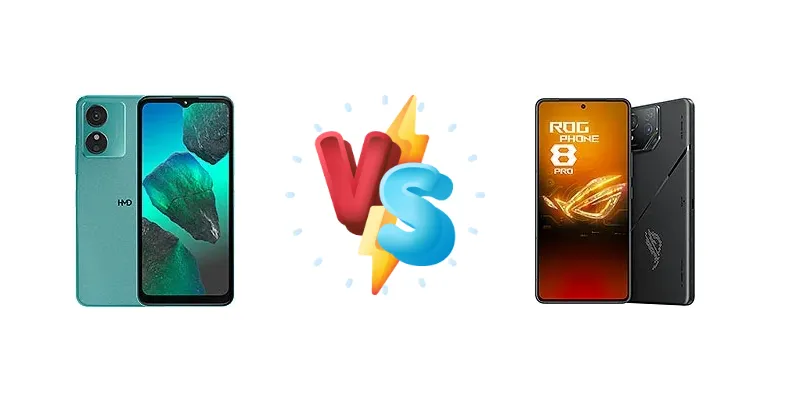
For demanding users and gamers, the Asus ROG Phone 8 Pro is the clear winner, offering a vastly superior chipset, display, and charging speed. However, the HMD Aura 2 provides a functional smartphone experience at a significantly lower price point, making it ideal for budget-conscious users.
| PHONES | ||
|---|---|---|
| Phone Names | HMD Aura 2 | Asus ROG Phone 8 Pro |
| Network | ||
|---|---|---|
| 2G bands | GSM 850 / 900 / 1800 / 1900 | GSM 850 / 900 / 1800 / 1900 |
| 3G bands | HSDPA 850 / 900 / 2100 | HSDPA 850 / 900 / 1700(AWS) / 1800 / 1900 / 2100 - International |
| 4G bands | 1, 3, 5, 7, 8, 20, 28, 38, 40, 41 | 1, 2, 3, 4, 5, 7, 8, 12, 17, 18, 19, 20, 25, 26, 28, 32, 34, 38, 39, 40, 41, 42, 43, 48, 66 - International |
| 5G bands | - | 1, 2, 3, 5, 7, 8, 12, 18, 20, 25, 26, 28, 38, 40, 41, 48, 66, 77, 78, 79 SA/NSA/Sub6 - International |
| Speed | HSPA, LTE | HSPA, LTE (Up to 7CA), 5G |
| Technology | GSM / HSPA / LTE | GSM / CDMA / HSPA / LTE / 5G |
| Launch | ||
|---|---|---|
| Announced | 2025, February 11 | 2024, January 08 |
| Status | Available. Released 2025, March 13 | Available. Released 2024, January 18 |
| Body | ||
|---|---|---|
| Build | - | Glass front (Gorilla Glass Victus 2), glass back (Gorilla Glass), aluminum frame |
| Dimensions | 166.4 x 76.9 x 9 mm (6.55 x 3.03 x 0.35 in) | 163.8 x 76.8 x 8.9 mm (6.45 x 3.02 x 0.35 in) |
| SIM | Nano-SIM | Nano-SIM + Nano-SIM |
| Weight | 185.4 g (6.53 oz) | 225 g (7.94 oz) |
| Display | ||
|---|---|---|
| Protection | - | Corning Gorilla Glass Victus 2 |
| Resolution | 576 x 1280 pixels, 20:9 ratio (~215 ppi density) | 1080 x 2400 pixels, 20:9 ratio (~388 ppi density) |
| Size | 6.52 inches, 102.6 cm2 (~80.2% screen-to-body ratio) | 6.78 inches, 111.0 cm2 (~88.2% screen-to-body ratio) |
| Type | IPS LCD, 460 nits (peak) | LTPO AMOLED, 1B colors, 165Hz, HDR10, 1600 nits (HBM), 2500 nits (peak) |
| Platform | ||
|---|---|---|
| CPU | Octa-core (4x1.6 GHz Cortex-A55 & 4x1.2 GHz Cortex-A55) | Octa-core (1x3.3 GHz Cortex-X4 & 3x3.2 GHz Cortex-A720 & 2x3.0 GHz Cortex-A720 & 2x2.3 GHz Cortex-A520) |
| Chipset | Unisoc SC9863A (28 nm) | Qualcomm SM8650-AB Snapdragon 8 Gen 3 (4 nm) |
| GPU | IMG8322 | Adreno 750 |
| OS | Android 14 (Go edition) | Android 14, up to 2 major Android upgrades |
| Memory | ||
|---|---|---|
| Card slot | microSDXC | No |
| Internal | 256GB 4GB RAM | 512GB 16GB RAM, 1TB 24GB RAM |
| Main Camera | ||
|---|---|---|
| Features | LED flash, panorama | LED flash, HDR, panorama |
| Single | 13 MP, (wide), AF | - |
| Triple | - | 50 MP, f/1.9, 24mm (wide), 1/1.56", 1.0µm, PDAF, gimbal OIS 32 MP, f/2.4, (telephoto), 1/3.2", 0.7µm, PDAF, OIS, 3x optical zoom 13 MP, f/2.2, 13mm, 120˚ (ultrawide) |
| Video | Yes | 8K@24fps, 4K@30/60fps, 1080p@30/60/120/240fps, 720p@480fps; gyro-EIS, HDR10+ |
| Selfie camera | ||
|---|---|---|
| Features | - | Panorama, HDR |
| Single | 5 MP | 32 MP, f/2.5, 22mm (wide), 1/3.2", 0.7µm |
| Video | Yes | 1080p@30fps |
| Sound | ||
|---|---|---|
| 35mm jack | Yes | Yes |
| Loudspeaker | Yes | Yes, with stereo speakers |
| Comms | ||
|---|---|---|
| Bluetooth | 5.2, A2DP, LE | 5.4, A2DP, LE, aptX HD, aptX Adaptive, aptX Lossless |
| NFC | No | Yes |
| Positioning | GPS, GALILEO | GPS (L1+L5), BDS (B1I+B1c+B2a), GALILEO (E1+E5a), QZSS (L1+L5), NavIC (L5), GLONASS |
| Radio | FM radio | No |
| USB | USB Type-C | USB Type-C (side), DisplayPort 1.4; USB Type-C (bottom), OTG |
| WLAN | Wi-Fi 802.11 b/g/n | Wi-Fi 802.11 a/b/g/n/ac/6e/7, tri-band, Wi-Fi Direct |
| Features | ||
|---|---|---|
| Sensors | Fingerprint (side-mounted), accelerometer, proximity | Fingerprint (under display, optical), accelerometer, gyro, proximity, compass |
| Battery | ||
|---|---|---|
| Charging | 10W wired | 65W wired, PD3.0, PPS, QC5, 100% in 39 min - International 30W wired, PD3.0, PPS - India 15W wireless (Qi) 10W reverse wired |
| Type | 5000 mAh | 5500 mAh |
| Misc | ||
|---|---|---|
| Colors | Midnight Black, Icy Blue, Electric Purple | Phantom Black |
| Models | - | AI2401, AI2401_A, AI2401_D |
| Price | About 100 EUR | $ 1,157.98 / £ 1,693.75 / € 632.66 |
HMD Aura 2
- Exceptional performance with Snapdragon 8 Gen 3
- Bright and smooth display with high peak brightness
- Fast 65W charging with multiple standards
- Higher price point
- Potentially bulky design (typical of ROG Phones)
Asus ROG Phone 8 Pro
- Extremely affordable price
- Functional for basic smartphone tasks
- Compact and lightweight (likely)
- Significantly weaker performance
- Slow 10W charging
Display Comparison
The Asus ROG Phone 8 Pro boasts a significantly more advanced display, reaching a measured peak brightness of 1765 nits. This high brightness ensures excellent visibility even in direct sunlight. While the Aura 2’s display specifications are not provided, its price point suggests a lower-quality panel with lower peak brightness and potentially narrower color gamut. The ROG Phone 8 Pro likely incorporates LTPO technology for adaptive refresh rates, further enhancing power efficiency and smoothness, a feature absent in the Aura 2.
Camera Comparison
The Asus ROG Phone 8 Pro features a 'Photo / Video' camera system, suggesting a more versatile and capable setup. While specific sensor details are missing, ROG phones typically prioritize camera quality. The HMD Aura 2’s camera specifications are not detailed, but given its price point, it likely features a basic camera system suitable for casual snapshots. The ROG Phone 8 Pro likely benefits from advanced image processing algorithms and potentially optical image stabilization (OIS), features unlikely to be found on the Aura 2.
Performance
The performance gap is substantial. The Asus ROG Phone 8 Pro’s Qualcomm Snapdragon 8 Gen 3 (4nm) is a flagship chipset featuring a complex core configuration – 1x3.3 GHz Cortex-X4, 3x3.2 GHz Cortex-A720, 2x3.0 GHz Cortex-A720, and 2x2.3 GHz Cortex-A520 – designed for demanding tasks. In contrast, the HMD Aura 2 utilizes the Unisoc SC9863A (28nm) with a much less powerful octa-core setup (4x1.6 GHz Cortex-A55 & 4x1.2 GHz Cortex-A55). The 4nm process node of the Snapdragon 8 Gen 3 delivers significantly better thermal efficiency and performance per watt, minimizing throttling during extended gaming sessions. The Aura 2’s older 28nm process will likely result in lower performance and increased heat generation.
Battery Life
The Asus ROG Phone 8 Pro excels in battery and charging. It achieves an impressive 14:43h of active use, indicating excellent battery life. Furthermore, it supports 65W wired charging (International) or 30W (India) with fast charging standards like PD3.0, PPS, and QC5, achieving a 100% charge in just 39 minutes. The HMD Aura 2 is limited to 10W wired charging, resulting in a significantly longer charging time. While the Aura 2’s battery capacity isn’t specified, the slower charging speed suggests it may need more time to reach a full charge, even with a comparable capacity.
Buying Guide
Buy the HMD Aura 2 if you need a basic, reliable smartphone for everyday tasks like calling, texting, and light social media use, and prioritize affordability above all else. Buy the Asus ROG Phone 8 Pro if you are a mobile gamer, content creator, or power user who demands the fastest performance, brightest display, and quickest charging available, and are willing to pay a premium.