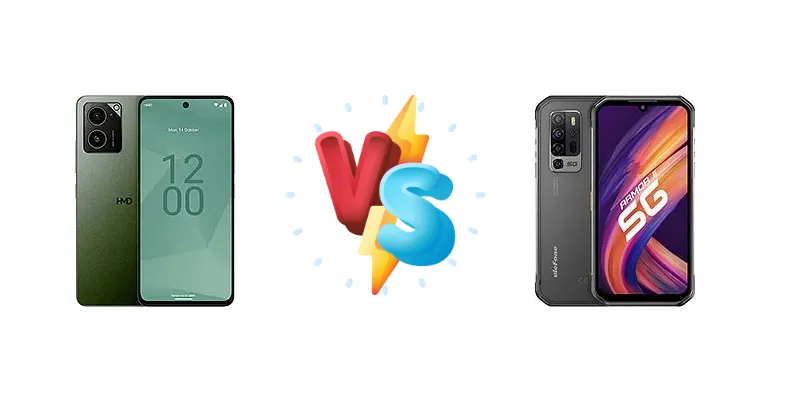
The rugged smartphone market is heating up, offering durable devices for demanding users. We pit the newly released HMD Atlas, powered by Qualcomm's efficient Snapdragon 4 Gen 2, against the established Ulefone Armor 11 5G, featuring the Mediatek Dimensity 800. This comparison focuses on how chipset choices impact real-world performance, battery life, and overall user experience.
🏆 Quick Verdict
For the average user prioritizing long-term performance and efficiency, the HMD Atlas emerges as the winner. Its newer 4nm Snapdragon 4 Gen 2 chipset offers a more modern architecture and better thermal management than the Ulefone Armor 11 5G's Dimensity 800, despite the latter's higher clock speeds on some cores.
| Network |
|---|
| 2G bands | GSM 850 / 900 / 1800 / 1900 | GSM 850 / 900 / 1800 / 1900 |
| 3G bands | HSDPA 850 / 900 / 2100 | HSDPA 850 / 900 / 1700(AWS) / 1900 / 2100 |
| 4G bands | LTE | 1, 2, 3, 4, 5, 7, 8, 12, 13, 17, 18, 19, 20, 25, 26, 28, 34, 38, 39, 40, 41, 66 |
| 5G bands | SA/NSA | 1, 3, 5, 8, 20, 28, 38, 41, 77, 78, 79 SA/NSA |
| Speed | HSPA, LTE, 5G | HSPA, LTE, 5G |
| Technology | GSM / HSPA / LTE / 5G | GSM / CDMA / HSPA / EVDO / LTE / 5G |
| | - | CDMA2000 1xEV-DO |
| Launch |
|---|
| Announced | Not announced yet | 2021, February 18 |
| Status | Cancelled | Available. Released 2021, March 08 |
| Body |
|---|
| Build | - | Front glass, aluminum back with rubber, aluminum frame |
| Dimensions | 163 x 75 x 8.8 mm (6.42 x 2.95 x 0.35 in) | 163.8 x 81.6 x 14.2 mm (6.45 x 3.21 x 0.56 in) |
| SIM | Nano-SIM | Nano-SIM + Nano-SIM |
| Weight | 210 g (7.41 oz) | 295 g (10.41 oz) |
| | - | IP68 dust/water resistant (up to 1.5m for 30 min)
Drop-to-concrete resistance from up to 1.2m
MIL-STD-810G compliant |
| Display |
|---|
| Protection | - | Oleophobic coating |
| Resolution | 1080 x 2400 pixels, 20:9 ratio (~396 ppi density) | 720 x 1560 pixels, 19.5:9 ratio (~282 ppi density) |
| Size | 6.64 inches, 106.4 cm2 (~87.1% screen-to-body ratio) | 6.1 inches, 91.3 cm2 (~68.3% screen-to-body ratio) |
| Type | IPS LCD, 120Hz | IPS LCD |
| Platform |
|---|
| CPU | Octa-core (2x2.2 GHz Cortex-A78 & 6x1.95 GHz Cortex-A55) | Octa-core (4x2.0 GHz Cortex-A76 & 4x2.0 GHz Cortex-A55) |
| Chipset | Qualcomm SM4450 Snapdragon 4 Gen 2 (4 nm) | Mediatek Dimensity 800 (7 nm) |
| GPU | Adreno 613 | Mali-G57 MP4 |
| OS | Android 14 | Android 10, planned upgrade to Android 11 |
| Memory |
|---|
| Card slot | microSDXC | No |
| Internal | 128GB 8GB RAM | 256GB 8GB RAM |
| | - | UFS 2.1 |
| Main Camera |
|---|
| Dual | 48 MP, f/1.8, (wide), AF
8 MP, (ultrawide) | - |
| Features | LED flash, HDR | Dual-LED dual-tone flash, HDR, panorama |
| Penta | - | 48 MP, f/1.8, 26mm (wide), 1/2.0", 0.8µm, PDAF
13 MP, f/2.4, 125˚ (ultrawide)
20 MP, f/1.8, (night vision), 1/2.78", 1.0µm
2 MP (macro)
Auxiliary lens |
| Single | - | 16 MP, f/2.0 |
| Video | 1080p@30fps | 4K@30fps, 1080p@30fps |
| Selfie camera |
|---|
| Features | - | HDR, panorama |
| Single | 16 MP | 16 MP, f/2.0 |
| Video | 1080p@30fps | 1080p@30fps |
| Sound |
|---|
| 3.5mm jack | - | Yes |
| 35mm jack | Yes | Yes |
| Loudspeaker | Yes | Yes |
| Comms |
|---|
| Bluetooth | 5.1, A2DP, LE | 5.0, A2DP, LE |
| NFC | Yes | Yes |
| Positioning | GPS, GALILEO | GPS, GLONASS, GALILEO, BDS |
| Radio | Unspecified | FM radio, RDS, recording |
| USB | USB Type-C 2.0, OTG | USB Type-C 2.0, OTG |
| WLAN | Wi-Fi 802.11 a/b/g/n/ac | Wi-Fi 802.11 a/b/g/n/ac, Wi-Fi Direct |
| Features |
|---|
| Sensors | Fingerprint (side-mounted), accelerometer, proximity, compass | Fingerprint (side-mounted), accelerometer, gyro, proximity, compass, baroceptor |
| Battery |
|---|
| Charging | Wired, QC4 | 18W wired
10W wireless |
| Type | 5500 mAh | Li-Po 5200 mAh |
| Misc |
|---|
| Colors | Green | Black |
| Price | About 220 EUR | About 480 EUR |
HMD Atlas
- More efficient Snapdragon 4 Gen 2 chipset
- Likely better sustained performance
- QC4 fast charging support
- No wireless charging
- Limited camera details available
Ulefone Armor 11 5G
- Wireless charging support
- Potentially faster peak performance
- Established rugged phone brand
- Less efficient Dimensity 800 chipset
- Potential for thermal throttling
- Older chipset architecture
Display Comparison
Display specifications are not provided, so a direct comparison is limited. However, given the HMD Atlas's focus on modern features, it likely employs a higher-quality panel with better color accuracy and viewing angles. The Ulefone Armor 11 5G, being an older model, may exhibit wider bezels and a less refined display experience. Both devices, being rugged, will likely prioritize durability over ultra-high resolutions.
Camera Comparison
Camera details are unavailable, making a detailed comparison impossible. However, given the market positioning, the HMD Atlas likely prioritizes computational photography and software optimization, leveraging Qualcomm's ISP. The Ulefone Armor 11 5G may rely more on hardware specifications, potentially offering a higher megapixel count but potentially lacking the same level of image processing refinement. The presence of a 2MP macro camera on the Ulefone is likely a marketing feature with limited real-world utility.
Performance
The core difference lies in the chipsets. The HMD Atlas's Qualcomm SM4450 Snapdragon 4 Gen 2 (4nm) utilizes a more efficient manufacturing process than the Ulefone Armor 11 5G's Mediatek Dimensity 800 (7nm). While the Dimensity 800 boasts higher clock speeds on its Cortex-A76 cores (2.0 GHz vs 2.2 GHz on the Atlas's A78 cores), the Snapdragon 4 Gen 2's newer architecture and smaller node size translate to better sustained performance and reduced heat generation. This means the Atlas is less likely to throttle during extended gaming sessions or demanding tasks. The Atlas's CPU configuration (2x2.2 GHz Cortex-A78 & 6x1.95 GHz Cortex-A55) also offers a more balanced approach, with the A78 cores providing a significant performance boost when needed.
Battery Life
Battery capacity is not specified for either device. However, the Ulefone Armor 11 5G offers both 18W wired and 10W wireless charging, providing flexibility. The HMD Atlas supports Qualcomm Quick Charge 4 (QC4), which, while potentially delivering higher wattage than 18W, requires a compatible charger. The Snapdragon 4 Gen 2's superior efficiency will likely result in longer battery life for the HMD Atlas, even with a similar capacity battery, offsetting the convenience of wireless charging on the Ulefone.
Buying Guide
Buy the HMD Atlas if you need a rugged phone with a focus on sustained performance, efficient power usage, and future-proofed connectivity. It's ideal for users who frequently use demanding apps or want a device that won't throttle under load. Buy the Ulefone Armor 11 5G if you prioritize faster peak performance for short bursts, and value the convenience of wireless charging, and are comfortable with potentially higher operating temperatures.
Frequently Asked Questions
❓ Will the Dimensity 800 in the Ulefone Armor 11 5G overheat during prolonged gaming sessions?
The Dimensity 800, being a 7nm chip, is more prone to thermal throttling than the HMD Atlas's 4nm Snapdragon 4 Gen 2. While it can deliver strong peak performance, expect performance to decrease over time during extended gaming, potentially leading to dropped frames and a less enjoyable experience.
❓ Does the HMD Atlas support VoLTE and 5G on all carriers?
HMD Global generally provides broad carrier compatibility with its devices. However, it's crucial to verify 5G and VoLTE support with your specific carrier before purchasing, as compatibility can vary by region and network configuration. Check HMD Global's website or contact your carrier for confirmation.
❓ Is the 10W wireless charging on the Ulefone Armor 11 5G significantly slower than wired charging?
Yes, 10W wireless charging is considerably slower than the 18W wired charging offered by the Ulefone Armor 11 5G, and potentially faster charging with QC4 on the HMD Atlas. Expect a full charge via wireless to take several hours, making it more suitable for overnight charging rather than quick top-ups.