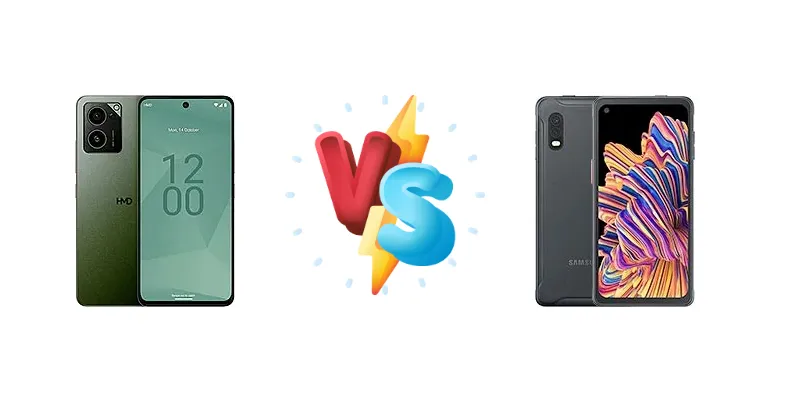
The rugged smartphone market caters to a specific need: durability. Both the HMD Atlas and Samsung Galaxy XCover Pro aim to deliver that, but they take different approaches under the hood. The Atlas leverages a newer, more efficient Qualcomm chipset, while the XCover Pro relies on Samsung’s older Exynos platform. This comparison dissects the key differences to determine which phone offers the best value for demanding users.
🏆 Quick Verdict
For most users prioritizing performance and future-proofing, the HMD Atlas emerges as the stronger choice. Its Snapdragon 4 Gen 2 chipset, built on a 4nm process, provides a significant efficiency and performance advantage over the XCover Pro’s 10nm Exynos 9611. While the XCover Pro benefits from Samsung’s software ecosystem, the Atlas delivers more bang for your buck.
| Network |
|---|
| 2G bands | GSM 850 / 900 / 1800 / 1900 | GSM 850 / 900 / 1800 / 1900 |
| 3G bands | HSDPA 850 / 900 / 2100 | HSDPA 850 / 900 / 1900 / 2100 - International |
| 4G bands | LTE | 1, 2, 3, 5, 7, 8, 20, 28, 38, 40, 41 - International |
| 5G bands | SA/NSA | - |
| Speed | HSPA, LTE, 5G | HSPA 42.2/5.76 Mbps, LTE (3CA) Cat11 600/50 Mbps |
| Technology | GSM / HSPA / LTE / 5G | GSM / HSPA / LTE |
| | - | 1, 2, 3, 4, 5, 7, 12, 13, 14, 20, 29, 38, 40, 41, 66 - Canada |
| Launch |
|---|
| Announced | Not announced yet | 2020, January |
| Status | Cancelled | Available. Released 2020, January |
| Body |
|---|
| Dimensions | 163 x 75 x 8.8 mm (6.42 x 2.95 x 0.35 in) | 159.9 x 76.7 x 10 mm (6.30 x 3.02 x 0.39 in) |
| SIM | Nano-SIM | · Nano-SIM· Nano-SIM + Nano-SIM |
| Weight | 210 g (7.41 oz) | 218 g (7.69 oz) |
| | - | IP68 dust/water resistant (up to 1.5m for 35 min)
Drop-to-concrete resistance from up to 1.5m
MIL-STD-810G compliant*
*does not guarantee ruggedness or use in extreme conditions |
| Display |
|---|
| Protection | - | Corning Gorilla Glass 5 |
| Resolution | 1080 x 2400 pixels, 20:9 ratio (~396 ppi density) | 1080 x 2340 pixels, 19.5:9 ratio (~409 ppi density) |
| Size | 6.64 inches, 106.4 cm2 (~87.1% screen-to-body ratio) | 6.3 inches, 97.4 cm2 (~79.4% screen-to-body ratio) |
| Type | IPS LCD, 120Hz | IPS LCD |
| Platform |
|---|
| CPU | Octa-core (2x2.2 GHz Cortex-A78 & 6x1.95 GHz Cortex-A55) | Octa-core (4x2.3 GHz Cortex-A73 & 4x1.7 GHz Cortex-A53) |
| Chipset | Qualcomm SM4450 Snapdragon 4 Gen 2 (4 nm) | Exynos 9611 (10 nm) |
| GPU | Adreno 613 | Mali-G72 MP3 |
| OS | Android 14 | Android 10, upgradable to Android 13, One UI 5 |
| Memory |
|---|
| Card slot | microSDXC | microSDXC (dedicated slot) |
| Internal | 128GB 8GB RAM | 64GB 4GB RAM |
| Main Camera |
|---|
| Dual | 48 MP, f/1.8, (wide), AF
8 MP, (ultrawide) | 25 MP, f/1.7, 26mm (wide), PDAF
8 MP, f/2.2, 123˚ (ultrawide), 1/4.0", 1.12µm |
| Features | LED flash, HDR | Dual-LED flash, HDR, panorama |
| Video | 1080p@30fps | 1080p@30fps |
| Selfie camera |
|---|
| Features | - | HDR |
| Single | 16 MP | 13 MP, f/2.0, (wide), 1/3.1", 1.12µm |
| Video | 1080p@30fps | 1080p@30fps |
| Sound |
|---|
| 3.5mm jack | - | Yes |
| 35mm jack | Yes | Yes |
| Loudspeaker | Yes | Yes |
| Comms |
|---|
| Bluetooth | 5.1, A2DP, LE | 5.0, A2DP, LE |
| NFC | Yes | Yes |
| Positioning | GPS, GALILEO | GPS, GLONASS, GALILEO, BDS |
| Radio | Unspecified | FM radio (market/region dependent) |
| USB | USB Type-C 2.0, OTG | USB Type-C 2.0 |
| WLAN | Wi-Fi 802.11 a/b/g/n/ac | Wi-Fi 802.11 a/b/g/n/ac/k/v/r, dual-band, Wi-Fi Direct |
| Features |
|---|
| Sensors | Fingerprint (side-mounted), accelerometer, proximity, compass | Fingerprint (side-mounted), accelerometer, gyro, proximity, compass |
| | - | ANT+ |
| Battery |
|---|
| Charging | Wired, QC4 | 15W wired |
| Type | 5500 mAh | Li-Po 4050 mAh, removable |
| Misc |
|---|
| Colors | Green | Black |
| Models | - | SM-G715FN/DS, SM-G715FN, SM-G715F, SM-G715W, SM-G715U, SM-G715U1 |
| Price | About 220 EUR | About 120 EUR |
| SAR EU | - | 0.47 W/kg (head) 1.23 W/kg (body) |
HMD Atlas
- More efficient Snapdragon 4 Gen 2 chipset
- Faster charging with QC4 support
- Likely better sustained performance due to thermal efficiency
- Brand recognition is lower than Samsung
- Software updates may be less frequent than Samsung
Samsung Galaxy XCover Pro
- Samsung’s established software ecosystem
- Compatibility with Samsung accessories
- Potentially wider availability
- Older, less efficient Exynos 9611 chipset
- Slow 15W charging
- Likely more thermal throttling under load
Display Comparison
Neither device is known for a standout display. Given the context data, we can assume both utilize LCD panels, common in rugged phones for visibility and durability. The lack of specifics suggests neither boasts high refresh rates or peak brightness. The XCover Pro, being a slightly older model, likely has larger bezels. The Atlas’s newer chipset *could* allow for more efficient display power management, but without display specs, this is speculative. Color accuracy is likely similar, prioritizing practicality over vibrancy.
Camera Comparison
Without detailed camera specs, a direct comparison is difficult. However, the rugged phone segment typically prioritizes functionality over photographic excellence. We can assume both phones feature basic camera setups. The absence of information suggests neither phone will excel in low-light photography or offer advanced features like 8K video recording. The Atlas’s newer ISP (Image Signal Processor) within the Snapdragon 4 Gen 2 *may* offer slightly improved image processing, but the difference is unlikely to be substantial. Any 2MP macro lens on either device should be considered a marketing feature rather than a genuinely useful camera component.
Performance
The core difference lies in the chipsets. The HMD Atlas’s Qualcomm Snapdragon 4 Gen 2 (4nm) is a clear upgrade over the Samsung Galaxy XCover Pro’s Exynos 9611 (10nm). The 4nm process node translates to significantly improved power efficiency and thermal performance. The Atlas’s CPU configuration – 2x2.2 GHz Cortex-A78 & 6x1.95 GHz Cortex-A55 – offers a more modern architecture than the XCover Pro’s 4x2.3 GHz Cortex-A73 & 4x1.7 GHz Cortex-A53. While the XCover Pro’s cores have a higher clock speed, the newer architecture of the Atlas’s cores provides better instructions per clock (IPC), resulting in superior real-world performance. This means smoother multitasking, faster app loading times, and better sustained performance during demanding tasks. The Atlas will also benefit from Qualcomm’s optimizations.
Battery Life
Battery life will depend heavily on usage patterns. While the mAh capacity isn’t specified, the HMD Atlas’s more efficient Snapdragon 4 Gen 2 chipset will likely deliver longer battery life than the XCover Pro, despite the latter potentially having a slightly larger battery. The XCover Pro is limited to 15W wired charging, a significantly slower rate than the Atlas’s Quick Charge 4 (QC4) support. This means the Atlas will charge much faster, reducing downtime. A full charge on the XCover Pro could take well over two hours, while the Atlas should achieve a full charge in under 90 minutes.
Buying Guide
Buy the HMD Atlas if you need a phone that balances ruggedness with modern processing power for everyday tasks and light multitasking. It’s ideal for field workers who rely on apps and need a phone that won’t throttle under sustained use. Buy the Samsung Galaxy XCover Pro if you are deeply embedded in the Samsung ecosystem and prioritize compatibility with Samsung accessories and services, and are willing to trade some performance for that integration.
Frequently Asked Questions
❓ Does the Exynos 9611 in the Galaxy XCover Pro overheat during prolonged use of GPS or demanding apps?
The Exynos 9611, built on a 10nm process, is known to generate more heat than newer chipsets. Prolonged use of GPS, augmented reality apps, or gaming on the XCover Pro is likely to result in noticeable thermal throttling, reducing performance to manage temperatures. The HMD Atlas, with its 4nm Snapdragon 4 Gen 2, will handle these tasks more efficiently.
❓ How does the Quick Charge 4 (QC4) support on the HMD Atlas impact its usability for field workers who need to quickly recharge between tasks?
QC4 support on the HMD Atlas is a significant advantage for users who need to minimize downtime. The faster charging speeds mean you can quickly top up the battery during breaks, ensuring the phone is ready for the next task. The Samsung XCover Pro’s 15W charging is considerably slower, requiring a much longer charging period.
❓ Is the HMD Atlas likely to receive more software updates than the Samsung Galaxy XCover Pro?
Samsung generally provides longer software support for its devices. However, HMD Global has improved its update cadence in recent years. While the XCover Pro may receive a few more major Android updates, the Atlas’s newer chipset may benefit from ongoing Qualcomm optimizations and security patches.