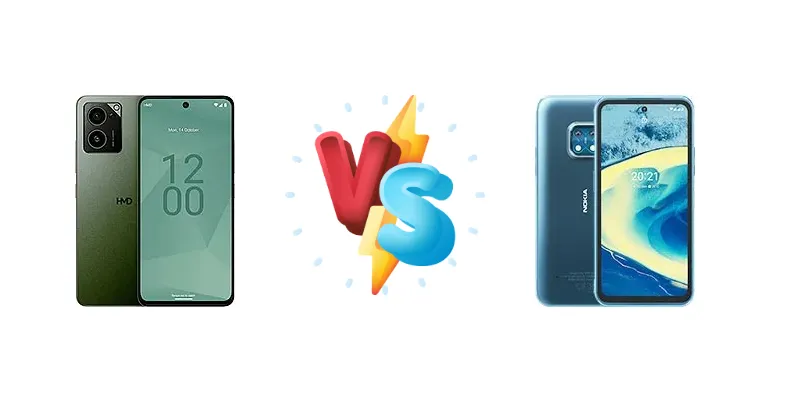
The HMD Atlas and Nokia XR20 represent compelling options in the increasingly popular rugged smartphone segment. While both aim to provide durability and 5G connectivity at accessible price points, they diverge significantly in their underlying hardware. The Atlas leverages Qualcomm’s newer, 4nm Snapdragon 4 Gen 2, while the XR20 relies on the older, 8nm Snapdragon 480. This comparison dissects these differences to determine which device delivers the best overall experience.
🏆 Quick Verdict
For most users, the HMD Atlas emerges as the stronger choice. Its Snapdragon 4 Gen 2 chipset, built on a more efficient 4nm process, provides a noticeable performance advantage and improved thermal management over the Nokia XR20’s Snapdragon 480. While the XR20 counters with wireless charging, the Atlas’s superior processing power makes it the better all-rounder.
| Network |
|---|
| 2G bands | GSM 850 / 900 / 1800 / 1900 | GSM 850 / 900 / 1800 / 1900 |
| 3G bands | HSDPA 850 / 900 / 2100 | HSDPA 850 / 900 / 1700(AWS) / 1900 / 2100 |
| 4G bands | LTE | 1, 2, 3, 4, 5, 7, 8, 12, 13, 14, 20, 25, 26, 28, 30, 38, 40, 41, 48, 66, 71 |
| 5G bands | SA/NSA | 2, 5, 25, 38, 41, 48, 66, 77, 78 SA/NSA |
| Speed | HSPA, LTE, 5G | HSPA, LTE, 5G |
| Technology | GSM / HSPA / LTE / 5G | GSM / CDMA / HSPA / EVDO / LTE / 5G |
| | - | CDMA2000 1xEV-DO |
| Launch |
|---|
| Announced | Not announced yet | 2021, July 27 |
| Status | Cancelled | Available. Released 2021, August 04 |
| Body |
|---|
| Dimensions | 163 x 75 x 8.8 mm (6.42 x 2.95 x 0.35 in) | 171.6 x 81.5 x 10.6 mm (6.76 x 3.21 x 0.42 in) |
| SIM | Nano-SIM | · Nano-SIM· Nano-SIM + Nano-SIM |
| Weight | 210 g (7.41 oz) | 248 g (8.75 oz) |
| | - | IP68 dust/water resistant (up to 1.5m for 60 min)
Drop-to-concrete resistance from up to 1.8m
MIL-STD-810H compliant |
| Display |
|---|
| Protection | - | Corning Gorilla Glass Victus |
| Resolution | 1080 x 2400 pixels, 20:9 ratio (~396 ppi density) | 1080 x 2400 pixels, 20:9 ratio (~395 ppi density) |
| Size | 6.64 inches, 106.4 cm2 (~87.1% screen-to-body ratio) | 6.67 inches, 107.4 cm2 (~76.8% screen-to-body ratio) |
| Type | IPS LCD, 120Hz | IPS LCD, 550 nits |
| Platform |
|---|
| CPU | Octa-core (2x2.2 GHz Cortex-A78 & 6x1.95 GHz Cortex-A55) | Octa-core (2x2.0 GHz Kryo 460 & 6x1.8 GHz Kryo 460) |
| Chipset | Qualcomm SM4450 Snapdragon 4 Gen 2 (4 nm) | Qualcomm SM4350 Snapdragon 480 5G (8 nm) |
| GPU | Adreno 613 | Adreno 619 |
| OS | Android 14 | Android 11, upgradable to Android 13 |
| Memory |
|---|
| Card slot | microSDXC | microSDXC (uses shared SIM slot) |
| Internal | 128GB 8GB RAM | 64GB 4GB RAM, 128GB 6GB RAM |
| Main Camera |
|---|
| Dual | 48 MP, f/1.8, (wide), AF
8 MP, (ultrawide) | 48 MP, f/1.8, (wide), 1/2.25", 0.8µm, PDAF
13 MP, f/2.4, 123˚ (ultrawide), 1/3.0", 1.12µm |
| Features | LED flash, HDR | Zeiss optics, Dual-LED dual-tone flash, second LED flash, HDR, panorama |
| Single | - | 8 MP, f/2.0 (wide), 1/4.0", 1.12µm |
| Video | 1080p@30fps | 1080p@30fps |
| Selfie camera |
|---|
| Single | 16 MP | 8 MP, f/2.0 (wide), 1/4.0", 1.12µm |
| Video | 1080p@30fps | 1080p@30fps |
| Sound |
|---|
| 3.5mm jack | - | Yes |
| 35mm jack | Yes | Yes |
| Loudspeaker | Yes | Yes, with stereo speakers |
| Comms |
|---|
| Bluetooth | 5.1, A2DP, LE | 5.1, A2DP, LE, aptX Adaptive |
| NFC | Yes | Yes |
| Positioning | GPS, GALILEO | GPS (L1+L5), GLONASS, BDS, GALILEO, QZSS, NavIC |
| Radio | Unspecified | Unspecified |
| USB | USB Type-C 2.0, OTG | USB Type-C 3.0 |
| WLAN | Wi-Fi 802.11 a/b/g/n/ac | Wi-Fi 802.11 a/b/g/n/ac/6, dual-band, Wi-Fi Direct |
| Features |
|---|
| Sensors | Fingerprint (side-mounted), accelerometer, proximity, compass | Fingerprint (side-mounted), accelerometer, gyro, proximity, compass, barometer |
| Battery |
|---|
| Charging | Wired, QC4 | 18W wired
15W wireless |
| Type | 5500 mAh | Li-Po 4630 mAh |
| Misc |
|---|
| Colors | Green | Ultra Blue, Granite Gray |
| Models | - | TA-1368, TA-1362 |
| Price | About 220 EUR | About 270 EUR |
| SAR EU | - | 1.13 W/kg (head) 1.43 W/kg (body) |
HMD Atlas
- More powerful and efficient Snapdragon 4 Gen 2 chipset
- Improved thermal management for sustained performance
- Potentially better image processing due to upgraded ISP
- Lacks wireless charging
- Detailed camera specs unavailable
Nokia XR20
- Convenient 18W wired and 15W wireless charging
- Established Nokia brand reputation for durability
- Potentially larger battery capacity (unconfirmed)
- Older and less efficient Snapdragon 480 chipset
- Lower CPU performance compared to the Atlas
- May exhibit more throttling under heavy load
Display Comparison
Neither HMD nor Nokia provided display specs beyond resolution. However, given the price points, both likely utilize IPS LCD panels. The key difference lies in the chipsets powering them; the Atlas’s more efficient processor could allow for slightly better sustained brightness. The XR20’s display is likely similar in quality, but the older chipset may struggle to maintain peak brightness for extended periods. Bezels are expected to be comparable, reflecting the budget nature of both devices.
Camera Comparison
Detailed camera specs are unavailable for either device. However, given the market segment, both are likely to feature a primary sensor paired with auxiliary lenses of limited utility. The focus should be on image processing capabilities, which are heavily tied to the chipset. The Atlas’s Snapdragon 4 Gen 2 includes an upgraded ISP (Image Signal Processor) compared to the XR20’s Snapdragon 480, potentially leading to better dynamic range, noise reduction, and overall image quality. Without specific sensor details, it’s difficult to definitively declare a winner, but the Atlas has a processing advantage.
Performance
The HMD Atlas’s Qualcomm SM4450 Snapdragon 4 Gen 2 (4nm) is a clear upgrade over the Nokia XR20’s SM4350 Snapdragon 480 5G (8nm). The 4nm process node translates to significantly improved power efficiency and thermal performance. The Atlas’s CPU, with its 2x2.2 GHz Cortex-A78 cores, offers a substantial performance boost over the XR20’s 2x2.0 GHz Kryo 460 cores, particularly in single-core tasks. While both feature octa-core configurations, the architectural improvements in the Atlas’s CPU and the smaller process node will result in snappier app launches and smoother multitasking. The Atlas is likely to exhibit less throttling under sustained load.
Battery Life
Battery capacity is not specified for either device. However, the HMD Atlas’s more efficient Snapdragon 4 Gen 2 chipset will likely translate to longer battery life despite potentially having a smaller battery capacity than the XR20. The Nokia XR20 offers 18W wired and 15W wireless charging, a significant advantage over the Atlas’s wired QC4 charging only. For users who frequently utilize wireless charging, the XR20 is the more convenient option. However, the Atlas’s faster charging protocol (QC4) should compensate for any potential battery capacity deficit.
Buying Guide
Buy the HMD Atlas if you prioritize performance, efficiency, and future-proofing. Its newer chipset will handle demanding apps and multitasking with greater ease. Buy the Nokia XR20 if wireless charging is a non-negotiable feature and you’re willing to trade some processing power for that convenience. The XR20 is also a reasonable choice for users heavily invested in the Nokia ecosystem.
Frequently Asked Questions
❓ Will the Snapdragon 480 in the Nokia XR20 struggle with graphically intensive games?
Yes, the Snapdragon 480 is a budget-oriented chipset. While it can handle some gaming, you'll likely need to lower graphics settings and accept lower frame rates in demanding titles. The HMD Atlas, with its Snapdragon 4 Gen 2, will provide a noticeably smoother gaming experience.
❓ How much faster is the charging on the HMD Atlas with QC4 compared to the Nokia XR20's 18W charging?
Quick Charge 4 (QC4) can deliver significantly higher wattage than 18W, potentially reducing charging times. While the exact charging speed depends on the charger used, the Atlas will likely charge faster from 0-50% than the XR20. However, the XR20’s wireless charging offers a convenience factor that the Atlas lacks.
❓ Is the lack of wireless charging on the HMD Atlas a dealbreaker?
It depends on your usage habits. If you rely heavily on wireless charging, the Atlas may not be the best choice. However, if you primarily use wired charging, the Atlas’s superior performance and efficiency may outweigh the absence of wireless charging.