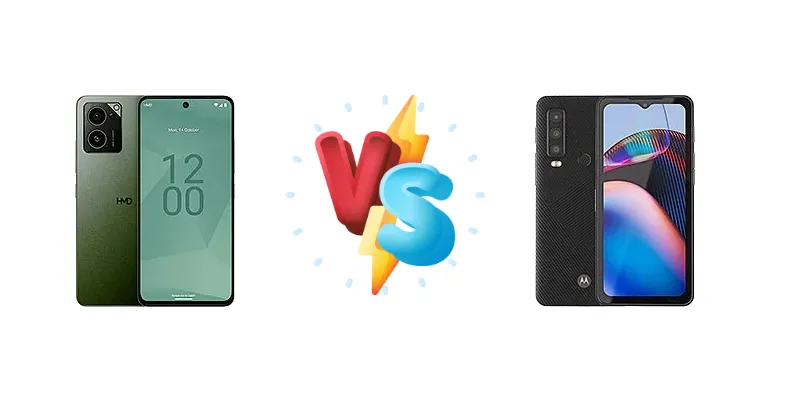
The HMD Atlas and Motorola Defy 2 represent distinct approaches to the mid-range smartphone market. The Atlas, powered by Qualcomm’s efficient Snapdragon 4 Gen 2, prioritizes power efficiency and modern architecture. Conversely, the Defy 2 leverages the Mediatek Dimensity 930, a more mature chipset offering a different balance of performance and features, including wireless charging. This comparison dissects these differences to determine which device delivers the best value.
🏆 Quick Verdict
For the average user prioritizing long-term performance and efficiency, the HMD Atlas emerges as the stronger choice. Its 4nm Snapdragon 4 Gen 2 offers a more modern architecture and potentially better thermal management, despite the Defy 2’s wireless charging capability. However, users heavily reliant on wireless charging may find the Defy 2 more convenient.
| Network |
|---|
| 2G bands | GSM 850 / 900 / 1800 / 1900 | GSM 850 / 900 / 1800 / 1900 |
| 3G bands | HSDPA 850 / 900 / 2100 | HSDPA 850 / 900 / 1700(AWS) / 1900 / 2100 |
| 4G bands | LTE | 1, 2, 3, 4, 5, 7, 8, 12, 13, 14, 17, 20, 25, 26, 28, 30, 38, 40, 41, 46, 48, 66, 71 |
| 5G bands | SA/NSA | 2, 5, 23, 25, 26, 28, 38, 41, 48, 66, 70, 71, 77, 78, 255, 256 SA/NSA/Sub6/mmWave |
| Speed | HSPA, LTE, 5G | HSPA, LTE, 5G |
| Technology | GSM / HSPA / LTE / 5G | GSM / HSPA / LTE / 5G |
| Launch |
|---|
| Announced | Not announced yet | 2023, February 24 |
| Status | Cancelled | Available. Released 2023, October |
| Body |
|---|
| Build | - | Glass front (Gorilla Glass Victus), plastic back, aluminum frame |
| Dimensions | 163 x 75 x 8.8 mm (6.42 x 2.95 x 0.35 in) | 171 x 80 x 11.9 mm (6.73 x 3.15 x 0.47 in) |
| SIM | Nano-SIM | Nano-SIM + Nano-SIM |
| Weight | 210 g (7.41 oz) | 268 g (9.45 oz) |
| | - | IP68/IP69 dust/water resistant (up to 5m for 35 min)
Drop-to-concrete resistance from up to 1.8m
MIL-STD-810H compliant |
| Display |
|---|
| Protection | - | Corning Gorilla Glass Victus |
| Resolution | 1080 x 2400 pixels, 20:9 ratio (~396 ppi density) | 1080 x 2408 pixels, 20:9 ratio (~400 ppi density) |
| Size | 6.64 inches, 106.4 cm2 (~87.1% screen-to-body ratio) | 6.6 inches, 104.9 cm2 (~76.7% screen-to-body ratio) |
| Type | IPS LCD, 120Hz | IPS LCD, 120Hz |
| Platform |
|---|
| CPU | Octa-core (2x2.2 GHz Cortex-A78 & 6x1.95 GHz Cortex-A55) | Octa-core (2x2.2 GHz Cortex-A78 & 6x2.0 GHz Cortex-A55) |
| Chipset | Qualcomm SM4450 Snapdragon 4 Gen 2 (4 nm) | Mediatek Dimensity 930 (6 nm) |
| GPU | Adreno 613 | IMG BXM-8-256 |
| OS | Android 14 | Android 12 |
| Memory |
|---|
| Card slot | microSDXC | microSDXC (uses shared SIM slot) |
| Internal | 128GB 8GB RAM | 128GB 6GB RAM |
| Main Camera |
|---|
| Dual | 48 MP, f/1.8, (wide), AF
8 MP, (ultrawide) | - |
| Features | LED flash, HDR | Dual-LED flash, HDR, panorama |
| Triple | - | 50 MP, f/1.8, (wide), PDAF
8 MP, f/2.2, (ultrawide)
2 MP (macro) |
| Video | 1080p@30fps | 1080p@30fps |
| Selfie camera |
|---|
| Single | 16 MP | 8 MP, f/2.0, (wide) |
| Video | 1080p@30fps | 1080p@30fps |
| Sound |
|---|
| 3.5mm jack | - | No |
| 35mm jack | Yes | No |
| Loudspeaker | Yes | Yes |
| Comms |
|---|
| Bluetooth | 5.1, A2DP, LE | 5.1, A2DP, LE |
| NFC | Yes | Yes |
| Positioning | GPS, GALILEO | GPS (L1+L5), GLONASS, GALILEO, BDS |
| Radio | Unspecified | Unspecified |
| USB | USB Type-C 2.0, OTG | USB Type-C 2.0, OTG |
| WLAN | Wi-Fi 802.11 a/b/g/n/ac | Wi-Fi 802.11 a/b/g/n/ac, dual-band |
| Features |
|---|
| Sensors | Fingerprint (side-mounted), accelerometer, proximity, compass | Fingerprint (rear-mounted), accelerometer, gyro, proximity, compass |
| | - | Emergency SOS via satellite (Bullitt Satellite Connect service) |
| Battery |
|---|
| Charging | Wired, QC4 | 15W wireless |
| Type | 5500 mAh | Li-Po 5000 mAh |
| Misc |
|---|
| Colors | Green | Black |
| Models | - | BM1S1B |
| Price | About 220 EUR | About 570 EUR |
HMD Atlas
- More efficient 4nm Snapdragon 4 Gen 2 chipset
- Potentially better thermal management
- QC4 fast wired charging
- Lacks wireless charging
- Display specifications unknown
Motorola Defy 2
- Convenient 15W wireless charging
- Proven Dimensity 930 chipset
- Ruggedized design (implied by brand)
- Less efficient 6nm process
- Potential for thermal throttling under load
Display Comparison
Display specifications are absent from the provided data, making a direct comparison impossible. However, given the price points, both devices likely utilize LCD panels. The HMD Atlas’s Snapdragon 4 Gen 2 may benefit from a more modern display driver, potentially leading to slightly better color accuracy and responsiveness. The Defy 2, being a rugged phone, may prioritize durability over display quality, potentially resulting in thicker bezels.
Camera Comparison
Without sensor details, a comprehensive camera comparison is limited. However, the Snapdragon 4 Gen 2’s integrated ISP (Image Signal Processor) benefits from Qualcomm’s latest algorithms, potentially offering superior image processing, especially in low-light conditions. The Defy 2’s Dimensity 930 also has a capable ISP, but it’s likely a generation behind. The absence of information regarding OIS or main sensor size makes it difficult to definitively declare a winner; however, Qualcomm’s advancements in computational photography give the Atlas a slight edge.
Performance
The core difference lies in the chipsets. The HMD Atlas’s Qualcomm SM4450 Snapdragon 4 Gen 2 (4nm) utilizes a newer architecture than the Motorola Defy 2’s Mediatek Dimensity 930 (6nm). While both CPUs feature the same 2x2.2 GHz Cortex-A78 and 6x Cortex-A55 configuration, the 4nm process node of the Snapdragon offers significantly improved power efficiency. This translates to less heat generation under load, potentially reducing throttling during extended gaming sessions. The Snapdragon 4 Gen 2 also benefits from Qualcomm’s advancements in AI processing, which could improve camera performance and app responsiveness. The Dimensity 930, while capable, is a generation older and less efficient.
Battery Life
Battery capacity is not specified, but the HMD Atlas’s more efficient Snapdragon 4 Gen 2 will likely deliver longer battery life for a given capacity. The Motorola Defy 2 compensates with 15W wireless charging, a feature absent on the Atlas. While 15W is relatively slow compared to wired charging, it offers convenience for users already invested in wireless charging ecosystems. The Atlas supports QC4 wired charging, which, while wattage is unspecified, is generally faster than 15W wireless charging. The efficiency of the 4nm process will likely result in a shorter overall charge time for the Atlas, even with a potentially smaller battery.
Buying Guide
Buy the HMD Atlas if you need a phone that balances performance with battery life, and appreciate a more modern chipset architecture for future software support. It’s ideal for everyday tasks, moderate gaming, and users who value efficiency. Buy the Motorola Defy 2 if you prioritize the convenience of wireless charging and prefer a chipset with a proven track record, even if it means slightly less efficiency and potentially more thermal throttling under sustained load.
Frequently Asked Questions
❓ Will the Dimensity 930 in the Motorola Defy 2 overheat during prolonged gaming sessions?
The Dimensity 930 is a capable chipset, but its 6nm process is less efficient than the 4nm Snapdragon 4 Gen 2. This means it's more likely to generate heat under sustained load, potentially leading to thermal throttling and reduced performance during extended gaming. While not necessarily a deal-breaker, users prioritizing long gaming sessions should consider the HMD Atlas.
❓ How much faster is the QC4 charging on the HMD Atlas compared to the 15W wireless charging on the Motorola Defy 2?
QC4 charging, while the exact wattage is unspecified, typically delivers significantly faster charging speeds than 15W wireless charging. Expect a 0-100% charge on the Atlas to be considerably quicker, potentially taking under 90 minutes with a compatible charger, whereas the Defy 2’s wireless charging could take upwards of 3 hours.
❓ Does the HMD Atlas benefit from a more future-proof chipset compared to the Motorola Defy 2?
Yes, the Snapdragon 4 Gen 2’s newer architecture and 4nm process node suggest better long-term software support and optimization. Qualcomm generally provides longer software update cycles for its chipsets, meaning the Atlas is more likely to receive Android updates and security patches for a longer period.