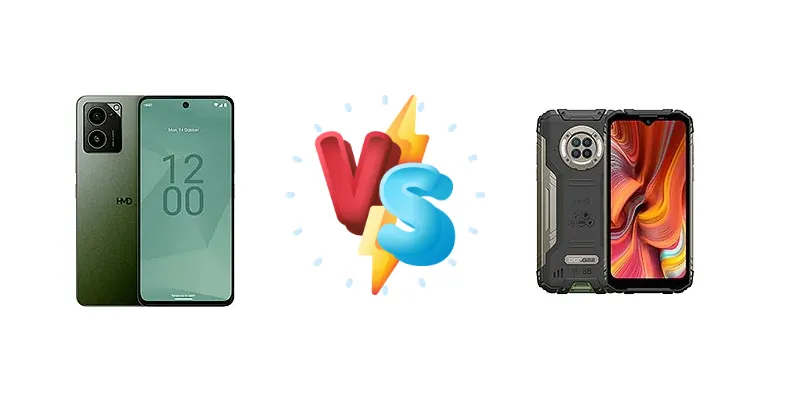
The rugged smartphone market is heating up, offering durable devices for outdoor enthusiasts and demanding work environments. The HMD Atlas, powered by Qualcomm's efficient Snapdragon 4 Gen 2, enters the arena against the Doogee S96 Pro, featuring MediaTek's Helio G90. This comparison dissects their core components to determine which phone delivers the best balance of performance, battery life, and rugged reliability.
🏆 Quick Verdict
For the average user prioritizing long-term performance and efficiency, the HMD Atlas emerges as the stronger choice. Its 4nm Snapdragon 4 Gen 2 chipset offers a significant advantage in power efficiency and sustained performance compared to the Doogee S96 Pro's older 12nm Helio G90, despite the latter's faster wireless charging.
| Network |
|---|
| 2G bands | GSM 850 / 900 / 1800 / 1900 | GSM 850 / 900 / 1800 / 1900 |
| 3G bands | HSDPA 850 / 900 / 2100 | HSDPA 800 / 850 / 900 / 1700(AWS) / 1900 / 2100 |
| 4G bands | LTE | 1, 2, 3, 4, 5, 7, 8, 12, 13, 17, 18, 19, 20, 25, 26, 28, 38, 40, 66 |
| 5G bands | SA/NSA | - |
| Speed | HSPA, LTE, 5G | HSPA, LTE |
| Technology | GSM / HSPA / LTE / 5G | GSM / CDMA / HSPA / LTE |
| Launch |
|---|
| Announced | Not announced yet | 2020, October 26. Released 2020, November |
| Status | Cancelled | Discontinued |
| Body |
|---|
| Dimensions | 163 x 75 x 8.8 mm (6.42 x 2.95 x 0.35 in) | 167 x 81.4 x 15.5 mm (6.57 x 3.20 x 0.61 in) |
| SIM | Nano-SIM | Nano-SIM + Nano-SIM |
| Weight | 210 g (7.41 oz) | 310 g (10.93 oz) |
| Display |
|---|
| Protection | - | Corning Gorilla Glass |
| Resolution | 1080 x 2400 pixels, 20:9 ratio (~396 ppi density) | 720 x 1520 pixels, 19:9 ratio (~270 ppi density) |
| Size | 6.64 inches, 106.4 cm2 (~87.1% screen-to-body ratio) | 6.22 inches, 96.6 cm2 (~71.0% screen-to-body ratio) |
| Type | IPS LCD, 120Hz | IPS LCD |
| Platform |
|---|
| CPU | Octa-core (2x2.2 GHz Cortex-A78 & 6x1.95 GHz Cortex-A55) | Octa-core (2x2.0 GHz Cortex-A76 & 6x2.0 GHz Cortex-A55) |
| Chipset | Qualcomm SM4450 Snapdragon 4 Gen 2 (4 nm) | Mediatek MT6785 Helio G90 (12 nm) |
| GPU | Adreno 613 | Mali-G76 MC4 |
| OS | Android 14 | Android 10 |
| Memory |
|---|
| Card slot | microSDXC | microSDXC (dedicated slot) |
| Internal | 128GB 8GB RAM | 128GB 8GB RAM |
| Main Camera |
|---|
| Dual | 48 MP, f/1.8, (wide), AF
8 MP, (ultrawide) | - |
| Features | LED flash, HDR | Quad-LED flash, HDR, panorama |
| Quad | - | 48 MP, f/1.8, (wide), PDAF
8 MP, f/2.2, 130˚, (ultrawide)
20 MP, f/2.8, (night vision), 4 infrared night vision lights
2 MP (macro) |
| Video | 1080p@30fps | 1080p |
| Selfie camera |
|---|
| Single | 16 MP | 16 MP, f/2.0, (wide) |
| Video | 1080p@30fps | 1080p |
| Sound |
|---|
| 35mm jack | Yes | Yes |
| Loudspeaker | Yes | Yes |
| Comms |
|---|
| Bluetooth | 5.1, A2DP, LE | 5.0, A2DP, LE |
| NFC | Yes | Yes |
| Positioning | GPS, GALILEO | GPS, GLONASS, BDS, GALILEO |
| Radio | Unspecified | FM radio |
| USB | USB Type-C 2.0, OTG | USB Type-C 2.0, OTG |
| WLAN | Wi-Fi 802.11 a/b/g/n/ac | Wi-Fi 802.11 a/b/g/n/ac, dual-band |
| Features |
|---|
| Sensors | Fingerprint (side-mounted), accelerometer, proximity, compass | Fingerprint (side-mounted), accelerometer, gyro, proximity, compass |
| Battery |
|---|
| Charging | Wired, QC4 | 24W wired
10W wireless |
| Type | 5500 mAh | 6350 mAh |
| Misc |
|---|
| Colors | Green | Black, Orange, Green |
| Price | About 220 EUR | About 280 EUR |
HMD Atlas
- More efficient 4nm Snapdragon 4 Gen 2 chipset
- Potentially better sustained performance
- QC4 fast charging support
- Wireless charging not supported
- Specific battery capacity and display specs unknown
Doogee S96 Pro
- Wireless charging support (10W)
- Slightly higher CPU clock speeds (on paper)
- Faster wired charging (24W)
- Less efficient 12nm Helio G90 chipset
- Potential for thermal throttling under load
- Older chipset architecture
Display Comparison
Neither device's display specifications are provided, so a direct comparison is limited. However, given the HMD Atlas's focus on efficiency and the Doogee S96 Pro's positioning, we can infer the Doogee likely prioritizes a higher refresh rate for gaming, while the HMD Atlas may focus on maximizing battery life through a more conservative panel. The absence of details like peak brightness, resolution, and panel type makes a definitive statement impossible, but the target audience suggests different priorities.
Camera Comparison
Without specific camera sensor details, a detailed comparison is challenging. However, the rugged phone market often prioritizes durability over cutting-edge camera technology. It's reasonable to assume both phones feature capable cameras for outdoor photography, but likely won't compete with flagship devices. The absence of information regarding OIS or lens apertures prevents a meaningful analysis of image quality. The focus should be on the image processing capabilities of each chipset, where Qualcomm typically holds an advantage.
Performance
The core difference lies in the chipsets. The HMD Atlas utilizes the Qualcomm SM4450 Snapdragon 4 Gen 2, built on a 4nm process. This smaller node translates to significantly improved power efficiency and thermal performance compared to the Doogee S96 Pro’s MediaTek Helio G90 (12nm). While the Helio G90’s Cortex-A76 cores have a slightly higher clock speed (2.0 GHz vs 2.2 GHz on the Atlas’s A78 cores), the architectural advantages and process node of the Snapdragon 4 Gen 2 will result in superior sustained performance and less throttling during demanding tasks. The Atlas’s CPU configuration (2x2.2 GHz Cortex-A78 & 6x1.95 GHz Cortex-A55) provides a more balanced approach, favoring both single-core and multi-core workloads.
Battery Life
The Doogee S96 Pro offers both 24W wired and 10W wireless charging, providing flexibility. The HMD Atlas supports QC4 wired charging, which, while wattage is unspecified, is a fast-charging standard. The efficiency of the Snapdragon 4 Gen 2 in the Atlas will likely offset any charging speed advantage the Doogee has. The 4nm process allows for more efficient power usage, potentially resulting in longer real-world battery life despite potentially having a similar capacity battery. Wireless charging is a convenience factor, but the slower speeds and inherent inefficiencies mean it's not a replacement for wired charging when time is critical.
Buying Guide
Buy the HMD Atlas if you need a phone that prioritizes sustained performance for tasks like navigation, communication, and light productivity while on the go, and value a modern, efficient chipset. Buy the Doogee S96 Pro if you prefer the convenience of wireless charging and are primarily focused on casual gaming and basic smartphone functions, accepting potential thermal throttling under heavy load.
Frequently Asked Questions
❓ Will the Helio G90 in the Doogee S96 Pro overheat during extended gaming sessions?
The MediaTek Helio G90, built on a 12nm process, is known to generate more heat under sustained load compared to newer chipsets. While the Doogee S96 Pro likely incorporates thermal management solutions, users should expect potential throttling and reduced performance during prolonged gaming or other demanding tasks.
❓ How does the Snapdragon 4 Gen 2 in the HMD Atlas handle multitasking and app switching?
The Snapdragon 4 Gen 2, with its efficient architecture and 4nm process, is well-suited for multitasking and app switching. The combination of Cortex-A78 and Cortex-A55 cores provides a balanced approach, ensuring smooth performance even with multiple apps running simultaneously. The improved efficiency also contributes to better battery life during extended use.
❓ Is the lack of wireless charging on the HMD Atlas a significant drawback?
For users who heavily rely on wireless charging, its absence on the HMD Atlas is a consideration. However, the benefits of the Snapdragon 4 Gen 2's efficiency and potentially faster wired charging (via QC4) may outweigh the convenience of wireless charging for many users, especially those prioritizing battery life and performance.