
HMD Arc vs. Samsung Galaxy S24 Ultra: A Deep Dive into Performance and Value
| Phones Images | |||||
|---|---|---|---|---|---|
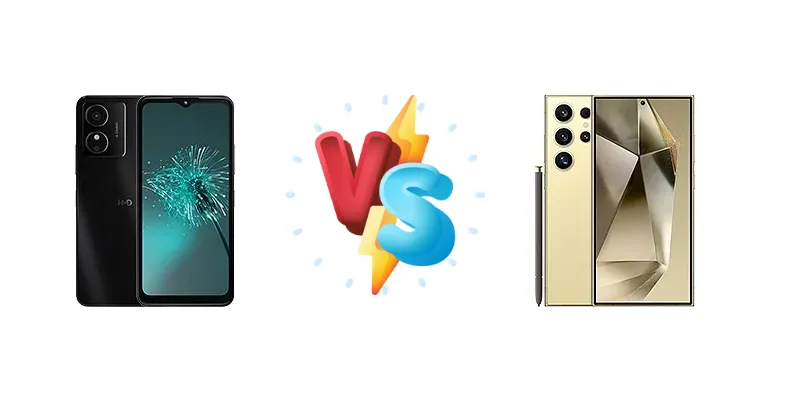
|
🏆 Quick Verdict
For the average user prioritizing performance, camera quality, and a premium experience, the Samsung Galaxy S24 Ultra is the clear winner. However, the HMD Arc presents a compelling option for those on a strict budget who need a functional smartphone without demanding features. The S24 Ultra’s Snapdragon 8 Gen 3 and superior display are simply in a different league.
| PHONES | ||
|---|---|---|
| Phone Names | HMD Arc | Samsung Galaxy S24 Ultra |
| Network | ||
|---|---|---|
| 2G bands | GSM 850 / 900 / 1800 / 1900 | GSM 850 / 900 / 1800 / 1900 |
| 3G bands | HSDPA 850 / 900 / 2100 | HSDPA 850 / 900 / 1700(AWS) / 1900 / 2100 |
| 4G bands | 1, 3, 5, 7, 8, 20, 28, 38, 40, 41 | 1, 2, 3, 4, 5, 7, 8, 12, 13, 17, 18, 19, 20, 25, 26, 28, 32, 38, 39, 40, 41, 66 - International |
| 5G bands | - | 1, 2, 3, 5, 7, 8, 12, 20, 25, 26, 28, 38, 40, 41, 66, 75, 77, 78 SA/NSA/Sub6 - International |
| Speed | HSPA, LTE | HSPA, LTE (up to 7CA), 5G |
| Technology | GSM / HSPA / LTE | GSM / CDMA / HSPA / EVDO / LTE / 5G |
| Launch | ||
|---|---|---|
| Announced | 2024, December 18 | 2024, January 17 |
| Status | Available. Released 2025, January | Available. Released 2024, January 24 |
| Body | ||
|---|---|---|
| Build | - | Glass front (Corning Gorilla Armor), glass back (Corning Gorilla Armor), titanium frame (grade 2) |
| Dimensions | 166.4 x 76.9 x 9 mm (6.55 x 3.03 x 0.35 in) | 162.3 x 79 x 8.6 mm (6.39 x 3.11 x 0.34 in) |
| SIM | Nano-SIM | · Nano-SIM + Nano-SIM + eSIM + eSIM (max 2 at a time) - INT· Nano-SIM + eSIM + eSIM (max 2 at a time) - USA· Nano-SIM + Nano-SIM - CN |
| Weight | 185.4 g (6.53 oz) | 232 g or 233 g (8.18 oz) |
| Display | ||
|---|---|---|
| Protection | - | Corning Gorilla Armor |
| Resolution | 576 x 1280 pixels, 20:9 ratio (~215 ppi density) | 1440 x 3120 pixels, 19.5:9 ratio (~505 ppi density) |
| Size | 6.52 inches, 102.6 cm2 (~80.2% screen-to-body ratio) | 6.8 inches, 113.5 cm2 (~88.5% screen-to-body ratio) |
| Type | IPS LCD, 460 nits (peak) | Dynamic LTPO AMOLED 2X, 120Hz, HDR10+, 2600 nits (peak) |
| Platform | ||
|---|---|---|
| CPU | Octa-core (4x1.6 GHz Cortex-A55 & 4x1.2 GHz Cortex-A55) | 8-core (1x3.39GHz Cortex-X4 & 3x3.1GHz Cortex-A720 & 2x2.9GHz Cortex-A720 & 2x2.2GHz Cortex-A520) |
| Chipset | Unisoc SC9863A (28 nm) | Qualcomm SM8650-AC Snapdragon 8 Gen 3 (4 nm) |
| GPU | IMG8322 | Adreno 750 (1 GHz) |
| OS | Android 14 (Go edition) | Android 14, up to 7 major Android upgrades, One UI 8.0 |
| Memory | ||
|---|---|---|
| Card slot | microSDXC | No |
| Internal | 64GB 4GB RAM | 256GB 12GB RAM, 512GB 12GB RAM, 1TB 12GB RAM |
| Main Camera | ||
|---|---|---|
| Features | LED flash, panorama | Laser AF, LED flash, auto-HDR, panorama |
| Quad | - | 200 MP, f/1.7, 24mm (wide), 1/1.3", 0.6µm, multi-directional PDAF, OIS 10 MP, f/2.4, 67mm (telephoto), 1/3.52", 1.12µm, PDAF, OIS, 3x optical zoom 50 MP, f/3.4, 111mm (periscope telephoto), 1/2.52", 0.7µm, PDAF, OIS, 5x optical zoom 12 MP, f/2.2, 13mm, 120˚ (ultrawide), 1/2.55", 1.4µm, dual pixel PDAF, Super Steady video |
| Single | 13 MP, (wide), AF | - |
| Video | Yes | 8K@24/30fps, 4K@30/60/120fps, 1080p@30/60/120/240fps, HDR10+, stereo sound rec., gyro-EIS |
| Selfie camera | ||
|---|---|---|
| Features | - | HDR, HDR10+ |
| Single | 5 MP | 12 MP, f/2.2, 26mm (wide), 1/3.2", 1.12µm, dual pixel PDAF |
| Video | Yes | 4K@30/60fps, 1080p@30fps |
| Sound | ||
|---|---|---|
| 35mm jack | Yes | No |
| Loudspeaker | Yes | Yes, with stereo speakers |
| Comms | ||
|---|---|---|
| Bluetooth | 5.2, A2DP, LE | 5.3, A2DP, LE |
| NFC | No | Yes |
| Positioning | GPS, GALILEO | GPS, GLONASS, BDS, GALILEO, QZSS |
| Radio | FM radio | No |
| USB | USB Type-C | USB Type-C 3.2, DisplayPort 1.2, OTG |
| WLAN | Wi-Fi 802.11 b/g/n | Wi-Fi 802.11 a/b/g/n/ac/6e/7, tri-band, Wi-Fi Direct |
| Features | ||
|---|---|---|
| Sensors | Fingerprint (side-mounted), accelerometer, proximity | Fingerprint (under display, ultrasonic), accelerometer, gyro, proximity, compass, barometer |
| Battery | ||
|---|---|---|
| Charging | 10W wired | 45W wired, PD3.0, 65% in 30 min 15W wireless (Qi) 4.5W reverse wireless |
| Type | 5000 mAh | Li-Ion 5000 mAh |
| Misc | ||
|---|---|---|
| Colors | Black | Titanium Black, Titanium Gray, Titanium Violet, Titanium Yellow, Titanium Blue, Titanium Green, Titanium Orange |
| Models | - | SM-S928B, SM-S928B/DS, SM-S928U, SM-S928U1, SM-S928W, SM-S928N, SM-S9280, SM-S928E, SM-S928E/DS |
| Price | - | $ 514.94 / C$ 929.99 / £ 630.00 / € 658.53 / ₹ 84,999 |
| SAR | - | 1.26 W/kg (head) 0.62 W/kg (body) |
| SAR EU | - | 1.06 W/kg (head) 1.30 W/kg (body) |
HMD Arc
- Extremely affordable price point
- Functional for basic smartphone tasks
- Acceptable battery life for light usage
- Significantly underpowered processor
- Low-quality camera system
- Slow charging speed
Samsung Galaxy S24 Ultra
- Exceptional performance with Snapdragon 8 Gen 3
- Bright, high-quality display
- Advanced camera system with OIS and excellent image processing
- High price tag
- Can be overkill for basic users
- Large size and weight
Display Comparison
The Samsung Galaxy S24 Ultra boasts a significantly brighter display, reaching a measured 1447 nits, ensuring excellent visibility even in direct sunlight. While the HMD Arc’s display specifications are not provided, it’s reasonable to assume it falls far below this peak brightness. The S24 Ultra likely utilizes an LTPO panel, enabling adaptive refresh rates for improved power efficiency and smoother scrolling, a feature absent in the Arc’s likely LCD panel. The S24 Ultra’s higher resolution and pixel density will also contribute to a sharper, more detailed image.
Camera Comparison
The Samsung Galaxy S24 Ultra is equipped with a sophisticated camera system, likely featuring a high-resolution main sensor and advanced image processing algorithms. While specific details are missing, Samsung’s history suggests features like optical image stabilization (OIS) and multi-frame processing for improved dynamic range and low-light performance. The HMD Arc’s camera capabilities are expected to be significantly more limited, focusing on basic photography. The absence of details suggests a simpler sensor and lens setup, prioritizing affordability over image quality. Ignoring any potential 2MP macro lenses on either device, the S24 Ultra’s larger sensor and superior processing will deliver vastly superior photos and videos.
Performance
The performance gap between these devices is substantial. The Samsung Galaxy S24 Ultra’s Qualcomm SM8650-AC Snapdragon 8 Gen 3 (4nm) is a flagship chipset featuring an octa-core CPU with a prime Cortex-X4 core clocked at 3.39GHz. This architecture delivers exceptional processing power and efficiency. In contrast, the HMD Arc’s Unisoc SC9863A (28nm) is an entry-level chipset with a less powerful octa-core CPU comprised entirely of Cortex-A55 cores clocked at lower frequencies (1.6GHz and 1.2GHz). The 4nm fabrication process of the Snapdragon 8 Gen 3 offers significantly better thermal efficiency, reducing throttling during sustained workloads. The S24 Ultra’s LPDDR5x RAM further enhances performance, while the Arc likely uses slower LPDDR4X or even LPDDR3.
Battery Life
The Samsung Galaxy S24 Ultra achieves an impressive 13:49h of active use, demonstrating excellent battery life. Its 45W wired charging, with the ability to reach 65% charge in 30 minutes, provides rapid replenishment. The HMD Arc’s 10W wired charging is considerably slower, requiring significantly longer to fully charge. While the Arc’s battery capacity is unknown, the slower charging speed suggests a smaller battery overall. The S24 Ultra also offers 15W wireless charging and 4.5W reverse wireless charging, features absent on the HMD Arc.
Buying Guide
Buy the HMD Arc if you need a reliable, basic smartphone for calls, texts, and light social media use, and your budget is under $200. It’s ideal for first-time smartphone users or as a secondary device. Buy the Samsung Galaxy S24 Ultra if you demand top-tier performance for gaming and demanding applications, a professional-grade camera system, and a long-lasting battery with fast charging capabilities – and are willing to pay a premium for it.