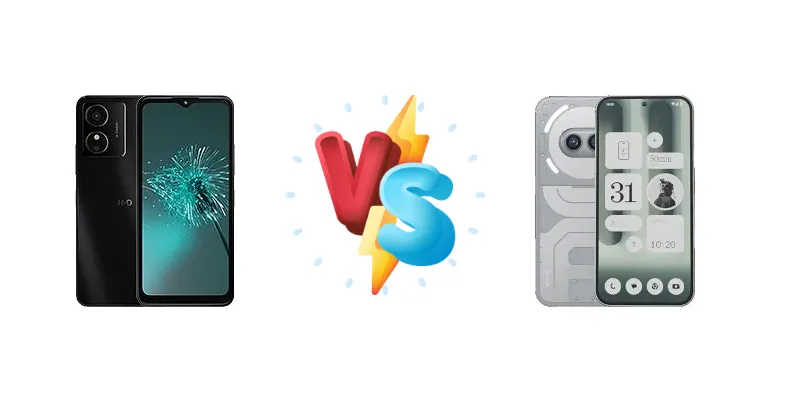
The smartphone market is flooded with options, but finding the right balance between price and performance can be challenging. We pit the ultra-budget HMD Arc against the more ambitious Nothing Phone (2a) Plus, examining where each device excels and who will benefit most from its strengths.
🏆 Quick Verdict
For most users, the Nothing Phone (2a) Plus is the clear winner. Its significantly more powerful Mediatek Dimensity 7350 Pro chipset, coupled with 50W fast charging and a brighter display, justifies the price difference over the HMD Arc's basic Unisoc processor and slow 10W charging.
| Network |
|---|
| 2G bands | GSM 850 / 900 / 1800 / 1900 | GSM 850 / 900 / 1800 / 1900 |
| 3G bands | HSDPA 850 / 900 / 2100 | HSDPA 800 / 850 / 900 / 1700(AWS) / 1900 / 2100 |
| 4G bands | 1, 3, 5, 7, 8, 20, 28, 38, 40, 41 | 1, 3, 4, 5, 7, 8, 18, 19, 20, 26, 28, 38, 39, 40, 41, 42, 66 |
| 5G bands | - | 1, 3, 5, 7, 8, 20, 28, 38, 40, 41, 66, 77, 78 SA/NSA |
| Speed | HSPA, LTE | HSPA, LTE, 5G |
| Technology | GSM / HSPA / LTE | GSM / HSPA / LTE / 5G |
| Launch |
|---|
| Announced | 2024, December 18 | 2024, July 31 |
| Status | Available. Released 2025, January | Available. Released 2024, August 03 |
| Body |
|---|
| Build | - | Glass front (Gorilla Glass 5), plastic frame, plastic back |
| Dimensions | 166.4 x 76.9 x 9 mm (6.55 x 3.03 x 0.35 in) | 161.7 x 76.3 x 8.5 mm (6.37 x 3.00 x 0.33 in) |
| SIM | Nano-SIM | Nano-SIM + Nano-SIM |
| Weight | 185.4 g (6.53 oz) | 190 g (6.70 oz) |
| Display |
|---|
| Protection | - | Corning Gorilla Glass 5 |
| Resolution | 576 x 1280 pixels, 20:9 ratio (~215 ppi density) | 1080 x 2412 pixels, 20:9 ratio (~395 ppi density) |
| Size | 6.52 inches, 102.6 cm2 (~80.2% screen-to-body ratio) | 6.7 inches, 107.5 cm2 (~87.1% screen-to-body ratio) |
| Type | IPS LCD, 460 nits (peak) | AMOLED, 1B colors, 120Hz, 2160Hz PWM, HDR10+, 700 nits (typ), 1100 nits (HBM), 1300 nits (peak) |
| Platform |
|---|
| CPU | Octa-core (4x1.6 GHz Cortex-A55 & 4x1.2 GHz Cortex-A55) | Octa-core (2x3.0 GHz Cortex-A715 & 6x 2.0 GHz Cortex-A510) |
| Chipset | Unisoc SC9863A (28 nm) | Mediatek Dimensity 7350 Pro (4 nm) |
| GPU | IMG8322 | Mali-G610 MC4 |
| OS | Android 14 (Go edition) | Android 14, up to 3 major Android upgrades, Nothing OS 3.0 |
| Memory |
|---|
| Card slot | microSDXC | No |
| Internal | 64GB 4GB RAM | 256GB 8GB RAM, 256GB 12GB RAM |
| Main Camera |
|---|
| Dual | - | 50 MP, f/1.9, 24mm (wide), 1/1.57", 1.0µm, PDAF, OIS
50 MP, f/2.2, 114˚ (ultrawide), 1/2.76", 0.64µm |
| Features | LED flash, panorama | LED flash, panorama, HDR |
| Single | 13 MP, (wide), AF | - |
| Video | Yes | 4K@30fps, 1080p@60/120fps, gyro-EIS |
| Selfie camera |
|---|
| Features | - | HDR |
| Single | 5 MP | 50 MP, f/2.2, (wide), 1/2.76" |
| Video | Yes | 4K@30fps |
| Sound |
|---|
| 35mm jack | Yes | No |
| Loudspeaker | Yes | Yes, with stereo speakers |
| Comms |
|---|
| Bluetooth | 5.2, A2DP, LE | 5.3, A2DP, LE |
| NFC | No | Yes, 360˚ |
| Positioning | GPS, GALILEO | GPS, GALILEO, GLONASS, BDS, QZSS |
| Radio | FM radio | No |
| USB | USB Type-C | USB Type-C 2.0, OTG |
| WLAN | Wi-Fi 802.11 b/g/n | Wi-Fi 802.11 a/b/g/n/ac/6, dual-band, Wi-Fi Direct |
| Features |
|---|
| Sensors | Fingerprint (side-mounted), accelerometer, proximity | Fingerprint (under display, optical), accelerometer, gyro, proximity, compass |
| Battery |
|---|
| Charging | 10W wired | 50W wired, 50% in 21 min, 100% in 56 min |
| Type | 5000 mAh | 5000 mAh |
| Misc |
|---|
| Colors | Black | Black, Grey |
| Models | - | A142P |
| Price | - | € 269.90 / ₹ 22,599 |
HMD Arc
- Extremely affordable
- Functional for basic tasks
- Lightweight and portable
- Very slow performance
- Slow 10W charging
- Likely low-quality display
Nothing Phone (2a) Plus
- Fast and responsive performance
- 50W fast charging
- Bright and vibrant display
- Higher price point
- May be overkill for basic users
- No expandable storage (assumed)
Display Comparison
The Nothing Phone (2a) Plus boasts a significantly brighter display, reaching a measured peak of 1097 nits. This is crucial for outdoor visibility, a weakness the HMD Arc will likely share with other phones in its price bracket. While the Arc's display specs are unavailable, its target market suggests a lower-quality panel. The Nothing Phone (2a) Plus’s brightness allows for a more comfortable viewing experience in direct sunlight, and likely offers better color accuracy, though detailed color calibration data is absent for both devices.
Camera Comparison
Without detailed camera specifications for the HMD Arc, a direct comparison is limited. However, given its price point, it's safe to assume a basic camera setup. The Nothing Phone (2a) Plus, while not a flagship camera phone, benefits from a more modern image signal processor (ISP) within the Dimensity 7350 Pro. This allows for better image processing, noise reduction, and dynamic range. The absence of OIS on either device suggests a reliance on software stabilization, but the Nothing Phone (2a) Plus’s superior processing power will likely yield better results.
Performance
The performance gap between these two devices is substantial. The Nothing Phone (2a) Plus utilizes the Mediatek Dimensity 7350 Pro, built on a power-efficient 4nm process, featuring a dual-core Cortex-A715 configuration clocked at 3.0 GHz alongside six Cortex-A510 cores. This contrasts sharply with the HMD Arc’s Unisoc SC9863A (28nm), an octa-core processor comprised entirely of lower-performance Cortex-A55 cores clocked at 1.6 GHz and 1.2 GHz. The Dimensity 7350 Pro’s architecture and fabrication process translate to significantly faster app loading times, smoother multitasking, and a more responsive user experience. The Arc will struggle with demanding applications.
Battery Life
The Nothing Phone (2a) Plus shines in battery and charging. While the exact battery capacity isn't specified, its active use score of 16:34h demonstrates excellent endurance. Crucially, it supports 50W wired charging, achieving a 50% charge in just 21 minutes and a full charge in 56 minutes. The HMD Arc, limited to 10W charging, will take considerably longer to replenish its battery, making it less convenient for users who need a quick top-up. The slower charging speed will be a significant drawback for many.
Buying Guide
Buy the HMD Arc if you absolutely need the cheapest possible smartphone for basic communication – calls, texts, and light app usage. It's a functional device for those with minimal needs. Buy the Nothing Phone (2a) Plus if you prioritize performance, a vibrant display, and fast charging, even if it means spending a bit more. It's ideal for users who stream video, play mobile games, or rely on their phone throughout the day.
Frequently Asked Questions
❓ Is the Unisoc SC9863A chipset in the HMD Arc capable of running popular social media apps smoothly?
While the HMD Arc can likely run basic social media apps like Facebook and WhatsApp, expect noticeable lag and slowdowns, especially when multitasking or using features like video playback. The chipset's limited processing power and older architecture are not optimized for modern app demands.
❓ How does the 50W charging on the Nothing Phone (2a) Plus compare to standard 15W or 18W charging?
50W charging is significantly faster. A standard 15W or 18W charger would take well over two hours to fully charge the Nothing Phone (2a) Plus, whereas the included 50W charger achieves a full charge in just 56 minutes. This difference is particularly noticeable for users who frequently need to top up their battery throughout the day.
❓ Will the HMD Arc receive software updates and security patches?
Given HMD's history, the Arc will likely receive minimal software support. Expect limited updates, potentially only essential security patches, and a shorter overall software support lifespan compared to the Nothing Phone (2a) Plus, which benefits from Nothing's commitment to software updates.