
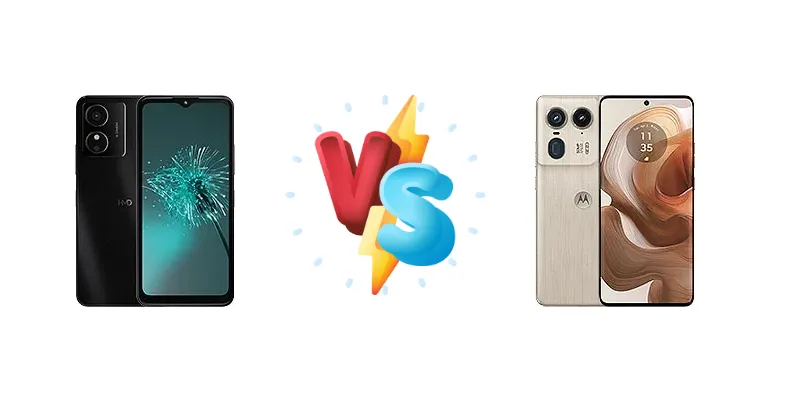
HMD Arc vs. Motorola Edge 50 Ultra: A Deep Dive into Performance and Value
| Phones Images | |||||
|---|---|---|---|---|---|
|
🏆 Quick Verdict
For most users, the Motorola Edge 50 Ultra is the superior choice, offering a dramatically faster processor, a brighter display, and incredibly quick charging. However, the HMD Arc presents a viable option for those prioritizing extreme affordability and basic smartphone tasks.
| PHONES | ||
|---|---|---|
| Phone Names | HMD Arc | Motorola Edge 50 Ultra |
| Network | ||
|---|---|---|
| 2G bands | GSM 850 / 900 / 1800 / 1900 | GSM 850 / 900 / 1800 / 1900 |
| 3G bands | HSDPA 850 / 900 / 2100 | HSDPA 850 / 900 / 1700(AWS) / 1900 / 2100 |
| 4G bands | 1, 3, 5, 7, 8, 20, 28, 38, 40, 41 | 1, 2, 3, 4, 5, 7, 8, 12, 13, 17, 18, 19, 20, 25, 26, 28, 32, 38, 39, 40, 41, 42, 43, 66 |
| 5G bands | - | 1, 2, 3, 5, 7, 8, 20, 26, 28, 38, 40, 41, 66, 71, 75, 77, 78 SA/NSA/Sub6 |
| Speed | HSPA, LTE | HSPA, LTE, 5G |
| Technology | GSM / HSPA / LTE | GSM / HSPA / LTE / 5G |
| Launch | ||
|---|---|---|
| Announced | 2024, December 18 | 2024, April 16 |
| Status | Available. Released 2025, January | Available. Released 2024, May 15 |
| Body | ||
|---|---|---|
| Build | - | Glass front (Gorilla Glass Victus), wooden back or silicone polymer back (eco leather), aluminum frame |
| Dimensions | 166.4 x 76.9 x 9 mm (6.55 x 3.03 x 0.35 in) | 161.1 x 72.4 x 8.6 mm (6.34 x 2.85 x 0.34 in) |
| SIM | Nano-SIM | Nano-SIM + eSIM |
| Weight | 185.4 g (6.53 oz) | 197 g (6.95 oz) |
| Display | ||
|---|---|---|
| Protection | - | Corning Gorilla Glass Victus |
| Resolution | 576 x 1280 pixels, 20:9 ratio (~215 ppi density) | 1220 x 2712 pixels, 20:9 ratio (~446 ppi density) |
| Size | 6.52 inches, 102.6 cm2 (~80.2% screen-to-body ratio) | 6.7 inches, 107.4 cm2 (~92.1% screen-to-body ratio) |
| Type | IPS LCD, 460 nits (peak) | P-OLED, 1B colors, 144Hz, HDR10+, 2500 nits (peak) |
| Platform | ||
|---|---|---|
| CPU | Octa-core (4x1.6 GHz Cortex-A55 & 4x1.2 GHz Cortex-A55) | Octa-core (1x3.0 GHz Cortex-X4 & 4x2.8 GHz Cortex-A720 & 3x2.0 GHz Cortex-A520) |
| Chipset | Unisoc SC9863A (28 nm) | Qualcomm SM8635 Snapdragon 8s Gen 3 (4 nm) |
| GPU | IMG8322 | Adreno 735 |
| OS | Android 14 (Go edition) | Android 14, upgradable to Android 16, up to 3 major Android upgrades |
| Memory | ||
|---|---|---|
| Card slot | microSDXC | No |
| Internal | 64GB 4GB RAM | 512GB 12GB RAM, 512GB 16GB RAM, 1TB 16GB RAM |
| Main Camera | ||
|---|---|---|
| Features | LED flash, panorama | Laser AF, Dual-LED flash, HDR, panorama |
| Single | 13 MP, (wide), AF | - |
| Triple | - | 50 MP, f/1.6, 23mm (wide), 1/1.3", 1.2µm, multi-directional PDAF, OIS 64 MP, f/2.4, 72mm (periscope telephoto), 1/2.0", 0.7µm, PDAF, OIS, 3x optical zoom 50 MP, f/2.0, 12mm, 122˚ (ultrawide), 1/2.76", 0.64µm, PDAF |
| Video | Yes | 4K@30/60fps, 1080p@30/60/120/240/960fps, 10-bit HDR10+, gyro-EIS |
| Selfie camera | ||
|---|---|---|
| Features | - | HDR |
| Single | 5 MP | 50 MP, f/1.9, 21mm (wide), 1/2.76", 0.64µm, PDAF |
| Video | Yes | 4K@30/60fps, 1080p@30/60/120fps, HDR |
| Sound | ||
|---|---|---|
| 35mm jack | Yes | No |
| Loudspeaker | Yes | Yes, with stereo speakers |
| Comms | ||
|---|---|---|
| Bluetooth | 5.2, A2DP, LE | 5.4, A2DP, LE |
| NFC | No | Yes |
| Positioning | GPS, GALILEO | GPS, GLONASS, GALILEO, BDS, NavIC |
| Radio | FM radio | No |
| USB | USB Type-C | USB Type-C 3.1 Gen2, OTG, DisplayPort 1.4 |
| WLAN | Wi-Fi 802.11 b/g/n | Wi-Fi 802.11 a/b/g/n/ac/6e/7, tri-band, Wi-Fi Direct |
| Features | ||
|---|---|---|
| Sensors | Fingerprint (side-mounted), accelerometer, proximity | Fingerprint (under display, optical), accelerometer, gyro, proximity, compass |
| Battery | ||
|---|---|---|
| Charging | 10W wired | 125W wired 50W wireless 10W reverse wireless |
| Type | 5000 mAh | 4500 mAh |
| Misc | ||
|---|---|---|
| Colors | Black | Forest Grey, Nordic Wood, Peach Fuzz |
| Price | - | $ 939.00 / C$ 1,299.00 / £ 490.00 / € 609.90 / ₹ 59,999 |
HMD Arc
- Extremely affordable price point
- Functional for basic smartphone tasks
- Compact and lightweight design (likely)
- Significantly slower processor
- Limited camera capabilities
- Slow charging speed
Motorola Edge 50 Ultra
- Powerful Snapdragon 8s Gen 3 chipset
- Ultra-fast 125W wired charging
- Bright and vibrant display
- Higher price tag
- Potentially larger and heavier design
- May include bloatware (Motorola history)
Display Comparison
The Motorola Edge 50 Ultra’s display is a clear standout, achieving a measured peak brightness of 1473 nits. This ensures excellent visibility even in direct sunlight, a feature the HMD Arc likely lacks given its budget positioning. While the Arc’s panel specifications are unavailable, it’s reasonable to assume a significantly lower brightness and potentially inferior color accuracy. The Edge 50 Ultra’s panel likely incorporates advanced features like LTPO for adaptive refresh rates, further enhancing power efficiency and smoothness, a feature absent in the Arc.
Camera Comparison
Without detailed camera specifications for the HMD Arc, a direct comparison is limited. However, the Motorola Edge 50 Ultra is expected to feature a more sophisticated camera system, likely with a larger main sensor and advanced image processing capabilities. The Edge 50 Ultra’s image signal processor (ISP), integrated within the Snapdragon 8s Gen 3, will deliver superior noise reduction, dynamic range, and overall image quality. While the Arc may offer a functional camera for casual snapshots, it won’t compete with the Edge 50 Ultra’s potential for detailed and vibrant photography.
Performance
The performance gap between these devices is substantial. The Motorola Edge 50 Ultra is powered by the Qualcomm SM8635 Snapdragon 8s Gen 3 (4nm), featuring a tri-cluster architecture with a high-performance Cortex-X4 core clocked at 3.0 GHz. This contrasts sharply with the HMD Arc’s Unisoc SC9863A (28nm) and its octa-core configuration of Cortex-A55 cores clocked at lower frequencies (1.6 GHz and 1.2 GHz). The 4nm process node of the Snapdragon 8s Gen 3 offers significantly improved thermal efficiency and performance per watt compared to the 28nm Unisoc chip, translating to less throttling during sustained workloads and a more responsive user experience. The Edge 50 Ultra will handle demanding games and applications with ease, while the Arc will struggle with anything beyond basic tasks.
Battery Life
The Motorola Edge 50 Ultra boasts a remarkable charging capability with 125W wired charging, allowing for a full charge in a matter of minutes. It also includes 50W wireless charging and 10W reverse wireless charging. The HMD Arc, limited to 10W wired charging, will take considerably longer to replenish its battery. While the Edge 50 Ultra’s battery capacity isn’t specified, its active use score of 12:56h suggests efficient power management. The Arc’s battery life will likely be shorter due to the less efficient Unisoc chipset and lower-brightness display.
Buying Guide
Buy the HMD Arc if you need a functional smartphone for essential tasks like calls, messaging, and light web browsing, and your budget is extremely limited. You're willing to accept slower performance and limited features. Buy the Motorola Edge 50 Ultra if you prioritize a smooth, responsive experience for demanding apps, gaming, and content creation, and you value features like fast charging and a vibrant display. You're willing to invest in a premium experience.