
Asus ROG Phone 8 Pro vs. HMD Arc: A Deep Dive into Performance and Value
| Phones Images | |||||
|---|---|---|---|---|---|
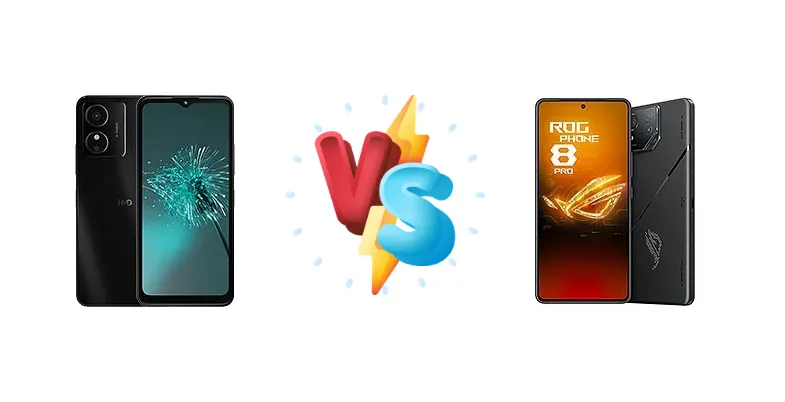
|
🏆 Quick Verdict
For demanding users and gamers, the Asus ROG Phone 8 Pro is the clear winner, delivering unparalleled performance and a premium experience. However, the HMD Arc provides a functional and affordable option for users prioritizing basic smartphone tasks and budget constraints.
| PHONES | ||
|---|---|---|
| Phone Names | HMD Arc | Asus ROG Phone 8 Pro |
| Network | ||
|---|---|---|
| 2G bands | GSM 850 / 900 / 1800 / 1900 | GSM 850 / 900 / 1800 / 1900 |
| 3G bands | HSDPA 850 / 900 / 2100 | HSDPA 850 / 900 / 1700(AWS) / 1800 / 1900 / 2100 - International |
| 4G bands | 1, 3, 5, 7, 8, 20, 28, 38, 40, 41 | 1, 2, 3, 4, 5, 7, 8, 12, 17, 18, 19, 20, 25, 26, 28, 32, 34, 38, 39, 40, 41, 42, 43, 48, 66 - International |
| 5G bands | - | 1, 2, 3, 5, 7, 8, 12, 18, 20, 25, 26, 28, 38, 40, 41, 48, 66, 77, 78, 79 SA/NSA/Sub6 - International |
| Speed | HSPA, LTE | HSPA, LTE (Up to 7CA), 5G |
| Technology | GSM / HSPA / LTE | GSM / CDMA / HSPA / LTE / 5G |
| Launch | ||
|---|---|---|
| Announced | 2024, December 18 | 2024, January 08 |
| Status | Available. Released 2025, January | Available. Released 2024, January 18 |
| Body | ||
|---|---|---|
| Build | - | Glass front (Gorilla Glass Victus 2), glass back (Gorilla Glass), aluminum frame |
| Dimensions | 166.4 x 76.9 x 9 mm (6.55 x 3.03 x 0.35 in) | 163.8 x 76.8 x 8.9 mm (6.45 x 3.02 x 0.35 in) |
| SIM | Nano-SIM | Nano-SIM + Nano-SIM |
| Weight | 185.4 g (6.53 oz) | 225 g (7.94 oz) |
| Display | ||
|---|---|---|
| Protection | - | Corning Gorilla Glass Victus 2 |
| Resolution | 576 x 1280 pixels, 20:9 ratio (~215 ppi density) | 1080 x 2400 pixels, 20:9 ratio (~388 ppi density) |
| Size | 6.52 inches, 102.6 cm2 (~80.2% screen-to-body ratio) | 6.78 inches, 111.0 cm2 (~88.2% screen-to-body ratio) |
| Type | IPS LCD, 460 nits (peak) | LTPO AMOLED, 1B colors, 165Hz, HDR10, 1600 nits (HBM), 2500 nits (peak) |
| Platform | ||
|---|---|---|
| CPU | Octa-core (4x1.6 GHz Cortex-A55 & 4x1.2 GHz Cortex-A55) | Octa-core (1x3.3 GHz Cortex-X4 & 3x3.2 GHz Cortex-A720 & 2x3.0 GHz Cortex-A720 & 2x2.3 GHz Cortex-A520) |
| Chipset | Unisoc SC9863A (28 nm) | Qualcomm SM8650-AB Snapdragon 8 Gen 3 (4 nm) |
| GPU | IMG8322 | Adreno 750 |
| OS | Android 14 (Go edition) | Android 14, up to 2 major Android upgrades |
| Memory | ||
|---|---|---|
| Card slot | microSDXC | No |
| Internal | 64GB 4GB RAM | 512GB 16GB RAM, 1TB 24GB RAM |
| Main Camera | ||
|---|---|---|
| Features | LED flash, panorama | LED flash, HDR, panorama |
| Single | 13 MP, (wide), AF | - |
| Triple | - | 50 MP, f/1.9, 24mm (wide), 1/1.56", 1.0µm, PDAF, gimbal OIS 32 MP, f/2.4, (telephoto), 1/3.2", 0.7µm, PDAF, OIS, 3x optical zoom 13 MP, f/2.2, 13mm, 120˚ (ultrawide) |
| Video | Yes | 8K@24fps, 4K@30/60fps, 1080p@30/60/120/240fps, 720p@480fps; gyro-EIS, HDR10+ |
| Selfie camera | ||
|---|---|---|
| Features | - | Panorama, HDR |
| Single | 5 MP | 32 MP, f/2.5, 22mm (wide), 1/3.2", 0.7µm |
| Video | Yes | 1080p@30fps |
| Sound | ||
|---|---|---|
| 35mm jack | Yes | Yes |
| Loudspeaker | Yes | Yes, with stereo speakers |
| Comms | ||
|---|---|---|
| Bluetooth | 5.2, A2DP, LE | 5.4, A2DP, LE, aptX HD, aptX Adaptive, aptX Lossless |
| NFC | No | Yes |
| Positioning | GPS, GALILEO | GPS (L1+L5), BDS (B1I+B1c+B2a), GALILEO (E1+E5a), QZSS (L1+L5), NavIC (L5), GLONASS |
| Radio | FM radio | No |
| USB | USB Type-C | USB Type-C (side), DisplayPort 1.4; USB Type-C (bottom), OTG |
| WLAN | Wi-Fi 802.11 b/g/n | Wi-Fi 802.11 a/b/g/n/ac/6e/7, tri-band, Wi-Fi Direct |
| Features | ||
|---|---|---|
| Sensors | Fingerprint (side-mounted), accelerometer, proximity | Fingerprint (under display, optical), accelerometer, gyro, proximity, compass |
| Battery | ||
|---|---|---|
| Charging | 10W wired | 65W wired, PD3.0, PPS, QC5, 100% in 39 min - International 30W wired, PD3.0, PPS - India 15W wireless (Qi) 10W reverse wired |
| Type | 5000 mAh | 5500 mAh |
| Misc | ||
|---|---|---|
| Colors | Black | Phantom Black |
| Models | - | AI2401, AI2401_A, AI2401_D |
| Price | - | $ 1,157.98 / £ 1,693.75 / € 632.66 |
HMD Arc
- Extremely affordable price point.
- Functional for basic smartphone tasks.
- Compact and lightweight design (assumed).
- Significantly underpowered processor.
- Slow charging speed (10W).
- Likely limited camera capabilities.
Asus ROG Phone 8 Pro
- Flagship Snapdragon 8 Gen 3 performance.
- Exceptional display with high brightness.
- Ultra-fast 65W charging (international).
- Higher price point.
- Larger and heavier design.
- May be overkill for basic users.
Display Comparison
The Asus ROG Phone 8 Pro’s display is a standout feature, achieving a measured peak brightness of 1765 nits, ensuring excellent visibility even in direct sunlight. While the HMD Arc’s display specifications are not provided, it’s reasonable to assume it falls significantly behind in brightness and likely lacks features like high refresh rates or LTPO technology found in the ROG Phone 8 Pro. This difference translates to a far more immersive and responsive visual experience on the Asus device, particularly during gaming and video consumption.
Camera Comparison
The Asus ROG Phone 8 Pro features a photo/video camera system, though specific details are missing. It’s reasonable to expect a multi-lens setup with features like Optical Image Stabilization (OIS) and advanced image processing. The HMD Arc’s camera specifications are not detailed, suggesting a more basic camera experience. Without sensor size or aperture information, it’s difficult to make a direct comparison, but the ROG Phone 8 Pro is likely to offer superior image quality, especially in low-light conditions.
Performance
The core difference lies in the chipsets: the Asus ROG Phone 8 Pro utilizes the Qualcomm SM8650-AB Snapdragon 8 Gen 3 (4nm), a powerhouse with an octa-core configuration featuring a Cortex-X4 prime core clocked at 3.3 GHz. This contrasts sharply with the HMD Arc’s Unisoc SC9863A (28nm) and its less powerful octa-core CPU. The 4nm fabrication process of the Snapdragon 8 Gen 3 offers superior power efficiency and thermal management compared to the 28nm Unisoc chip, meaning the ROG Phone 8 Pro can sustain peak performance for longer periods without significant throttling. The ROG Phone 8 Pro’s LPDDR5x RAM further enhances performance, providing faster data access than the likely LPDDR4X or older RAM in the HMD Arc.
Battery Life
The Asus ROG Phone 8 Pro boasts impressive battery life, achieving 14 hours and 43 minutes of active use. It also supports incredibly fast 65W wired charging (international markets), capable of reaching 100% charge in just 39 minutes. The HMD Arc, with its 10W wired charging, will take considerably longer to fully charge. While the HMD Arc’s battery capacity isn’t specified, the ROG Phone 8 Pro’s combination of efficient chipset and fast charging provides a significant advantage for users who demand all-day battery life and quick top-ups.
Buying Guide
Buy the HMD Arc if you need a reliable, basic smartphone for everyday tasks like calling, texting, and light social media use, and your budget is under $200. Buy the Asus ROG Phone 8 Pro if you prioritize mobile gaming, demanding applications, a stunning display, and fast charging, and are willing to invest in a premium device.