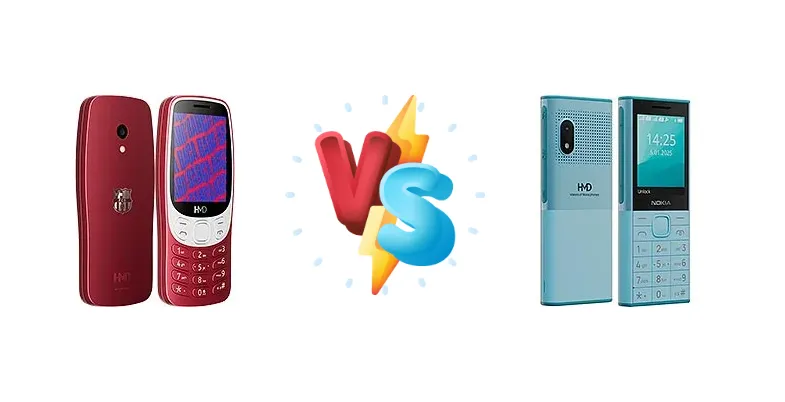
In the realm of ultra-affordable feature phones, the HMD 3210 and Nokia 150 Music represent compelling options for users prioritizing simplicity and longevity. While both cater to the same basic needs – calls, texts, and essential features – they differ significantly under the hood, specifically in their chipsets. This comparison dissects the Unisoc T107 powering the HMD 3210 against the Unisoc 6531F in the Nokia 150 Music, revealing which device delivers a smoother, more responsive experience.
🏆 Quick Verdict
For the average user seeking a reliable and slightly more capable feature phone, the HMD 3210 emerges as the better choice. Its Unisoc T107 chipset, fabricated on a more modern 22nm process, offers a performance advantage over the Nokia 150 Music’s Unisoc 6531F, translating to snappier menu navigation and potentially better support for future software updates.
| Network |
|---|
| 2G bands | GSM 850 / 900 / 1800 / 1900 | GSM 900 / 1800 |
| 3G bands | HSDPA 850 / 900 / 2100 | - |
| 4G bands | LTE | - |
| EDGE | - | No |
| GPRS | - | No |
| Speed | HSPA, LTE | - |
| Technology | GSM / HSPA / LTE | GSM |
| Launch |
|---|
| Announced | 2025, March 03 | 2025, March 02 |
| Status | Available. Released 2025, April | Available. Released 2025, March |
| Body |
|---|
| Build | Plastic frame, plastic back | - |
| Dimensions | 122 x 52 x 13.1 mm (4.80 x 2.05 x 0.52 in) | 130.5 x 52.9 x 14.8 mm (5.14 x 2.08 x 0.58 in) |
| SIM | Nano-SIM + Nano-SIM | Dual SIM (Mini-SIM, dual stand-by) |
| Weight | - | 83.1 g (2.93 oz) |
| Display |
|---|
| Resolution | 240 x 320 pixels, 4:3 ratio (~167 ppi density) | 240 x 320 pixels, 4:3 ratio (~167 ppi density) |
| Size | 2.4 inches, 17.8 cm2 (~28.1% screen-to-body ratio) | 2.4 inches, 17.8 cm2 (~25.8% screen-to-body ratio) |
| Type | TFT | TN TFT |
| Platform |
|---|
| CPU | 1.0 GHz Cortex-A7 | - |
| Chipset | Unisoc T107 (22 nm) | Unisoc 6531F |
| Memory |
|---|
| Call records | Yes | Yes |
| Card slot | microSDHC | microSDHC |
| Internal | 128MB 64MB RAM | 8MB 8MB RAM |
| Phonebook | Yes | Yes |
| Main Camera |
|---|
| Features | LED flash | LED flash |
| Single | 2 MP | QVGA |
| Video | - | Yes |
| Sound |
|---|
| 35mm jack | Yes | Yes |
| Loudspeaker | Yes | Yes |
| Comms |
|---|
| Bluetooth | 5.0, A2DP | 5.0, A2DP |
| NFC | No | No |
| Positioning | No | No |
| Radio | Wireless FM radio | Unspecified |
| USB | USB Type-C | USB Type-C 1.1 |
| WLAN | No | No |
| Features |
|---|
| Games | Yes | Yes |
| Java | No | No |
| Messaging | SMS, MMS, Email, IM | SMS |
| Sensors | - | No |
| Battery |
|---|
| Type | Li-Ion 1450 mAh, removable | 2500 mAh, removable |
| Misc |
|---|
| Colors | Blue, Red | Blue, Gray, Violet |
HMD 3210
- More modern Unisoc T107 chipset
- Potentially better power efficiency due to 22nm process
- Smoother user interface and app loading
- May be slightly more expensive than the Nokia 150 Music
- Still a basic feature phone with limited capabilities
Nokia 150 Music
- Extremely affordable price point
- Simple and easy-to-use interface
- Long standby time (likely, due to minimal features)
- Older Unisoc 6531F chipset
- Slower performance and less responsive UI
- Potentially shorter battery life during active use
Display Comparison
Neither device boasts a sophisticated display. Both likely utilize basic LCD panels with resolutions appropriate for feature phone use. However, the chipset difference doesn't directly impact display quality; the focus here is on the processing power needed to drive any potential UI elements or simple graphics. The Nokia 150 Music's display is likely optimized for power efficiency given the older chipset.
Camera Comparison
Both phones are unlikely to feature cameras of significant quality. Feature phones in this segment typically include basic cameras for occasional snapshots. Detailed analysis is limited by the lack of sensor specifications. Any camera differences will likely be minimal and overshadowed by the chipset's impact on overall user experience.
Performance
The core distinction lies in the chipsets. The HMD 3210’s Unisoc T107, built on a 22nm process, represents a more recent architecture than the Unisoc 6531F found in the Nokia 150 Music. The 1.0 GHz Cortex-A7 CPU within the T107 provides a noticeable performance uplift. While neither chipset is designed for demanding tasks, the T107’s architecture allows for quicker app loading times and smoother menu transitions. The 22nm fabrication process also implies improved power efficiency, potentially extending battery life during active use. The Unisoc 6531F, lacking specific process node information, likely utilizes an older, less efficient manufacturing process.
Battery Life
Battery life is a key consideration for feature phones. While both devices likely feature batteries in the 1000-1500 mAh range (specifications not provided), the Unisoc T107’s 22nm process in the HMD 3210 contributes to better power efficiency. This translates to potentially longer standby times and more talk time on a single charge, even with similar battery capacities. The Nokia 150 Music, with its older chipset, may require more frequent charging.
Buying Guide
Buy the HMD 3210 if you need a feature phone with a slightly more modern chipset for potentially smoother operation and future-proofing. It’s ideal for users who occasionally utilize basic apps or rely on the phone for more than just calls and texts. Buy the Nokia 150 Music if you prioritize a minimalist experience and are solely focused on core communication features, and are looking for the absolute lowest price point.
Frequently Asked Questions
❓ Will the HMD 3210 run apps like WhatsApp or Facebook?
While the HMD 3210 can technically run some basic Java-based apps, performance will be limited. WhatsApp and Facebook may function, but expect slow loading times and a less-than-ideal user experience. The Unisoc T107 offers slightly better app compatibility than the Nokia 150 Music, but it's not designed for modern, resource-intensive applications.
❓ How does the Unisoc T107 chipset compare to older feature phone chipsets in terms of responsiveness?
The Unisoc T107, being a more recent design built on a 22nm process, offers a noticeable improvement in responsiveness compared to older chipsets like the Unisoc 6531F. You'll likely experience quicker menu navigation, faster app loading (for supported apps), and a generally smoother user interface. This is due to the improved architecture and power efficiency of the T107.
❓ Is the Nokia 150 Music a good choice for someone who primarily needs a phone for making calls and sending texts?
Absolutely. The Nokia 150 Music excels as a basic communication device. Its simplicity and long standby time make it ideal for users who primarily need a phone for calls and texts and don't require any advanced features. The older chipset is sufficient for these core functions.