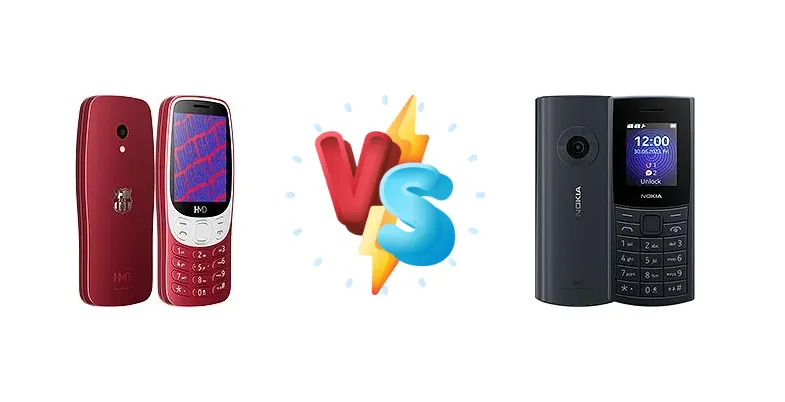
In a market dominated by smartphones, basic phones continue to hold appeal for users prioritizing simplicity, battery life, and affordability. We pit the HMD 3210, powered by a Unisoc chipset, against the Nokia 110 4G 2nd Edition to determine which offers the best experience for those seeking a no-frills mobile solution.
🏆 Quick Verdict
For users needing a slight performance edge and a known chipset, the HMD 3210 is the better choice. Its Unisoc T107 processor provides a measurable advantage over the likely less powerful Nokia 110 4G 2nd Edition, even if both phones are limited in overall capability. However, the Nokia 110 4G 2nd Edition may appeal to those prioritizing brand loyalty and potentially lower cost.
| Network |
|---|
| 2G bands | GSM 850 / 900 / 1800 / 1900 | GSM 900 / 1800 |
| 3G bands | HSDPA 850 / 900 / 2100 | HSDPA 850 / 900 / 1700(AWS) / 1900 / 2100 |
| 4G bands | LTE | LTE |
| Speed | HSPA, LTE | HSPA, LTE |
| Technology | GSM / HSPA / LTE | GSM / HSPA / LTE |
| Launch |
|---|
| Announced | 2025, March 03 | 2024, December |
| Status | Available. Released 2025, April | Available. Released 2024, December |
| Body |
|---|
| Build | Plastic frame, plastic back | - |
| Dimensions | 122 x 52 x 13.1 mm (4.80 x 2.05 x 0.52 in) | 121.5 x 50 x 14.4 mm (4.78 x 1.97 x 0.57 in) |
| SIM | Nano-SIM + Nano-SIM | · Nano-SIM· Nano-SIM + Nano-SIM |
| Weight | - | 94.5 g (3.35 oz) |
| Display |
|---|
| Resolution | 240 x 320 pixels, 4:3 ratio (~167 ppi density) | 120 x 160 pixels, 4:3 ratio (~111 ppi density) |
| Size | 2.4 inches, 17.8 cm2 (~28.1% screen-to-body ratio) | 1.8 inches, 10.0 cm2 (~16.5% screen-to-body ratio) |
| Type | TFT | IPS LCD |
| Platform |
|---|
| CPU | 1.0 GHz Cortex-A7 | - |
| Chipset | Unisoc T107 (22 nm) | - |
| Memory |
|---|
| Call records | Yes | Yes |
| Card slot | microSDHC | microSDHC |
| Internal | 128MB 64MB RAM | 48MB 128MB RAM |
| Phonebook | Yes | Yes |
| Main Camera |
|---|
| Features | LED flash | - |
| Single | 2 MP | QVGA |
| Video | - | Yes |
| Sound |
|---|
| 35mm jack | Yes | Yes |
| Loudspeaker | Yes | Yes |
| Comms |
|---|
| Bluetooth | 5.0, A2DP | 5.0, A2DP |
| NFC | No | No |
| Positioning | No | No |
| Radio | Wireless FM radio | Wireless FM radio |
| USB | USB Type-C | USB Type-C |
| WLAN | No | No |
| Features |
|---|
| Games | Yes | Yes |
| Java | No | No |
| Messaging | SMS, MMS, Email, IM | SMS |
| Battery |
|---|
| Type | Li-Ion 1450 mAh, removable | Li-Ion 1450 mAh, removable |
| Misc |
|---|
| Colors | Blue, Red | Midnight Blue, Arctic Purple |
| Price | - | About 60 EUR |
HMD 3210
- Known Unisoc T107 chipset offers a performance advantage.
- Potentially better power efficiency due to the 22nm process.
- 4G connectivity for basic data access.
- Limited features compared to smartphones.
- Basic camera quality.
Nokia 110 4G 2nd Edition
- Strong Nokia brand reputation.
- Potentially lower price point.
- Long battery life (expected).
- Unknown chipset and performance capabilities.
- Likely slower performance than the HMD 3210.
Display Comparison
Neither device is expected to boast a high-resolution or particularly vibrant display. Given the focus on affordability, both likely utilize basic LCD panels. Without specific display specs for the Nokia 110 4G 2nd Edition, it's reasonable to assume a similar, low-resolution experience to the HMD 3210. Bezels are expected to be substantial on both, maximizing screen real estate within a compact form factor.
Camera Comparison
Both devices are likely equipped with basic cameras primarily intended for occasional snapshots. Given the market segment, image quality will be limited. Without specific camera specs for the Nokia 110 4G 2nd Edition, it’s safe to assume a similar, low-resolution sensor to the HMD 3210. Expect limited detail and poor low-light performance from both. Focusing on camera capabilities would be misleading; these phones are not designed for photography.
Performance
The HMD 3210’s Unisoc T107 (22nm) chipset with a 1.0 GHz Cortex-A7 CPU represents a clear advantage over the Nokia 110 4G 2nd Edition, for which no chipset information is available. The 22nm process node, while not cutting-edge, is more efficient than older nodes likely used in the Nokia 110 4G 2nd Edition. This translates to potentially faster app loading times (for any pre-installed apps) and smoother multitasking, even if limited. The Cortex-A7 architecture, while dated, is still capable of handling basic phone functions effectively. The Nokia 110 4G 2nd Edition likely relies on a significantly less powerful chipset, resulting in slower performance and potentially longer loading times.
Battery Life
Both the HMD 3210 and Nokia 110 4G 2nd Edition prioritize long battery life. The Unisoc T107’s 22nm process in the HMD 3210 contributes to power efficiency. However, without knowing the battery capacity of the Nokia 110 4G 2nd Edition, it’s difficult to definitively state which offers superior endurance. Both phones are likely to provide days of standby time and several hours of talk time, making them ideal for users who need a reliable communication device without frequent charging.
Buying Guide
Buy the HMD 3210 if you need a basic phone with a slightly more modern processor for smoother operation of core features like calling and messaging. Buy the Nokia 110 4G 2nd Edition if you are a loyal Nokia customer, prioritize a potentially lower price point, and require only the most basic functionality without demanding performance.
Frequently Asked Questions
❓ Will the HMD 3210 handle WhatsApp or Facebook Lite smoothly?
The Unisoc T107 chipset in the HMD 3210 should be capable of running lightweight apps like WhatsApp or Facebook Lite, but expect limited performance. Don't anticipate a fluid experience; basic messaging and occasional browsing are more realistic expectations. The Nokia 110 4G 2nd Edition may struggle even with these apps due to its unknown, likely less powerful chipset.
❓ How important is 4G connectivity on these phones?
4G connectivity on both the HMD 3210 and Nokia 110 4G 2nd Edition allows for basic internet access, enabling features like WhatsApp messaging and limited web browsing. However, the experience will be slow compared to modern smartphones. It's primarily useful for staying connected in areas with limited Wi-Fi access.
❓ Can I easily transfer contacts from my smartphone to either of these phones?
Transferring contacts can be done via Bluetooth or by saving them to a microSD card (if supported by both devices). The process may not be as seamless as with smartphones, and may require manual input depending on the contact format.